Sawalkote Dam Project and Macroeconomic Implications of Low Inflation
Source:Indian Express ↗
Why It Matters
Provides essential conceptual clarity on core macroeconomic indicators (inflation vs. deflation) and tax reforms, alongside geographical and strategic knowledge regarding Himalayan river infrastructure, all of which are recurring themes in both Prelims and Mains examinations.
Summary
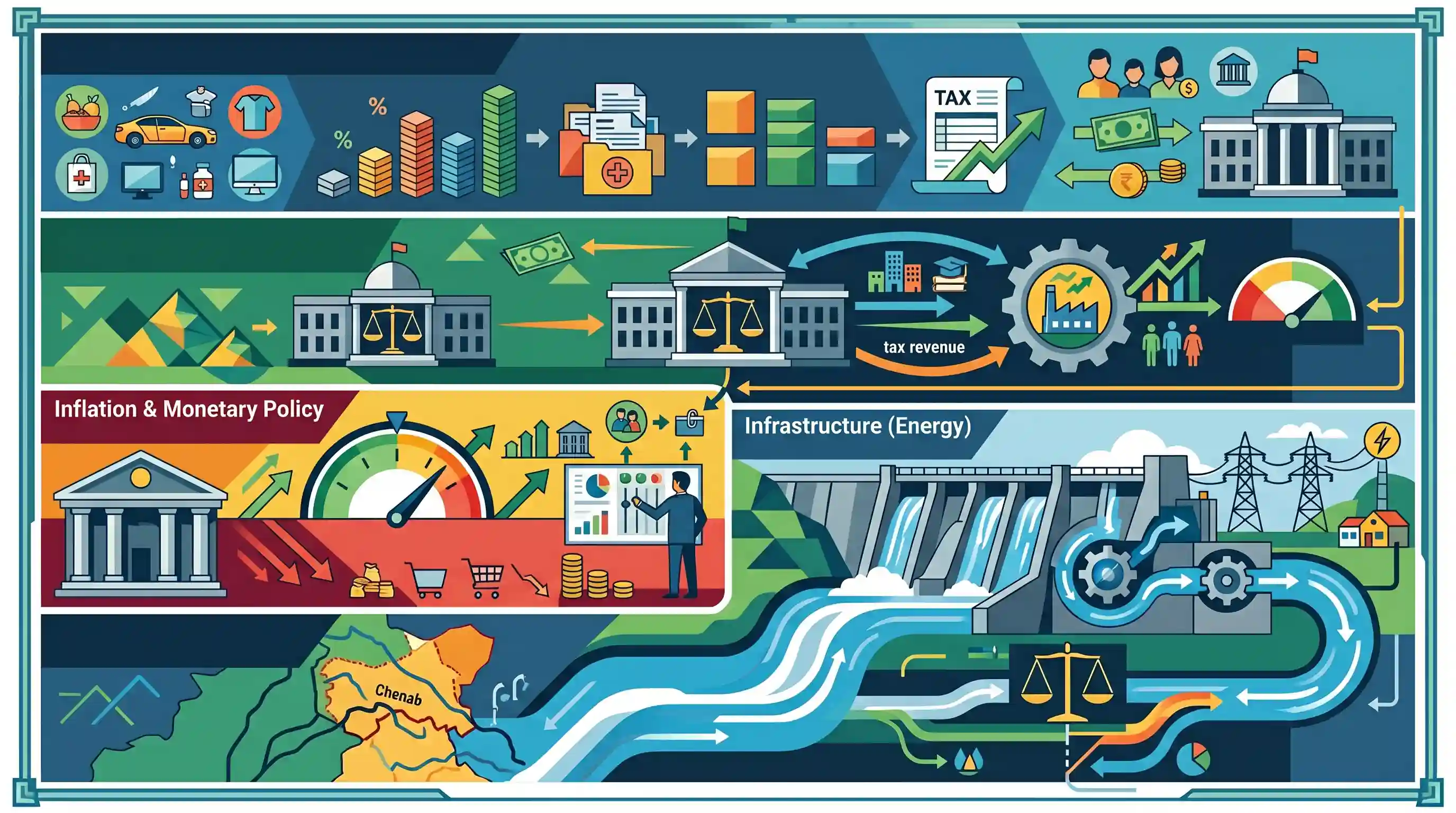
This edition of UPSC Key analyzes three critical topics for civil services preparation: the economic rationale behind revising Goods and Services Tax (GST) rates, the strategic and geographic significance of the Sawalkote hydroelectric dam on the Chenab river, and the macroeconomic risks associated with abnormally low inflation. It highlights how GST rationalization seeks to simplify indirect taxation, how infrastructure projects in J&K intersect with the Indus Water Treaty, and why central banks target moderate inflation to sustain economic growth rather than aiming for zero inflation or deflation.
Key Points
- The rationalization of GST rates aims to simplify India's indirect tax structure, resolve inverted duty issues, and ease compliance, while requiring careful balancing to protect state revenue streams.
- The 1856 MW Sawalkote run-of-the-river hydroelectric project on the Chenab river in J&K is a vital infrastructure initiative that must navigate both environmental concerns and the geopolitical constraints of the Indus Water Treaty.
- While high inflation reduces purchasing power, persistently low inflation or deflation can be equally harmful by discouraging consumer spending, delaying business investments, and increasing the real burden of debt.
- Macroeconomic stability requires a moderate rate of inflation (such as the RBI's 4% target) to incentivize production and sustain consistent economic growth.
Important Terms
Goods and Services Tax (GST)

A comprehensive, destination-based indirect tax levied on the supply of goods and services, replacing multiple central and state taxes to create a unified national market.
UPSC context
GS Paper III (Economy): Major tax reform; tests understanding of fiscal policy, cascading effects, and "One Nation, One Tax."
Indus Water Treaty
A 1960 water-sharing agreement between India and Pakistan, brokered by the World Bank, governing the use of the Indus River system's six rivers.
UPSC context
GS Paper II (International Relations): Key bilateral treaty; tests knowledge of water diplomacy and strategic transboundary river management.
GST Council
A constitutional body (Article 279A) chaired by the Union Finance Minister that makes recommendations on GST rates, exemptions, and administrative thresholds.
UPSC context
GS Paper II (Polity): Apex federal body; tests concepts of cooperative federalism and joint decision-making between Centre and States.
Reserve Bank of India (RBI)
India's central bank and regulatory body responsible for monetary policy, issuing currency, and maintaining price stability through inflation targeting.
UPSC context
GS Paper III (Economy): Monetary authority; tests understanding of tools like repo rates and the mandate of price stability.
Sawalkote Hydroelectric Project
A 1,856 MW run-of-the-river hydroelectric project on the Chenab River in Jammu & Kashmir, currently being fast-tracked for strategic energy needs.
UPSC context
GS Paper I (Geography) & GS III (Energy): Major infrastructure; tests mapping of Chenab tributaries and strategic resource utilization.
Inflation Targeting
A monetary policy framework where the central bank (RBI) aims to maintain Consumer Price Index (CPI) inflation within a specific target range (4% ±2%).
UPSC context
GS Paper III (Economy): Monetary framework; tests the rationale behind moderate inflation versus the risks of deflation or low demand.
Prelims Trap
Deflation benefits borrowers because falling prices reduce the real burden of their outstanding debt.
Deflation causes prices and nominal incomes to fall, but the principal loan amount remains unchanged. This increases the real value of the debt, making it significantly harder for borrowers to repay.
Static Concepts Connected
How does the Indus Water Treaty allocate river rights?
- Eastern Rivers: India has completely unrestricted use of the waters of the Ravi, Beas, and Sutlej.
- Western Rivers: Allocated primarily to Pakistan (Indus, Jhelum, Chenab), but India is allowed limited agricultural and non-consumptive uses.
- Hydroelectric Exceptions: India is permitted to construct run-of-the-river (RoR) power projects on Western rivers provided they do not alter the water flow.
What defines an Inverted Duty Structure under GST?
- Core Mechanism: It occurs when the GST rate levied on raw materials (inputs) is higher than the tax rate on the final manufactured product.
- Working Capital Trap: It traps working capital for businesses because they accumulate a large balance of unutilized Input Tax Credit (ITC).
- Corrective Action: The GST Council frequently undertakes rate rationalization to fix this anomaly or issues ITC refunds to affected manufacturers.
Cross-Topic Patterns
Run-of-the-river and Water Diplomacy
J&K hydro projects like Sawalkote and Kishanganga are increasingly viewed through an IR lens, tying domestic energy infrastructure directly to India's strategic leverage and demands to modify the Indus Water Treaty.
The Deflationary Debt Trap
Low inflation connects monetary policy to debt sustainability. Deflation increases real debt burdens for borrowers, creating a deflationary spiral that the RBI's 4% inflation target specifically aims to prevent.

Expect a 2026 prelims question mapping specific J&K run-of-the-river dams (Sawalkote, Ratle) to Indus Water Treaty river allocations.
Linked PYQs · 5
Linked PYQs · 5
- 2017PrelimsGS1
What is/are the most likely advantages of implementing 'Goods and Services Tax (GST)'? 1. It will replace multiple taxes collected by multiple authorities and will thus create a single market in India. 2. It will drastically reduce the 'Current Account Deficit' of India and will enable it to increase its foreign exchange reserves. 3. It will enormously increase the growth and size of economy of India and will enable it to overtake China in the near future. Select the correct answer using the code given below:
- 2019MainsGS3
Enumerate the indirect taxes which have been subsumed in the Goods and Services Tax (GST) in India. Also, comment on the revenue implications of the GST introduced in India since July 2017.
- 2020MainsGS3
Explain the rationale behind the Goods and Services Tax (Compensation to States) Act of 2017. How has COVID-19 impacted the GST compensation fund and created new federal tensions?
- 2021PrelimsGS1
With reference to the Indus river system, of the following four rivers, three of them pour into one of them which joins the Indus direct. Among the following, which one is such river that joins the Indus direct?
- 2011PrelimsGS1
Economic growth is usually coupled with
