Key policy updates on modified UDAN scheme and UAPA provisions
Source:Indian Express ↗
Why It Matters
This article provides a multi-dimensional update crucial for both Mains and Prelims. It connects infrastructure governance (UDAN), internal security policy and fundamental rights (UAPA), and international economic relations (India-Israel BIA). These topics directly address recurring syllabus themes on infrastructure development, security legislation versus human rights, and bilateral treaty frameworks.
Summary
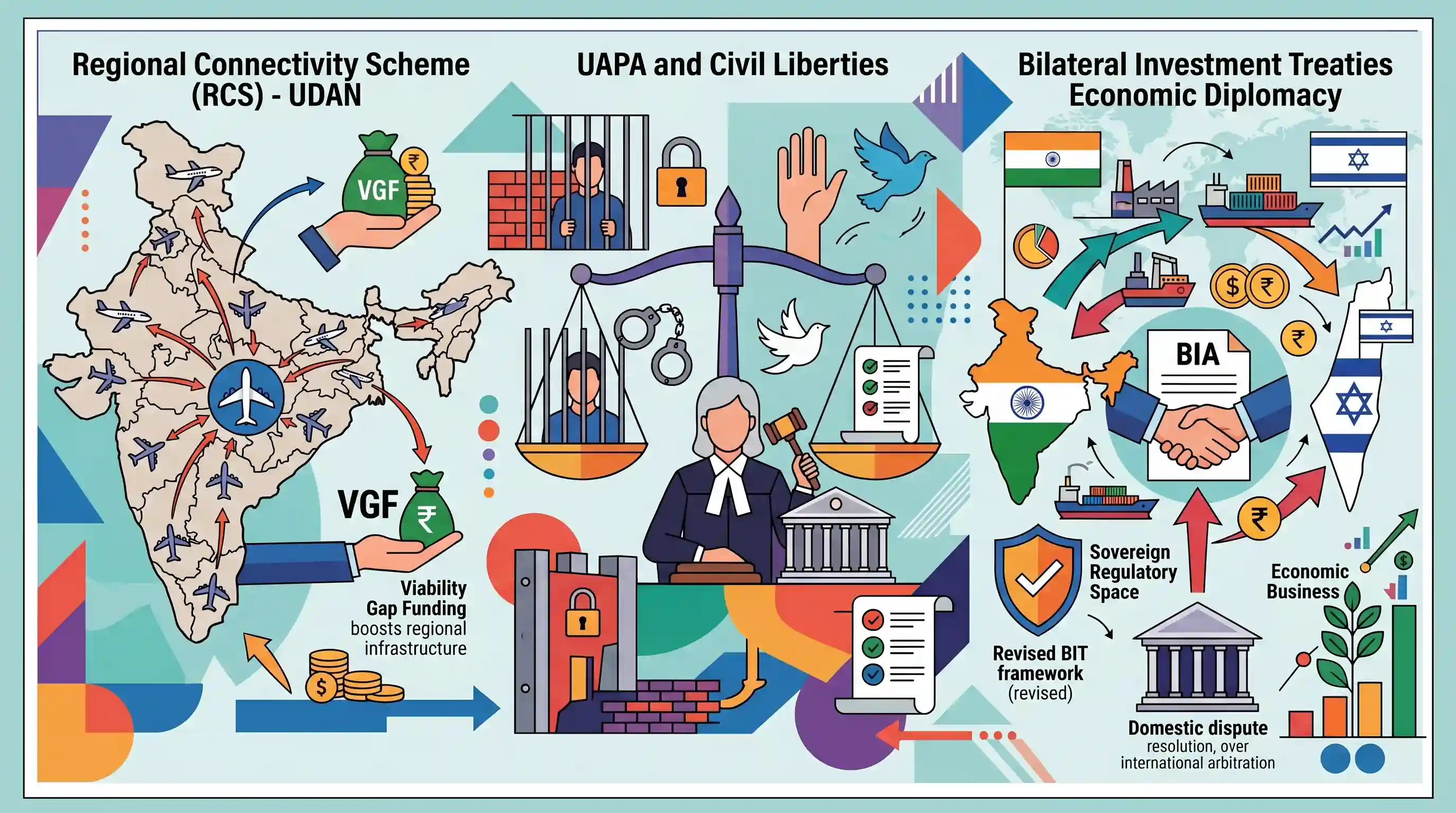
The article covers three vital themes for UPSC preparation: the evolution of the Regional Connectivity Scheme (RCS-UDAN), the legal and constitutional nuances of the Unlawful Activities (Prevention) Act (UAPA), and India's trade diplomacy through the proposed India-Israel Bilateral Investment Agreement (BIA). The modified UDAN scheme aims to revitalize regional aviation by improving viability gap funding and focusing on underserved regions using small aircraft. The discussion on UAPA centers around its strict anti-terrorism provisions, specifically the stringent bail conditions under Section 43D(5) and the judiciary's role in balancing individual liberty under Article 21 with state security. Lastly, the India-Israel BIA highlights India's revised strategy on Bilateral Investment Treaties (BITs), utilizing the 2015 Model BIT framework to protect foreign investments while safeguarding sovereign regulatory space and emphasizing domestic dispute resolution.
Key Points
- Modified UDAN Scheme: Focuses on enhancing regional air connectivity by removing the 500 km stage length cap, increasing Viability Gap Funding (VGF) incentives, and prioritizing smaller aircraft (sub-20 seats) and helicopters to connect remote, hilly, and unserved areas.
- Aviation Infrastructure: The continuation of UDAN supports India's broader aviation push, aiming to operationalize more regional airports, heliports, and water aerodromes to boost tourism and regional economic integration.
- UAPA Anti-Terror Framework: The Unlawful Activities (Prevention) Act (UAPA), 1967 remains a key legislative tool for national security, amended in 2019 to empower the central government to designate individuals as terrorists.
- UAPA Bail and Civil Liberties: Section 43D(5) of the UAPA creates a stringent threshold for bail, stating that bail cannot be granted if accusations are prima facie true, raising constitutional debates over the balance between national security and the right to a speedy trial under Article 21.
- Judicial Safeguards: The Supreme Court (e.g., in K.A. Najeeb) has ruled that statutory restrictions on bail under UAPA do not override constitutional courts' power to protect fundamental rights when trials are inordinately delayed.
- India-Israel BIA: India and Israel are negotiating a Bilateral Investment Agreement (BIA) designed to offer stable legal protection for foreign investments, encouraging mutual capital flow in high-tech, defense, water management, and agriculture.
- Model BIT 2015 Alignment: The BIA is aligned with India's 2015 Model Bilateral Investment Treaty, which seeks to prevent treaty abuse and features a strict 'exhaustion of local remedies' clause requiring investors to seek domestic court dispute resolution for a set period before pursuing international arbitration.
Important Terms
Unlawful Activities (Prevention) Act (UAPA), 1967

India's primary anti-terror law designed to prevent activities threatening national sovereignty and integrity. It empowers the government to designate individuals/groups as terrorists, featuring stringent bail conditions and extended pre-trial detention.
UPSC context
GS Paper II (Polity and Governance); tests understanding of internal security laws, preventive detention, civil liberties, and fundamental rights.
UDAN Scheme (Ude Desh Ka Aam Naagrik)
A regional airport development and connectivity initiative launched in 2016. It aims to make air travel affordable for the common citizen to underserved and unserved airports through Viability Gap Funding and capped airfares.
UPSC context
GS Paper III (Infrastructure-Airports); tests knowledge of government policies for regional development, physical connectivity, and civil aviation reforms.
Model Bilateral Investment Treaty (Model BIT) 2015
A revised framework adopted by India to negotiate investment pacts, balancing foreign investor protection with the state's sovereign right to regulate. It features an "enterprise-based" investment definition and mandates exhausting local judicial remedies first.
UPSC context
GS Paper III (Economy and Investment Models); tests concepts of bilateral trade diplomacy, investment frameworks, and dispute resolution mechanisms.
India-Israel Bilateral Investment Agreement (BIA)
A landmark treaty that entered into force in July 2026, aimed at providing legal certainty and protection for mutual investments. It makes Israel the first OECD member to sign a pact under India’s modern investment principles.
UPSC context
GS Paper II (Bilateral Agreements); tests understanding of economic diplomacy, bilateral relations with West Asian nations, and international investment jurisprudence.
Prelims Trap
The Supreme Court in the K.A. Najeeb case struck down Section 43D(5) of the UAPA as unconstitutional.
The Supreme Court did not invalidate the statutory bar under Section 43D(5). It merely held that constitutional courts retain the power to bypass this bar to protect the Article 21 right to a speedy trial in cases of extreme delay.
Static Concepts Connected
How does the UAPA bail standard differ from standard criminal procedure?
- Regular Bail Standard: Under standard criminal law, bail is the rule and jail is the exception, guided by flight risk and evidence-tampering assessments.
- Section 43D(5) Bar: Prohibits bail if the court, based on police diaries or the charge sheet, finds allegations to be 'prima facie true'.
- Judicial Override: The Supreme Court ruled that constitutional courts can still grant bail if prolonged trial delays violate Article 21.
What are the key features of India's 2015 Model Bilateral Investment Treaty (BIT)?
- Exhaustion of Local Remedies: Mandates that foreign investors must exhaust all domestic judicial and administrative remedies for at least 5 years before seeking international arbitration.
- Sovereign Carve-outs: Narrows treaty protection by excluding sovereign issues like taxation, subsidies, government procurement, and intellectual property rights.
- Exclusion of MFN: Omits the standard 'Most Favoured Nation' (MFN) clause to prevent foreign investors from borrowing beneficial provisions from other treaties.
Cross-Topic Patterns
UDAN 5.1 & Border Area Security
Using small aircraft and helicopters under regional connectivity schemes builds critical dual-use infrastructure in remote border sectors, reinforcing tactical logistics.
BITs & Sovereign Rating Impact
Insisting on a five-year domestic litigation clause balances sovereign regulatory space but can impact foreign capital inflows and global ease of doing business rankings.

The 5-year Exhaustion of Local Remedies (ELR) clause under the 2015 Model BIT is a high-probability target for a multi-statement 2026 MCQ.
Linked PYQs · 4
Linked PYQs · 4
- 2024MainsGS3
What is the need for expanding the regional air connectivity in India? In this context, discuss the government's UDAN Scheme and its achievements.
- 2019MainsGS3
Indian Government has recently strengthened the anti-terrorism laws by amending the Unlawful Activities (Prevention) Act (UAPA), 1967 and the NIA Act. Analyze the changes in the context of prevailing security environment while discussing the scope and reasons for opposing the UAPA by human rights organizations.
- 2023PrelimsGS1
Consider the following statements: 1. According to the Constitution of India, the Central Government has a duty to protect States from internal disturbances. 2. The Constitution of India exempts the States from providing legal counsel to a person being held for preventive detention. 3. According to the Prevention of Terrorism Act, 2002, confession of the accused before the police cannot be used as evidence. How many of the above statements are correct?
- 2017PrelimsGS1
'Broad-based Trade and Investment Agreement (BTIA)' is sometimes seen in the news in the context of negotiations held between India and
