India US Ties, Passive Euthanasia and 1946 Congress Vote
Source:Indian Express ↗
Why It Matters
This compilation covers diverse yet highly relevant syllabus areas: international relations (GS2), constitutional rights and ethics (GS2/GS4), and pre-independence political history (GS1). These themes are repeatedly tested in both Prelims and Mains exams.
Summary
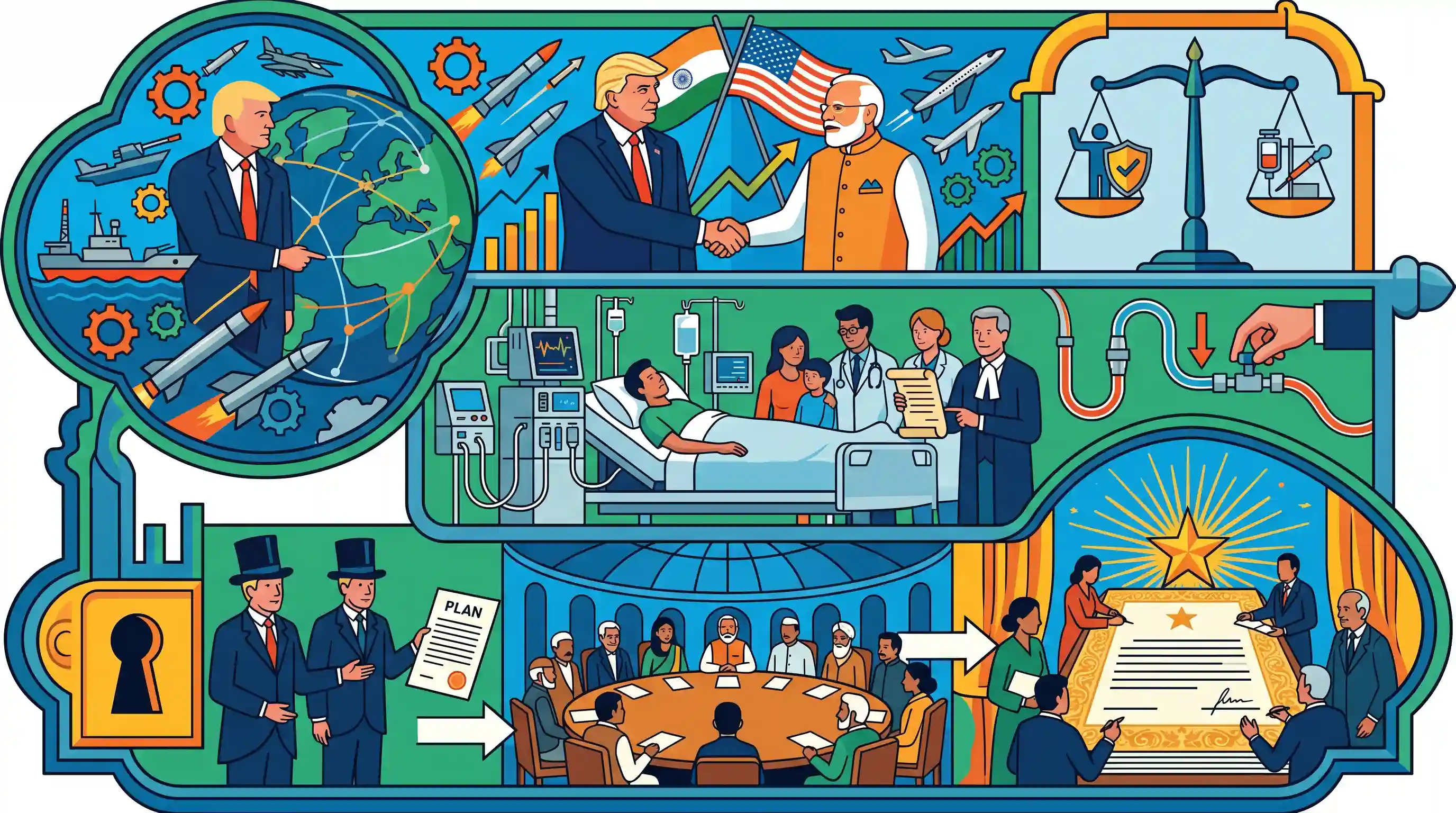
This multi-topic UPSC Key covers three distinct subjects. First, it analyzes the geopolitical implications of the Modi-Trump dialogue on India-US strategic and economic relations. Second, it explains the legal and ethical nuances of passive euthanasia and 'living wills' in India, contextualized within Article 21's Right to Life and the Aruna Shanbaug case. Finally, it revisits modern Indian history, focusing on the 1946 Congress vote and the Cabinet Mission Plan that paved the way for the Constituent Assembly.
Key Points
- The Modi-Trump dialogue indicates a continued emphasis on India-US strategic partnerships, focusing on technology, defense cooperation, and geopolitical alignment.
- Passive euthanasia, fundamentally distinct from active euthanasia, permits the withdrawal of life support for terminally ill patients, emphasizing the right to die with dignity.
- The Supreme Court recognizes 'living wills', continuously expanding the interpretation of Article 21 (Right to Life) to include personal autonomy in end-of-life medical decisions.
- The 1946 Congress vote and the provincial elections under the Cabinet Mission Plan were pivotal historical milestones that established the Constituent Assembly.
Important Terms
Cabinet Mission Plan, 1946

A 1946 British initiative to negotiate India's independence. It proposed a three-tier federal structure with a weak center, provincial autonomy, and the formation of a Constituent Assembly to draft the Constitution.
UPSC context
GS Paper 1 (Modern History) and GS Paper 2 (Polity); tests understanding of constitutional evolution and British-era negotiations.
Constituent Assembly
The body of representatives formed in 1946 to frame the Indian Constitution. It was partly elected indirectly by provincial assemblies and partly nominated by princely states, eventually serving as India's provisional Parliament.
UPSC context
GS Paper 1 and 2; critical for questions on the historical background of the Constitution and the making of India's democratic framework.
Article 21
A Fundamental Right stating "No person shall be deprived of his life or personal liberty except according to procedure established by law." Interpreted by courts to include the right to dignity.
UPSC context
GS Paper 2 (Polity); frequently tested in the context of judicial activism and the expansion of individual rights.
Passive Euthanasia
The intentional withholding or withdrawal of life-prolonging medical treatment (e.g., ventilators) to allow a terminally ill or vegetative-state patient to die naturally. Legalized in India with strict judicial and medical safeguards.
UPSC context
GS Paper 2 (Social Justice/Health) and GS Paper 4 (Ethics); tests ability to navigate complex legal-ethical dilemmas.
Aruna Shanbaug Case (2011)
A landmark 2011 Supreme Court judgment that first allowed passive euthanasia in India under exceptional circumstances. It recognized that the right to life under Article 21 includes the right to die with dignity.
UPSC context
GS Paper 2 and 4; a key case study for judicial interpretation of fundamental rights and bioethics.
Living Will
A legal document, also known as an Advance Medical Directive, allowing an individual to specify in advance that life-sustaining treatment be withheld if they become terminally ill or incapacitated.
UPSC context
GS Paper 2 (Governance/Health); tests knowledge of current legal reforms and patient autonomy rights.
Prelims Trap
"The Constituent Assembly of 1946 was elected directly by the people through universal adult franchise."
Members of the Constituent Assembly were indirectly elected by the Provincial Legislative Assemblies using proportional representation, not by direct universal adult franchise.
Static Concepts Connected
What are the key proposals of the Cabinet Mission Plan (1946)?
- Undivided India: It rejected the Muslim League's demand for a separate sovereign state of Pakistan, aiming to preserve an undivided India.
- Federal Structure: Proposed a weak center (handling foreign affairs, defense, communications) and strong provinces divided into three specific groups (A, B, and C).
- Constituent Assembly: Laid out the mechanism for indirectly electing the Constituent Assembly from the newly elected provincial assemblies.
How does Indian law distinguish between Active and Passive Euthanasia?
- Active Euthanasia: Involves direct medical intervention (e.g., lethal injection) to end life. It remains strictly illegal and is treated as a criminal offense in India.
- Passive Euthanasia: Involves withholding or withdrawing life-sustaining treatment, allowing natural death. Permitted for terminally ill patients under strict guidelines (Common Cause case 2018).
- Living Wills: Advance medical directives allowing individuals to state their end-of-life care preferences beforehand. Legally recognized under Article 21.
Cross-Topic Patterns
Article 21: Expanding dimensions of autonomy
The SC's recognition of 'Living Wills' under Article 21's Right to Die with Dignity parallels its expanding jurisprudence on personal autonomy, as seen in the landmark Puttaswamy privacy judgment.
Cabinet Mission vs Current Indian Federalism
The Cabinet Mission Plan proposed a weak center with grouped provinces, contrasting sharply with the strong-center federalism India ultimately adopted post-partition, drawing from the Government of India Act 1935.

Expect a Prelims question comparing the 2018 'Living Will' guidelines with the 2023 relaxed norms eliminating the Judicial Magistrate nod.
Linked PYQs · 5
Linked PYQs · 5
- 2023MainsGS2
‘The expansion and strengthening of NATO and a stronger US-Europe strategic partnership works well for India.’ What is your opinion about this statement ? Give reasons and examples to support your answer.
- 2024MainsGS2
Right to privacy is intrinsic to life and personal liberty and is inherently protected under Article 21 of the constitution. Explain. In this reference discuss the law relating to D.N.A. testing of child in the womb to establish its paternity.
- 2023MainsGS2
“The Constitution of India is a living instrument with capabilities of enormous dynamism. It is a constitution made for a progressive society.” Illustrate with special reference to the expanding horizons of the right to life and personal liberty.
- 2013PrelimsGS1
With reference to Indian History, the Members of the Constituent Assembly from the Provinces were
- 2015PrelimsGS1
With reference to the Cabinet Mission, which of the following statements is/are correct? 1. It recommended a federal government. 2. It enlarged the powers of the Indian courts. 3. It provided for more Indians in the ICS. Select the correct answer using the code given below.
