Bilateral Ties and IPR Issues Take Center Stage in Current Affairs
Source:Indian Express ↗
Why It Matters
This article spans crucial GS2 and GS3 themes. India-Russia relations are foundational to India's foreign policy and strategic autonomy. Meanwhile, IPR issues in pharmaceuticals directly impact public healthcare accessibility, and defence testing is vital for achieving self-reliance in aerospace technology.
Summary
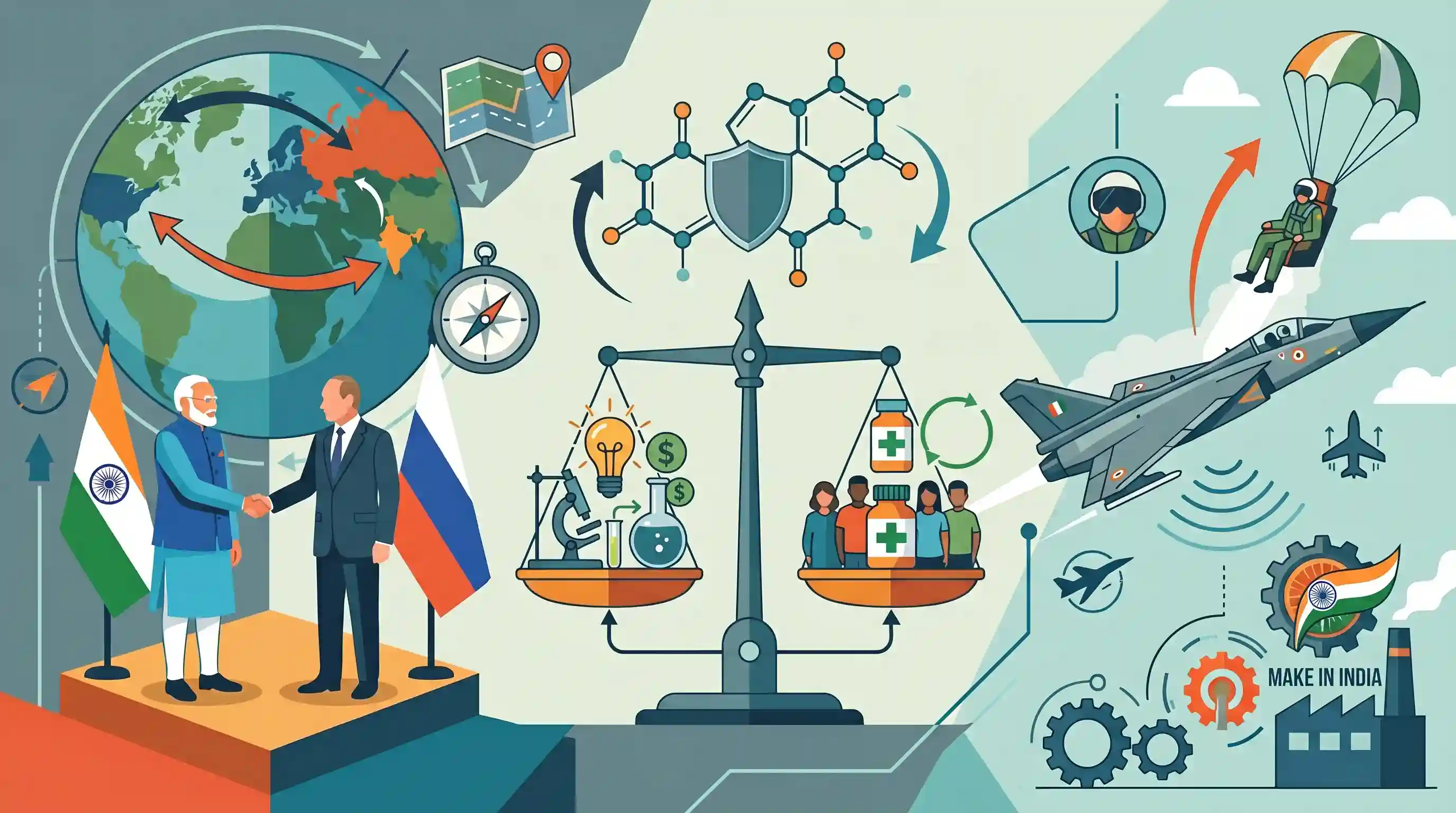
The article highlights three distinct current affairs topics relevant to the UPSC syllabus. First, the bilateral meeting between PM Narendra Modi and Russian President Vladimir Putin focuses on the strategic roadmap for India-Russia relations amid shifting global geopolitics. Second, a patent suit regarding the popular drug Semaglutide brings Intellectual Property Rights (IPR) and India's pharmaceutical patent laws into focus, balancing corporate innovation with generic drug accessibility. Third, successful fighter pilot ejection tests underscore advancements in aviation safety and the indigenisation of India's aerospace defence sector.
Key Points
- The Modi-Putin bilateral meeting focuses on charting a strategic roadmap for India-Russia relations, emphasizing defence, energy security, and regional geopolitics.
- The patent infringement lawsuit over Semaglutide (a diabetes/anti-obesity drug) highlights the tension between global pharmaceutical giants' Intellectual Property Rights (IPR) and India's generic drug industry.
- The Indian Patents Act and the TRIPS agreement form the crucial legal frameworks for balancing drug patent protections with public health needs and access to affordable medicines.
- Fighter pilot ejection tests are critical safety and technical milestones for indigenous aviation platforms, marking progress in India's defence technology self-reliance.
Important Terms
Indian Patents Act, 1970

The primary legislation governing patents in India, balancing innovator rights with public health. The 2005 amendment introduced product patents while maintaining safeguards to ensure the availability of affordable generic medicines.
UPSC context
GS-III: Intellectual Property Rights. Essential for understanding India's legal stance on pharmaceutical innovation versus public health access.
Section 3(d) (Patents Act)
A specific provision in India's Patent Act that prohibits patenting minor modifications of known substances unless they demonstrate significantly enhanced therapeutic efficacy. It is a key tool against corporate 'evergreening' strategies.
UPSC context
GS-III: Science and Tech. Highly relevant for questions on pharmaceutical patents and high-profile legal disputes like Novartis or Novo Nordisk.
Evergreening of Patents
The practice of pharmaceutical companies extending patent monopolies beyond the 20-year limit by obtaining new patents for minor, non-innovative variations of existing drugs to block generic competition.
UPSC context
GS-III: Economy and IPR. Crucial concept for analyzing the socioeconomic impact of patent laws on drug pricing and generic industries.
TRIPS Agreement
A WTO agreement setting global minimum standards for intellectual property. India utilizes TRIPS 'flexibilities,' as reaffirmed by the Doha Declaration, to prioritize public health over rigid patent enforcement.
UPSC context
GS-II: International Treaties; GS-III: IPR. Tests understanding of how international IP regimes interact with national domestic policy.
Special and Privileged Strategic Partnership
The formal designation for the India-Russia relationship since 2010. It signifies deep-rooted cooperation in defense, nuclear energy, and space, characterized by mutual trust and annual high-level summits.
UPSC context
GS-II: International Relations. Core term for describing India's strategic ties with Russia amid a multipolar world order.
DRDO (Defence Research and Development Organisation)
India’s premier defense research agency. It recently achieved a milestone by successfully testing an indigenous fighter aircraft escape (ejection) system at the Rail Track Rocket Sled (RTRS) facility.
UPSC context
GS-III: Science and Tech/Security. Focuses on national R&D institutions and their role in defense self-reliance.
Indigenisation of Defence
The strategic process of developing and manufacturing military hardware within India to reduce import reliance. It is a key pillar of 'Aatmanirbhar Bharat' in the defense sector.
UPSC context
GS-III: Internal Security/Economy. Tests understanding of strategies to achieve strategic autonomy and boost the domestic manufacturing base.
Prelims Trap
Compulsory licenses under the Indian Patents Act can only be granted during a declared national health emergency or extreme urgency.
False. Under Chapter XVI, compulsory licenses can also be granted if the patented drug is not available to the public at a reasonably affordable price three years after the patent is sealed.
Static Concepts Connected
How does Section 3(d) of the Indian Patents Act prevent 'evergreening' of pharmaceutical patents?
- Section 3(d): Prohibits patenting new forms of known substances unless they demonstrate significantly enhanced therapeutic efficacy.
- Novartis Case (2013): Supreme Court upheld Section 3(d) by rejecting a patent for a modified cancer drug, prioritizing affordable generic access over minor drug tweaks.
- TRIPS Flexibilities: Aligns with WTO TRIPS flexibilities, specifically the Doha Declaration, allowing developing nations to prioritize public health over IP monopolies.
How does the Special Rupee Vostro Account (SRVA) mechanism facilitate India-Russia trade settlement?
- Vostro Accounts: Russian banks open Special Rupee Vostro Accounts with authorized Indian correspondent banks to hold INR balances.
- Rupee Settlement: Indian importers pay in INR into these accounts; Indian exporters receive INR from them, bypassing SWIFT and the US Dollar entirely.
- Strategic Buffer: Protects bilateral trade from Western economic sanctions while helping India internationalize the Rupee and manage its current account deficit.
Cross-Topic Patterns
IPR flexibilities + Right to Health
The Semaglutide patent suit connects TRIPS IPR laws directly with GS2's Right to Health, pitting corporate R&D monopolies against constitutional obligations for affordable generic medicines.
Energy Security + Strategic Autonomy
India's push for $100B trade with Russia, driven by discounted crude, perfectly illustrates 'strategic autonomy', where domestic energy security dictates foreign policy choices despite Western sanctions.

Expect a 2026 prelims question testing Section 3(d) of the Patents Act, TRIPS flexibilities, and Compulsory Licensing conditions together.
Linked PYQs · 3
Linked PYQs · 3
- 2020MainsGS2
What is the significance of Indo-US defence deals over Indo-Russian defence deals? Discuss with reference to stability in the Indo-Pacific region.
- 2014MainsGS3
In a globalized world, Intellectual Property Rights assume significance and are a source of litigation. Broadly distinguish between the terms-Copyrights, Patents and Trade Secrets.
- 2024MainsGS3
What is the present world scenario of intellectual property rights with respect to life materials? Although, India is second in the world to file patents, still only a few have been commercialized. Explain the reasons behind this less commercialization.
