Decolonisation of Education and Regional Diplomatic Challenges
Source:Indian Express ↗
Why It Matters
The compilation covers critical multi-disciplinary themes: the decolonization of education is crucial for Indian society and governance; the political crisis in Bangladesh directly impacts India's border security and 'Neighbourhood First' policy; and COP30 themes like Amazon conservation are vital for global environmental governance and climate action.
Summary
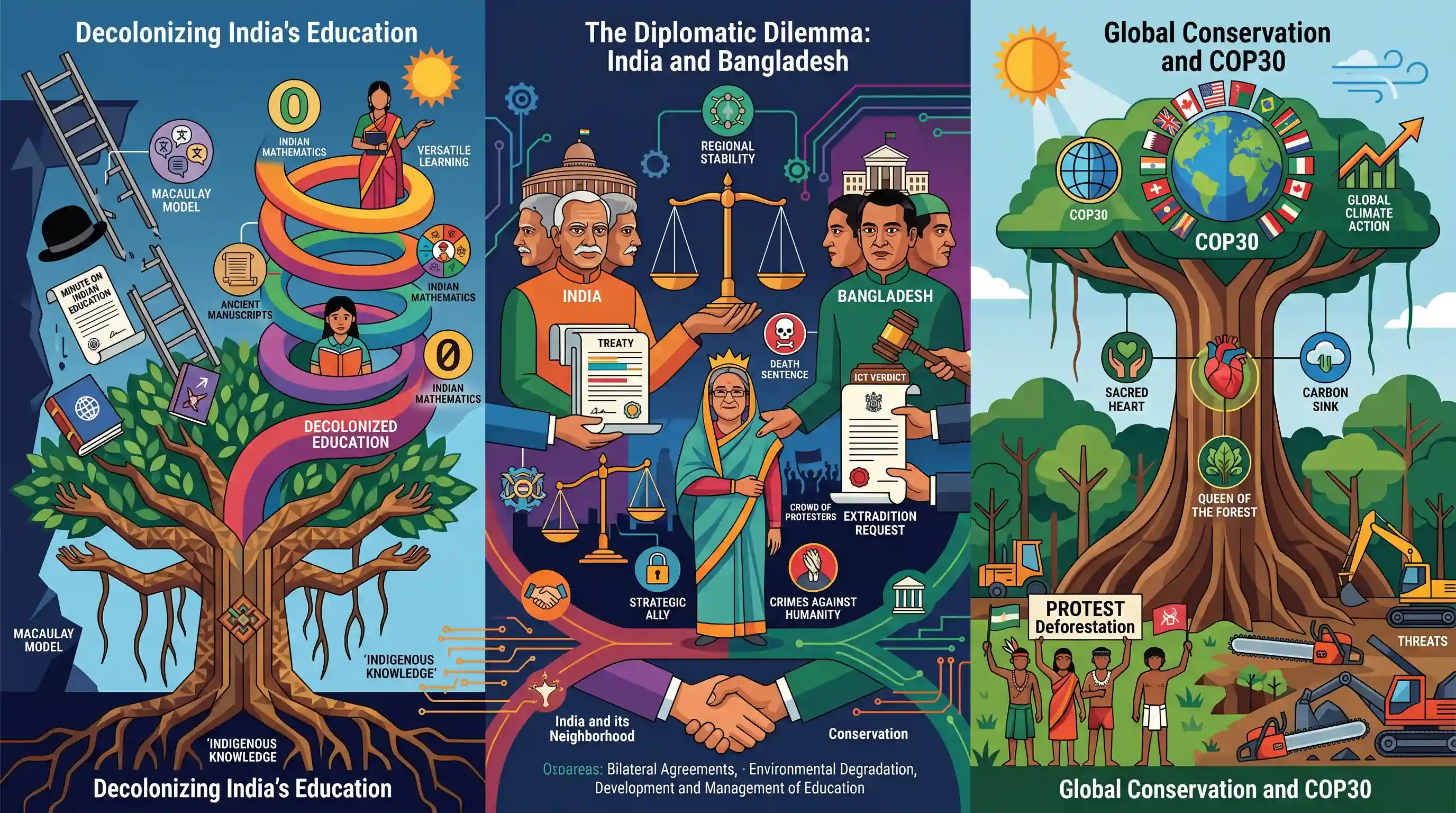
The article highlights three major developments relevant to the UPSC syllabus: the push to decolonize India's education system by discarding the Macaulay model, the diplomatic complexities for India arising from the legal proceedings and potential death verdict against former Bangladesh PM Sheikh Hasina, and the environmental focus on the Amazonian Samauma tree ahead of the COP30 climate summit in Brazil. These topics span colonial legacy in education, neighbourhood diplomacy, and global climate conservation efforts.
Key Points
- Prime Minister Modi criticized the colonial 'Macaulay' system of education, advocating for a shift towards indigenous knowledge and cultural roots, which resonates with the objectives of NEP 2020.
- Legal actions and potential severe verdicts against former Bangladesh Prime Minister Sheikh Hasina present a significant diplomatic challenge for India, impacting bilateral relations and testing the India-Bangladesh extradition framework.
- Ahead of the COP30 climate summit in Brazil, the Samauma tree (known as the 'Mother of the Forest') has emerged as a symbol for Amazon rainforest conservation, highlighting the role of indigenous ecological knowledge in combating climate change.
Important Terms
Macaulayism / Macaulay Minute

A 1835 policy document by Thomas Babington Macaulay that introduced English-medium Western education in India, aiming to create a class of intermediaries loyal to British colonial interests.
UPSC context
GS Paper I: Modern Indian History; tests understanding of colonial educational reforms and their long-term impact on Indian society and decolonization.
National Education Policy (NEP) 2020
The first 21st-century education policy in India, replacing the 1986 version, which emphasizes holistic, flexible, and multidisciplinary learning rooted in Indian ethos.
UPSC context
GS Paper II: Issues relating to development and management of Social Sector/Services relating to Education; essential for policy analysis.
India-Bangladesh Extradition Treaty
A bilateral agreement signed in 2013 (amended in 2016) allowing the transfer of fugitives accused of crimes punishable by at least one year of imprisonment under both nations' laws.
UPSC context
GS Paper II: India and its Neighborhood; critical for understanding diplomatic complexities involving Sheikh Hasina and bilateral security cooperation.
COP30
The 30th UN Climate Change Conference scheduled for 2025 in Belém, Brazil, focusing on the implementation of the Paris Agreement and conservation of the Amazon rainforest.
UPSC context
GS Paper III: Environmental Pollution and Degradation; tests knowledge of international climate negotiations and biodiversity hotspots like the Amazon.
Samauma Tree
Known as the 'Queen of the Rainforest' (Ceiba pentandra), this sacred Amazonian tree is a vital carbon sink and is central to indigenous culture and regional rainfall cycles.
UPSC context
GS Paper III: Conservation and Biodiversity; highlights nature-based solutions and indigenous rights in global climate action frameworks.
UNFCCC
A 1992 international environmental treaty aimed at stabilizing greenhouse gas concentrations to prevent dangerous human interference with the climate system.
UPSC context
GS Paper III: Environment; the primary framework for global climate governance and the annual Conference of Parties (COP).
International Crimes Tribunal (ICT) Bangladesh
A quasi-judicial body in Bangladesh established to prosecute individuals for crimes against humanity, genocide, and war crimes, currently involved in legal proceedings against former PM Sheikh Hasina.
UPSC context
GS Paper II: International Relations; relevant to regional legal standards, human rights, and the impact of domestic verdicts on bilateral ties.
Prelims Trap
A bilateral extradition treaty legally compels the Indian government to extradite individuals, overriding domestic statutory discretion.
Under Section 31(1)(c) of the Extradition Act, 1962, India retains the sovereign statutory right to refuse extradition if the offense has a 'political character.'
Static Concepts Connected
What were the key policy mandates of Macaulay's Minute on Education (1835)?
- English supremacy: It mandated English as the sole medium of instruction for higher education in India.
- Defunding traditional systems: It stopped the funding for the printing and promotion of traditional Arabic and Sanskrit literature.
- Downward Filtration Theory: It relied on educating a small elite class who would systematically pass knowledge down to the masses.
How is the 'political offense' exception handled under Indian Extradition law?
- Statutory protection: Section 31(1)(c) prohibits extradition if the Indian government deems the offense to be of a 'political character.'
- Murder/Terrorism exclusion: Modern bilateral treaties (like the India-Bangladesh treaty) explicitly exclude serious crimes like murder and terrorism from this political exemption.
- Dual Criminality: For extradition to occur, the offense must be a crime in both the requesting and requested states.
Cross-Topic Patterns
Macaulay's Minute vs. NEP 2020
NEP 2020's emphasis on mother-tongue instruction and Indian Knowledge Systems (IKS) acts as a direct policy reversal of the English-centric, downward-filtration model established by Macaulay's 1835 Minute.
Amazon's Samauma & Evapotranspiration
The Samauma tree links biodiversity conservation directly to geographical climatic concepts like evapotranspiration, which is essential for understanding the Amazon's self-sustaining rainfall cycles and global carbon sinks.
Extradition Law vs. Neighbourhood Diplomacy
Sheikh Hasina's case highlights the tension between domestic legal frameworks (Extradition Act's political asylum provisions) and bilateral diplomatic obligations when navigating volatile regime changes in the neighbourhood.

Extradition Act nuances (political offense exemption) and COP30’s Samauma tree (evapotranspiration) are prime targets for 2026 Prelims.
Linked PYQs · 3
Linked PYQs · 3
- 2025MainsGS1
Trace India's consolidation process during early phase of independence in terms of polity, economy, education and international relations.
- 2022MainsGS2
India is an age-old friend of Sri Lanka.’ Discuss India's role in the recent crisis in Sri Lanka in the light of the preceding statement.
- 2024PrelimsGS1
One of the following regions has the world's largest tropical peatland, which holds about three years worth of global carbon emissions from fossil fuels; and the possible destruction of which can exert detrimental effect on the global climate. Which one of the following denotes that region?
