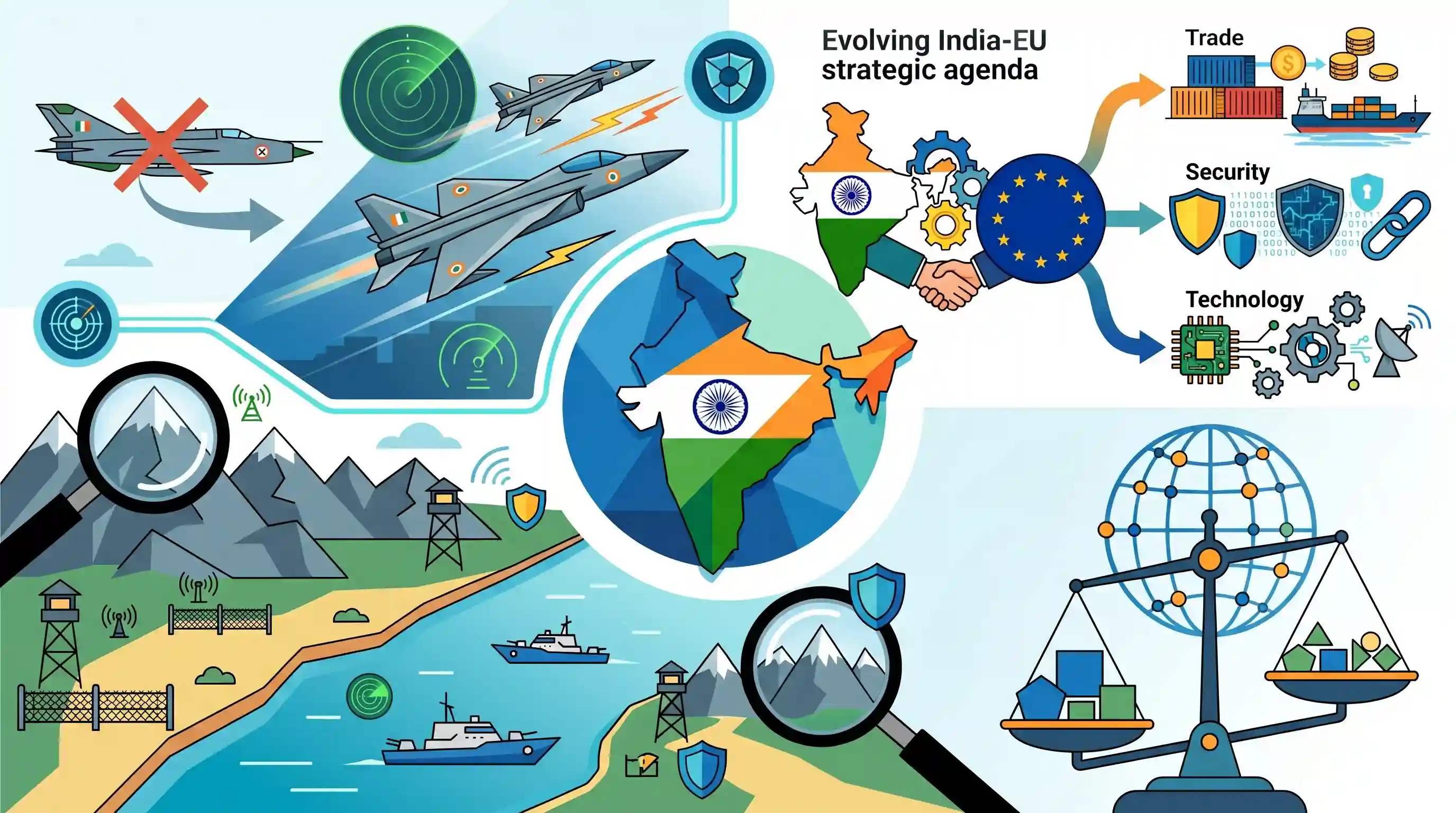
Indian Air Force phases out legacy MiG 21 fighter aircraft fleet
Source:Indian Express ↗
Why It Matters
Understanding the India-EU strategic agenda and WTO trade dynamics is essential for tackling questions related to International Relations and Economy. Furthermore, awareness of defense modernization processes like the phasing out of the MiG-21 is crucial for answering security-related questions in GS3.
Summary
The article covers key developments across defense, international relations, and global trade. It highlights the Indian Air Force's ongoing efforts to phase out its aging fleet of MiG-21 fighter jets as a critical part of its modernization strategy. It also examines the evolving strategic agenda between India and the European Union, emphasizing collaborative efforts to strengthen trade, security, and technological partnerships. Additionally, it discusses the World Trade Organization's Special and Differential Treatment (SDT) provisions, which offer tailored flexibilities for developing nations and remain a subject of debate in global trade governance.
Key Points
- The Indian Air Force is phasing out its legacy MiG-21 fighter jets, marking a significant step in its defense modernization and transition to advanced, indigenous platforms.
- The India-EU Strategic Agenda aims to deepen bilateral cooperation across crucial sectors including trade, climate change, digital technology, and regional security.
- The WTO's Special and Differential Treatment (SDT) provisions offer developing and least-developed countries flexibility in adhering to trade rules, though it remains a point of contention between developed and developing economies.
Important Terms
Special and Differential Treatment (SDT)

WTO provisions granting developing and least-developed countries (LDCs) special rights, such as longer transition periods for implementing agreements and preferential market access, to mitigate structural disadvantages.
UPSC context
GS Paper 3: Issues related to direct and indirect farm subsidies and WTO; critical for India's trade policy and food security.
India-EU Strategic Partnership
A multifaceted cooperation framework established to deepen ties in trade (Free Trade Agreement), security, and emerging technologies, while aligning on Indo-Pacific stability and climate action.
UPSC context
GS Paper 2: Bilateral agreements involving India; tests understanding of India's pivot towards Europe and trade diversification.
World Trade Organization (WTO)
An international organization established in 1995 (Marrakesh Agreement) to regulate global trade, resolve disputes, and host negotiations on trade liberalization through consensus-based decision-making.
UPSC context
GS Paper 3: Important International institutions; focuses on trade rules, dispute settlement, and impacts on developing economies.
MiG-21
A Soviet-designed supersonic fighter jet that served as the backbone of the IAF for decades; it is currently being phased out to prioritize safety and indigenous platforms.
UPSC context
GS Paper 3: Security challenges and modernization; focuses on squadron strength and transition to indigenous technology like LCA Tejas.
European Union (EU)
A political and economic union of 27 European member states with a standardized single market; it acts as a major global trade bloc and a key partner for India.
UPSC context
GS Paper 2: Regional groupings and their effect on India's interests; highlights economic integration and diplomatic alignment.
Indian Air Force (IAF)
The aerial branch of the Indian Armed Forces responsible for securing Indian airspace; currently undergoing a modernization phase to address aging fleets and squadron shortages.
UPSC context
GS Paper 3: Security challenges and their management; tests knowledge of defense preparedness and indigenous manufacturing goals.
Prelims Trap
The WTO uses strict economic criteria to classify nations as 'developing' for SDT benefits.
The WTO does not formally define or use metrics to classify "developing" countries. Members self-designate their status, though other members can challenge their right to avail SDT benefits.
Static Concepts Connected
What are the core provisions of Special and Differential Treatment (SDT) in the WTO?
- Longer Transition Periods: Developing and least-developed countries are granted extra time to comply with newly negotiated WTO agreements and commitments.
- Lower Tariff Reductions: Developing nations are often required to make smaller tariff cuts and take on less stringent market access commitments than developed nations.
- Capacity Building: Mandates developed members to provide technical assistance and capacity-building support to help LDCs implement trade rules and handle disputes.
How does the indigenous Tejas LCA fundamentally differ from the outgoing MiG-21?
- Generational Leap: While the MiG-21 is a 3rd-generation interceptor aircraft, the Tejas LCA Mk-1A is a modern 4.5-generation multi-role combat aircraft.
- Fly-By-Wire System: Unlike the MiG-21's older mechanical controls, Tejas incorporates an advanced quadruplex digital fly-by-wire flight control system, reducing pilot workload.
- Avionics & Radar: Tejas is equipped with Active Electronically Scanned Array (AESA) radar and Beyond Visual Range (BVR) missile capabilities lacking in legacy MiGs.
Cross-Topic Patterns
India-EU TTC & Quad Tech Diplomacy
India's Trade and Technology Council (TTC) with the EU mirrors its tech diplomacy in the Quad, focusing on resilient semiconductor supply chains and AI standard-setting outside Chinese dominance.
IMEC + EU's Global Gateway vs. BRI
The integration of the India-Middle East-Europe Economic Corridor (IMEC) with the EU's Global Gateway directly positions both frameworks as democratic, rules-based alternatives to China's Belt and Road Initiative (BRI).

WTO's 'self-designation' mechanism for developing nation status and SDT benefits is highly likely to appear as a tricky Prelims statement.
Linked PYQs · 3
Linked PYQs · 3
- 2023MainsGS3
What are the direct and indirect subsidies provided to farm sector in India? Discuss the issues raised by the World Trade Organization (WTO) in relation to agricultural subsidies.
- 2023MainsGS2
‘The expansion and strengthening of NATO and a stronger US-Europe strategic partnership works well for India.’ What is your opinion about this statement ? Give reasons and examples to support your answer.
- 2020PrelimsGS1
With reference to Trade-Related Investment Measures (TRIMS), which of the following statements is/are correct? 1. Quantitative restrictions on imports by foreign investors are prohibited. 2. They apply to investment measures related to trade in both goods and services. 3. They are not concerned with the regulation of foreign investment. Select the correct answer using the code given below:
