Environmental Pollution and India Energy Transition Roadmap
Source:Indian Express ↗
Why It Matters
These topics are foundational to the GS3 syllabus encompassing Environment and Economy. Understanding historical climate pacts (Kyoto), modern pollution crises (microplastics), and India's domestic policy pivots (renewable energy goals) allows candidates to tackle interconnected questions on sustainable development.
Summary
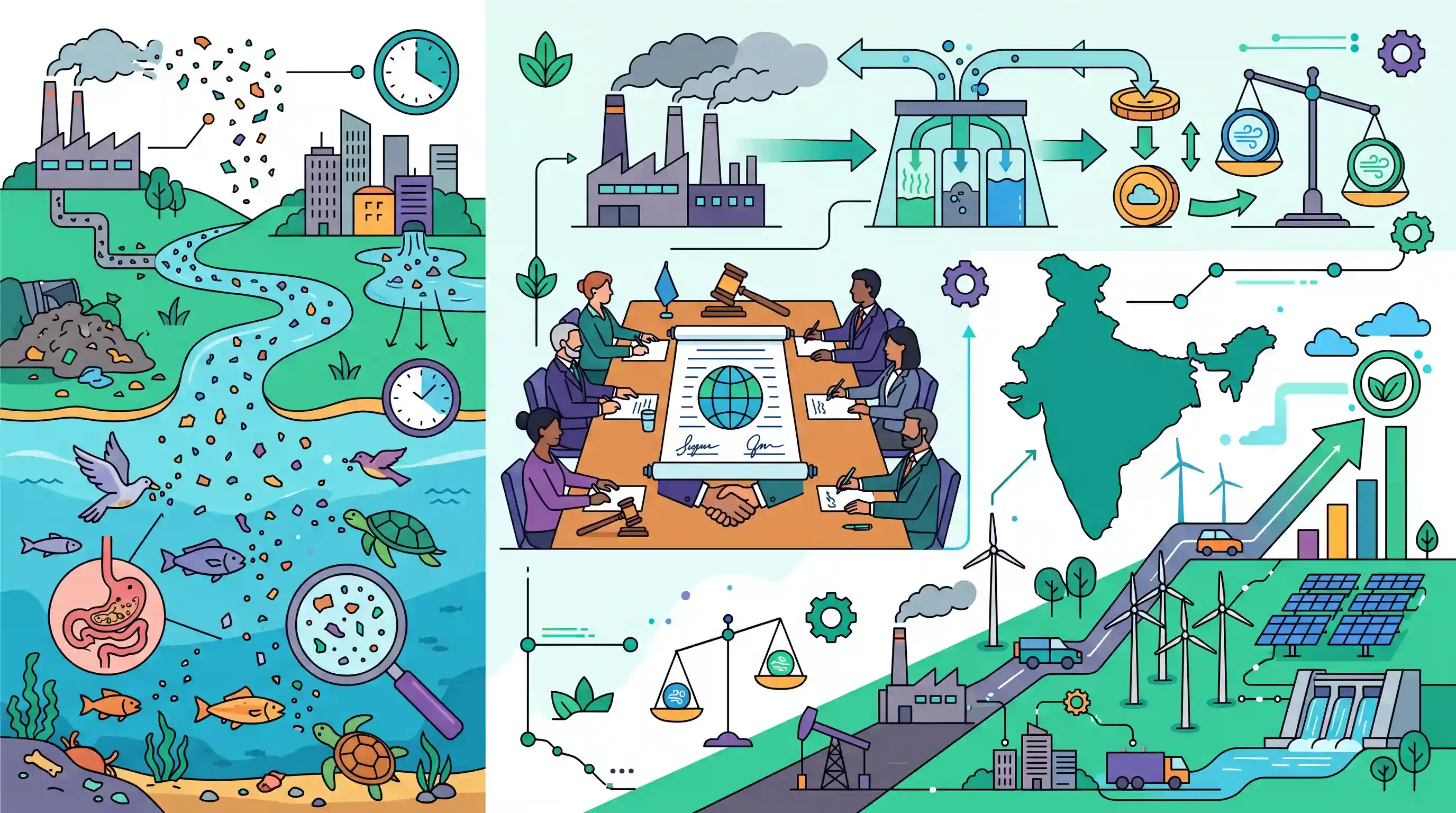
This article explores three pivotal environmental themes crucial for UPSC aspirants: the growing threat of microplastics, the historical significance of the Kyoto Protocol in climate diplomacy, and India's strategic roadmap for energy transition. It details how microplastics impact ecosystems, reviews the mechanisms introduced by Kyoto to curb greenhouse gas emissions, and outlines India's renewable energy targets, particularly the transition away from fossil fuels to meet its net-zero commitments by 2070.
Key Points
- Microplastics, particularly microbeads, present severe ecological challenges, accumulating in marine environments and entering the human food chain.
- The Kyoto Protocol, established under the UNFCCC, was a landmark international treaty that introduced legally binding targets for developed nations to reduce greenhouse gas emissions.
- India's ambitious energy transition is driven by its 'Panchamrit' commitments, targeting 500 GW of non-fossil fuel capacity and 50% energy from renewables by 2030, with a final goal of net-zero by 2070.
- Achieving energy transition requires phasing down fossil fuel subsidies, expanding green financing, and investing heavily in renewable grid infrastructure.
Important Terms
UNFCCC

A 1992 international treaty adopted at the Rio Earth Summit to stabilize greenhouse gas concentrations and provide a framework for global climate negotiations and subsequent protocols.
UPSC context
GS Paper III (Environment). Tests understanding of the global institutional framework for climate governance and the COP process.
Panchamrit
India's five-point climate action strategy announced at COP26 (2021), including targets for 500GW non-fossil energy capacity by 2030 and reaching Net Zero emissions by 2070.
UPSC context
GS Paper III (Energy/Environment). Crucial for questions on India's climate commitments and its leadership in global energy transition.
Paris Agreement
A 2015 legally binding treaty aiming to limit global warming to well below 2°C. It introduced the bottom-up approach of Nationally Determined Contributions (NDCs) for all parties.
UPSC context
GS Paper III (Environment). A core topic for comparing historical and modern climate treaties and evaluating global mitigation efforts.
Kyoto Protocol
The first international treaty (1997) that mandated legally binding greenhouse gas emission reductions for industrialized nations, establishing mechanisms like the Clean Development Mechanism (CDM).
UPSC context
GS Paper III (Environment). Tests knowledge of historical climate diplomacy, the principle of CBDR, and early carbon market mechanisms.
National Green Hydrogen Mission
A government flagship program launched in 2023 to make India a global hub for green hydrogen, targeting 5 MMT annual production capacity by 2030.
UPSC context
GS Paper III (Economy/Science & Tech). Relevant for decarbonizing hard-to-abate sectors and achieving energy self-reliance.
Microplastics
Plastic fragments smaller than 5mm that persist in ecosystems, often entering the food chain and posing significant risks to marine life and human health.
UPSC context
GS Paper III (Environmental Pollution). High relevance for questions on emerging pollutants, plastic waste management, and ecological conservation.
Prelims Trap
The Kyoto Protocol imposed legally binding greenhouse gas emission reduction targets on all member nations of the UNFCCC.
Kyoto placed legally binding targets *only* on developed (Annex I) countries under the principle of Common but Differentiated Responsibilities (CBDR). Developing nations like India were exempt.
Static Concepts Connected
What were the three key flexibility mechanisms introduced under the Kyoto Protocol?
- Clean Development Mechanism: Allowed developed countries to implement emission-reduction projects in developing nations to earn Certified Emission Reduction (CER) credits.
- Joint Implementation: Allowed developed countries to earn Emission Reduction Units (ERUs) by investing in emission-reduction projects in other developed countries.
- Emissions Trading: Allowed countries that had emission units to spare (emissions permitted but not used) to sell this excess capacity to countries over their targets.
How do primary microplastics differ from secondary microplastics?
- Primary Microplastics: Manufactured intentionally at a microscopic size (<5mm) for specific commercial uses, such as microbeads in cosmetics, facial cleansers, or industrial scrubbers.
- Secondary Microplastics: Formed from the fragmentation and breakdown of larger plastic items (like bottles or fishing nets) due to environmental weathering, UV radiation, and ocean waves.
Cross-Topic Patterns
Renewable targets & Critical Mineral Geopolitics
India's 500 GW non-fossil target sharply increases demand for lithium, cobalt, and rare earths, linking domestic climate commitments directly to import vulnerabilities and geopolitical supply-chain partnerships.
Microplastics & Trophic Level Biomagnification
Microplastics act as vectors for heavy metals and persistent organic pollutants (POPs), directly linking ocean solid waste pollution to bioaccumulation and biomagnification up the marine food web.
Kyoto, CBDR, and Climate Finance
The Annex I distinction in Kyoto operationalized 'Common but Differentiated Responsibilities' (CBDR), a principle India continues to leverage to demand green finance and technology transfer for its 2070 net-zero transition.

Expect a multi-statement question contrasting Kyoto's CDM with Paris Agreement's Article 6 carbon markets, alongside India's NDC targets.
Linked PYQs · 5
Linked PYQs · 5
- 2019PrelimsGS1
Why is there a great concern about the 'microbeads' that are released into environment?
- 2022MainsGS3
Discuss global warming and mention its effects on the global climate. Explain the control measures to bring down the level of greenhouse gases which cause global warming, in the light of the Kyoto Protocol, 1997.
- 2021MainsGS3
Describe the major outcomes of the 26th session of the Conference of the Parties (COP) to the United Nations Framework Convention on Climate Change (UNFCCC). What are the commitments made by India in this conference?
- 2022MainsGS3
Do you think India will meet 50 percent of its energy needs from renewable energy by 2030 ? Justify your answer. How will the shift of subsidies from fossil fuels to renewables help achieve the above objective ? Explain.
- 2018MainsGS3
“Access to affordable, reliable, sustainable and modern energy is the sine qua non to achieve Sustainable Development Goals (SDGs).” Comment on the progress made in India in this regard.
