Maratha Empire Administration and Federal Education Policy Trends
Source:Indian Express ↗
Why It Matters
These topics span multiple core areas of the UPSC syllabus. The Maratha administration is a frequent theme in Prelims history. Federal friction over education highlights center-state relations (GS2), while EV policy is crucial for tackling both economic constraints and climate change (GS3).
Summary
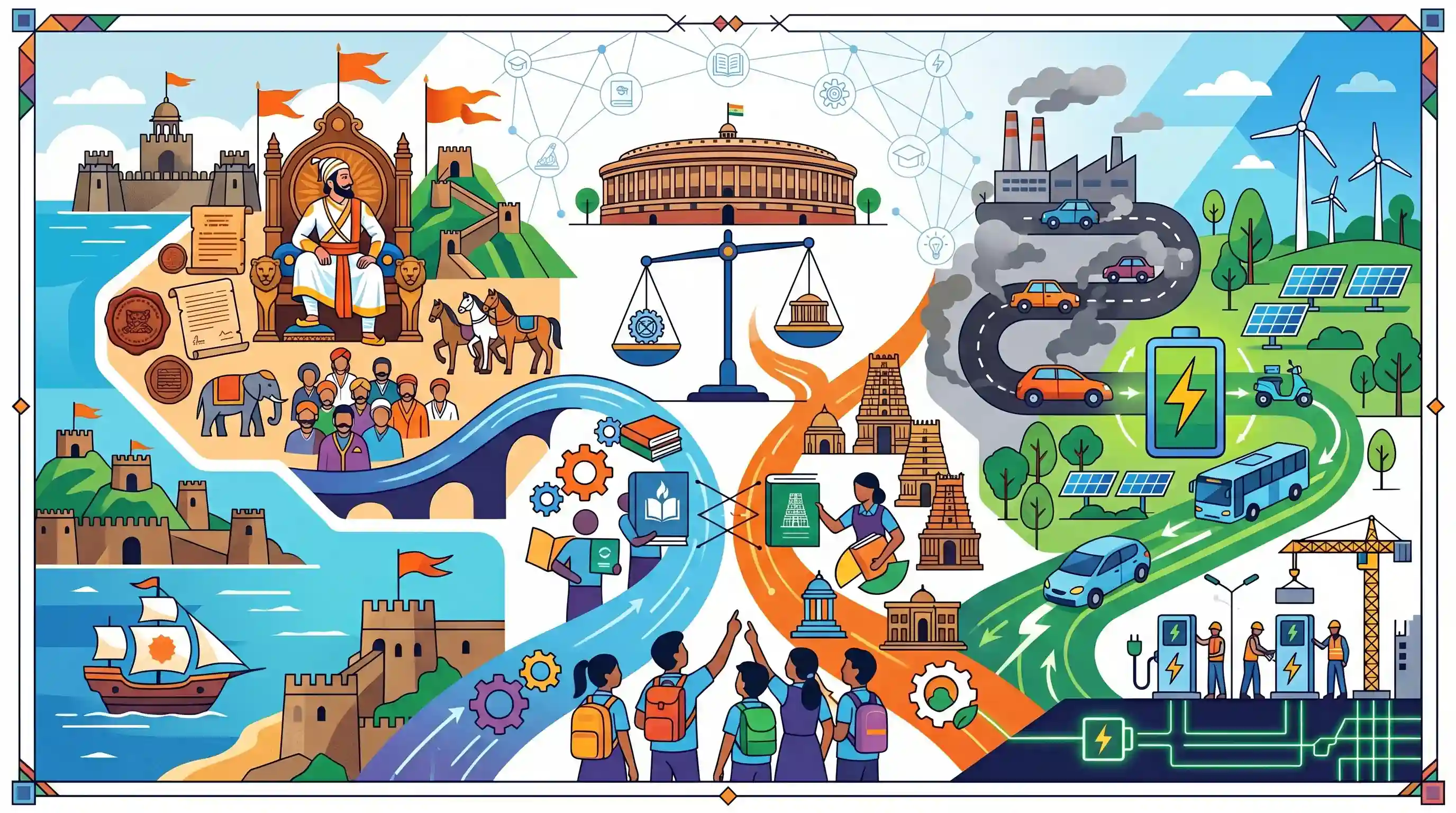
This daily roundup covers a trio of important UPSC topics across GS papers. It highlights the historical significance of the Maratha Empire's administration. In governance, it explores the federal tensions in the education sector as Tamil Nadu advances its own State Education Policy, resisting aspects of the NEP 2020. Finally, it outlines the ecological and economic dimensions of India's EV push, detailing the transition to electric mobility and the infrastructural challenges that accompany it.
Key Points
- The Maratha Empire's administrative genius and military strategies under Shivaji and the Peshwas laid a robust framework for regional statecraft.
- Tamil Nadu's drafting of its own State Education Policy highlights the ongoing federal friction over education, which is in the Concurrent List, in contrast to the Centre's National Education Policy (NEP) 2020.
- India is aggressively pushing for the adoption of Electric Vehicles (EVs) to reduce dependency on crude oil imports, cut down greenhouse gas emissions, and honor global climate commitments.
- Sustained EV adoption requires structural support such as the FAME scheme, expanding charging infrastructure, and robust supply chains for critical minerals like lithium.
Important Terms
National Education Policy (NEP) 2020

India's 21st-century education framework replacing the 1986 policy. It introduces a 5+3+3+4 structure, emphasizes holistic, multidisciplinary learning, and vocational integration to transform India into a "global knowledge superpower."
UPSC context
GS Paper II (Government Policies). Tests understanding of structural reforms and federal challenges in education.
Ashtapradhan
A council of eight ministers established by Chhatrapati Shivaji Maharaj to assist in administrative and military governance. It institutionalized a systematic bureaucracy with portfolios like finance (Peshwa) and external affairs (Sumant).
UPSC context
GS Paper I (Indian History). Tests knowledge of medieval administrative systems and the rise of Maratha polity.
FAME Scheme
Part of the National Electric Mobility Mission Plan, it provides subsidies to encourage electric vehicle adoption and manufacturing. Phase II focuses on public transport electrification and developing charging infrastructure.
UPSC context
GS Paper III (Economy/Environment). Relevant for sustainable transport and climate change mitigation strategies.
Chauth and Sardeshmukhi
Revenue systems of the Maratha Empire. Chauth was a 25% tax levied on non-Maratha territories for protection; Sardeshmukhi was an additional 10% claim based on hereditary rights.
UPSC context
GS Paper I (History). Essential for understanding Maratha economic foundations and expansionist military strategy.
Concurrent List
A list under the Seventh Schedule where both Union and State governments can legislate. Education's presence here often causes federal friction regarding national versus regional policy implementation.
UPSC context
GS Paper II (Polity/Federalism). Tests understanding of the division of powers and cooperative federalism.
State Education Policy (SEP)
A localized educational framework developed by a state (e.g., Tamil Nadu) to address regional socio-linguistic needs, often drafted as an alternative to the National Education Policy.
UPSC context
GS Paper II (Federalism). Highlights tensions in center-state relations over regional autonomy and language.
Prelims Trap
"The FAME scheme for promoting electric vehicles is administered by the Ministry of Road Transport and Highways."
FAME is actually administered by the Ministry of Heavy Industries. Aspirants often wrongly guess MoRTH or MoEFCC due to the scheme's focus on vehicular transport and emission reduction.
Static Concepts Connected
What was the structure of Shivaji's Ashtapradhan?
- Peshwa (Mukhya Pradhan): Served as the Prime Minister, overseeing the general administration and the overall finances of the Maratha Empire.
- Amatya (Majumdar): Acted as the Finance and Revenue Minister, strictly checking and managing all the public accounts.
- Sachiv (Surunavis): Managed the royal correspondence and ensured all royal edicts and letters were correctly drafted.
- Senapati (Sari Naubat): Functioned as the Commander-in-Chief, managing military recruitment, organization, and discipline.
How did the 42nd Amendment alter education's constitutional status?
- Originally State List: Education was initially placed exclusively under Entry 11 of the State List in the Seventh Schedule.
- Shift to Concurrent: The 42nd Amendment Act (1976) moved it to the Concurrent List (Entry 25) alongside forests and weights & measures.
- Federal Implication: Both Centre and States can legislate, but under Article 254 (repugnancy), Central laws generally prevail in case of direct conflict.
Cross-Topic Patterns
EV transition & critical mineral diplomacy
India's domestic EV targets rely on securing lithium and cobalt, directly linking domestic climate goals to geopolitical frameworks like the Minerals Security Partnership and China+1 strategies.
Concurrent List vs regional autonomy
Tamil Nadu’s State Education Policy highlights a recurring theme of states pushing back against centralized concurrent-list policies, mirroring recent state-centre friction over the Electricity Amendment Bill.

Expect a 2026 Prelims multi-statement question interlinking EV adoption schemes, their exact nodal ministries, and lithium supply chains.
Linked PYQs · 3
Linked PYQs · 3
- 2014MainsGS1
The third battle of Panipat was fought in 1761. Why were so many empire-shaking battles fought at Panipat?
- 2020MainsGS2
National Education Policy 2020 is in conformity with the Sustainable Development Goal-4 (2030). It intends to restructure and reorient education system in India. Critically examine the statement.
- 2023MainsGS3
The adoption of electric vehicles is rapidly growing worldwide. How do electric vehicles contribute to reducing carbon emissions and what are the key benefits they offer compared to traditional combustion engine vehicles?
