Left Wing Extremism and CPEC Strategic Concerns for India
Source:Indian Express ↗
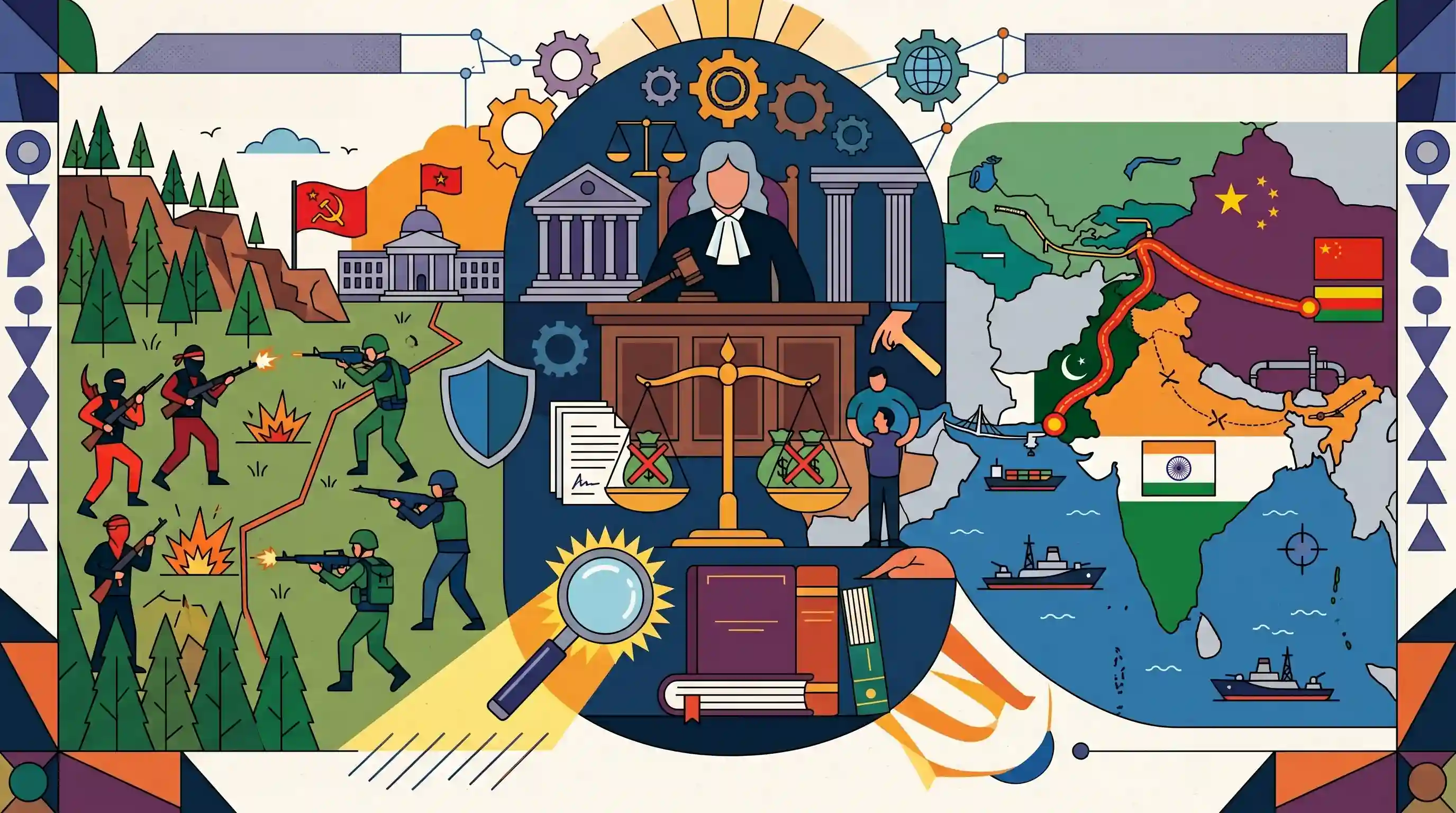
Why It Matters
LWE and CPEC are core components of the GS3 Security and GS2 IR syllabi, frequently appearing in Mains. The Veeraswami case is a foundational polity judgment on judicial independence and corruption, while the Booker Prize is a recurring factual topic for Prelims.
Summary
This edition of UPSC Key highlights multiple exam-relevant topics, including the internal security threats posed by Left Wing Extremism (LWE) and government countermeasures. It revisits the landmark K. Veeraswami case concerning judicial accountability and the Prevention of Corruption Act. The article also examines the geopolitical implications of the China-Pakistan Economic Corridor (CPEC) for India's sovereignty, and provides essential Prelims facts regarding the prestigious Booker Prize in literature.
Key Points
- Left Wing Extremism (LWE) remains a critical internal security challenge, requiring a multi-pronged approach that combines security measures with socio-economic development in affected regions.
- The Supreme Court\'s landmark K. Veeraswami case (1991) established crucial guidelines for judicial accountability, mandating prior sanction from the Chief Justice of India before investigating sitting judges under the Prevention of Corruption Act.
- The China-Pakistan Economic Corridor (CPEC), a flagship Belt and Road Initiative (BRI) project, is strongly opposed by India as it passes through Pakistan-occupied Kashmir (PoK), violating India\'s territorial sovereignty.
- The Booker Prize and International Booker Prize are key literary awards highlighted for Prelims, recognizing outstanding fiction written in or translated into English.
Important Terms
CPI (Maoist)

A banned far-left militant organization formed in 2004 via the merger of the PWG and MCCI. It aims to overthrow the Indian state through armed struggle (Protracted People’s War).
UPSC context
GS Paper III (Internal Security); tests knowledge of Left-Wing Extremism (LWE) origins, ideology, and government countermeasures.
Unlawful Activities (Prevention) Act (UAPA)
India's primary anti-terror law (1967) used to designate organizations and individuals as terrorists. It provides special procedures for handling activities that threaten India’s sovereignty and territorial integrity.
UPSC context
GS Paper III (Internal Security); critical for legal frameworks against terrorism and the balance between security and civil liberties.
China-Pakistan Economic Corridor (CPEC)
A flagship $60 billion project of China’s BRI, connecting Xinjiang to Pakistan’s Gwadar Port. India opposes it as it passes through Pakistan-occupied Kashmir (PoK), violating Indian sovereignty.
UPSC context
GS Paper II (International Relations); vital for India-China-Pakistan dynamics and territorial integrity challenges.
Prevention of Corruption Act
Legislation (1947/1988) aimed at curbing corruption among public servants. In the K. Veeraswami case, the Supreme Court held that higher judiciary judges qualify as "public servants" under this Act.
UPSC context
GS Paper II (Judiciary/Governance); important for judicial accountability and the legal status of constitutional functionaries.
Booker Prize
A prestigious literary award established in 1969, granted annually to the best original novel written in English and published in the UK or Ireland.
UPSC context
UPSC Prelims (Awards and Honours); tests awareness of major international literary recognitions and Indian laureates.
Belt and Road Initiative (BRI)
China’s global infrastructure strategy (launched 2013) to enhance connectivity across Asia, Africa, and Europe. It includes the land-based "Silk Road Economic Belt" and the "Maritime Silk Road."
UPSC context
GS Paper II (International Relations); central to studying China’s geopolitical influence and its impact on India’s neighbourhood.
Prelims Trap
"Judges of the higher judiciary are immune from the Prevention of Corruption Act as they are not considered 'public servants'."
The Supreme Court ruled in the 1991 Veeraswami case that judges ARE public servants under the PCA, but they require the CJI's prior sanction for an FIR.
Static Concepts Connected
How does the Prevention of Corruption Act (PCA) apply to the higher judiciary?
- Public Servants: Supreme Court and High Court judges fall under the definition of 'public servants' according to the PCA.
- CJI Sanction: Under the Veeraswami guidelines, no FIR can be registered against a sitting judge without prior sanction from the Chief Justice of India.
- CJI Investigation: If the Chief Justice of India is implicated, sanction must be sought from the President acting on the advice of the Council of Ministers.
What are the key pillars of India's multi-pronged approach to Left Wing Extremism (LWE)?
- Security Measures: Deployment of Central Armed Police Forces (CAPFs), intelligence sharing, and state police modernization via the Security Related Expenditure (SRE) scheme.
- Development Initiatives: Targeted infrastructure growth through the Road Connectivity Project in LWE areas, Eklavya Model Residential Schools, and expanding telecom coverage.
- Rights & Entitlements: Addressing the root causes of tribal alienation through the effective implementation of the Forest Rights Act (FRA) and PESA.
Cross-Topic Patterns
Judicial Independence vs. Accountability
The Veeraswami case bridges Constitutional law (impeachment process) with statutory anti-corruption mechanisms, highlighting the delicate balance of keeping the judiciary accountable without exposing it to executive harassment.
CPEC and Maritime Encirclement
CPEC's Gwadar terminus serves as a dual-use asset, linking China's continental Belt and Road infrastructure to its maritime 'String of Pearls' strategy in the Indian Ocean Region.
Tribal Alienation and Internal Security
UPSC often links LWE eradication to governance deficits. True resolution requires combining security force deployments with the effective enforcement of PESA and the Forest Rights Act in Schedule V areas.

A 2026 Mains question on judicial accountability will likely require citing the K. Veeraswami guidelines alongside the Judges Inquiry Act.
Linked PYQs · 5
Linked PYQs · 5
- 2018MainsGS3
Left Wing Extremism (LWE) is showing a downward trend, but still affects many parts of the country. Briefly explain the Government of India's approach to counter the challenges posed by LWE.
- 2025MainsGS3
The Government of India recently stated that Left Wing Extremism (LWE) will be eliminated by 2026. What do you understand by LWE and how are the people affected by it? What measures have been taken by the government to eliminate LWE?
- 2022MainsGS3
Naxalism is a social, economic and developmental issue manifesting as a violent internal security threat. In this context, discuss the emerging issues and suggest a multilayered strategy to tackle the menace of Naxalism.
- 2018MainsGS3
The China-Pakistan Economic Corridor (CPEC) is viewed as a cardinal subset of China's larger 'One Belt One Road' initiative. Give a brief description of CPEC and enumerate the reasons why India has distanced itself from the same.
- 2014MainsGS3
China and Pakistan have entered into an agreement for development of an economic corridor. What threat does this pose for India's security? Critically examine.
