MANAV AI vision and fiscal challenges in current affairs
Source:Indian Express ↗
Why It Matters
These topics sit at the intersection of technological governance, political economy, and macroeconomic stability. They require a balanced understanding of how emerging tech (AI), electoral populism, and traditional socio-economic behaviors (gold buying) collectively shape India's developmental trajectory and fiscal health.
Summary
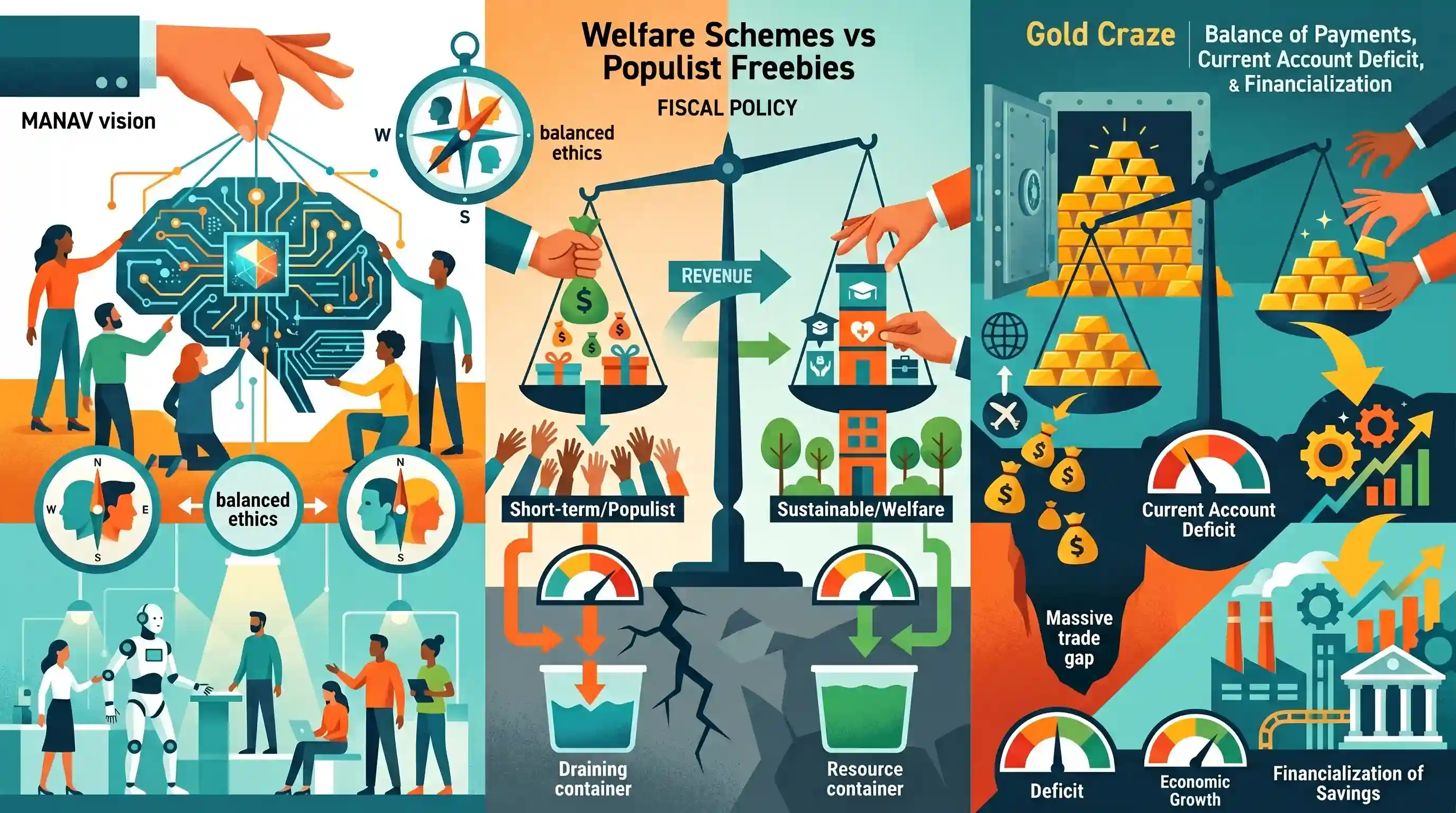
The article covers three key themes relevant to the UPSC examination: the emerging 'MANAV' vision advocating for human-centric and ethical Artificial Intelligence; the complex discourse on electoral 'freebies' versus sustainable welfare economics and their impact on fiscal health; and the enduring craze for gold investment among Indians, which poses persistent challenges to the country's current account deficit and necessitates the financialization of idle savings.
Key Points
- The 'MANAV' vision emphasizes the need for a human-centric approach to Artificial Intelligence, advocating for AI development that aligns with ethical guidelines, inclusivity, and societal advancement rather than displacing human capabilities.
- The ongoing debate over political 'freebies' highlights the tension between necessary welfare schemes targeted at poverty alleviation and populist measures that strain state exchequers, distort macroeconomic stability, and affect capital expenditure.
- The traditional Indian obsession with investing in physical gold continues to challenge the economy by inflating the import bill, widening the Current Account Deficit (CAD), and keeping potential savings outside the formal financial system.
- Policies like the Gold Monetization Scheme and Sovereign Gold Bonds (SGBs) are critical to shifting consumer behavior towards the financialization of gold savings.
Important Terms
MANAV Vision

India's human-centric AI governance framework based on five pillars: Moral & Ethical systems, Accountable governance, National sovereignty, Accessible & Inclusive AI, and Valid & Legitimate systems.
UPSC context
GS Paper III (S&T/AI Ethics); tests understanding of ethical tech governance and digital sovereignty.
Freebies
Consumption-based handouts (e.g., free electricity) often used for electoral gains; distinguished from merit-based welfare like health/education that build long-term human capacity.
UPSC context
GS Paper II (Polity) and GS Paper III (Economy); tests fiscal prudence vs. populist politics.
Gold Monetization Scheme
A 2015 scheme designed to mobilize idle gold from households and institutions into the formal economy as interest-bearing deposits for productive use.
UPSC context
GS Paper III (Economy); relevant for external sector stability and reducing import dependence.
Sovereign Gold Bonds
Government securities denominated in grams of gold and issued by the RBI, serving as a financial substitute for physical gold investment.
UPSC context
GS Paper III (Economy); tests knowledge of instruments used to manage domestic gold demand.
Current Account Deficit (CAD)
A macroeconomic indicator where a country's total value of imported goods and services exceeds its exports, frequently worsened in India by high gold imports.
UPSC context
GS Paper III (Economy); fundamental for Balance of Payments and external sector questions.
Financialization of Savings
The structural shift of household savings from physical assets like gold and real estate into financial instruments such as mutual funds and bonds.
UPSC context
GS Paper III (Economy); tests understanding of capital market depth and resource mobilization.
RBI
India's central bank and regulatory body responsible for monetary policy, maintaining fiscal stability, and issuing gold-related financial instruments.
UPSC context
GS Paper III (Economy); core institutional role in macroeconomic management and banking regulation.
Prelims Trap
"Sovereign Gold Bonds (SGBs) are backed by equivalent physical gold reserves maintained by the RBI."
SGBs are government securities (sovereign debt) that track gold prices and pay interest. They are not backed by physical gold vaults, unlike Gold ETFs.
Static Concepts Connected
What differentiates Merit Goods (welfare) from Non-Merit Goods (freebies)?
- Positive Externalities: Merit goods (health, education, PDS) benefit society at large with positive spillover effects, justifying state funding.
- Private Benefit: Non-merit goods (free TVs, electricity) only benefit the individual user, draining state exchequers without generating long-term economic returns.
How do physical gold imports affect macroeconomic stability?
- Current Account Deficit: High physical gold imports directly inflate the import bill, structurally widening the trade deficit and the Current Account Deficit (CAD).
- Rupee Depreciation: Paying for massive gold imports increases the demand for US Dollars, which drains forex reserves and puts downward pressure on the Rupee.
- Dead Capital: Physical gold locks up hidden household savings that could otherwise be loaned out by the formal banking sector for productive capital investment.
Cross-Topic Patterns
AI Ethics + Digital Sovereignty
India's MANAV framework bridges GS3 (Tech) and GS4 (Ethics). It acts as an alternative to the heavy-handed EU AI Act, emphasizing both inclusion and national data sovereignty.
Freebies + Finance Commission
State-level populism triggers Article 293 (borrowing limits). The 16th Finance Commission may factor state welfare spending versus capital expenditure into its devolution criteria.

SGB features (collateral utility, capital gains exemption) and India's MANAV AI pillars will likely feature in 2026 Prelims statements.
Linked PYQs · 3
Linked PYQs · 3
- 2023MainsGS3
Introduce the concept of Artificial Intelligence (AI). How does Al help clinical diagnosis? Do you perceive any threat to privacy of the individual in the use of Al in healthcare?
- 2015MainsGS3
Craze for gold in Indians has led to a surge in import of gold in recent years and put pressure on balance of payments and external value of rupee. In view of this, examine the merits of the Gold Monetization Scheme.
- 2022MainsGS2
Besides the welfare schemes, India needs deft management of inflation and unemployment to serve the poor and the underprivileged sections of the society. Discuss.
