Manav Vision AI and Fiscal Freebies Debate
Source:Indian Express ↗
Why It Matters
These issues are central to the UPSC syllabus across GS2 and GS3, touching upon the fiscal health of Indian states, the economic drain caused by unproductive physical assets like gold, and the socio-economic transformations driven by emerging technologies like AI.
Summary
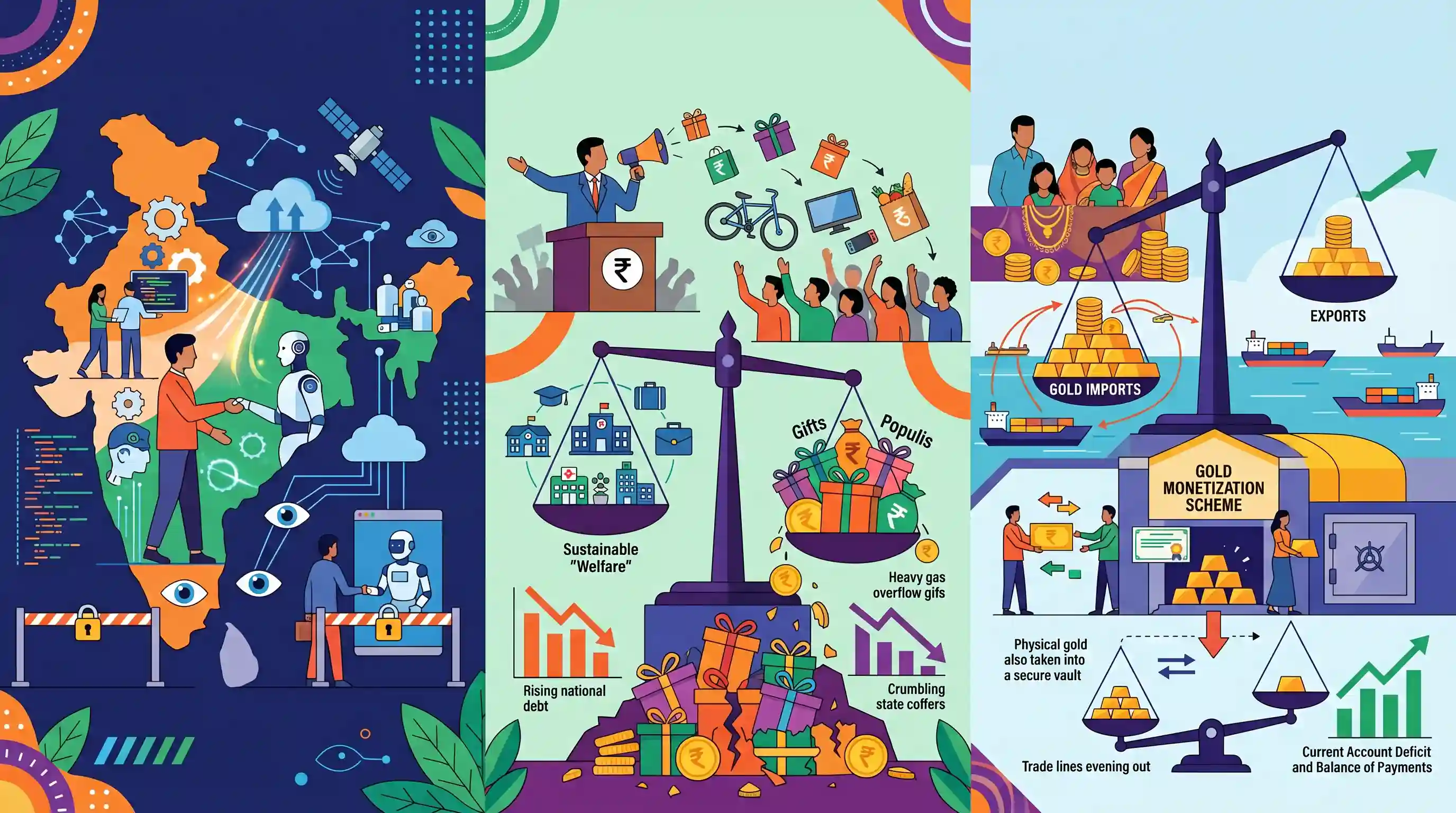
The article analyzes three distinct UPSC-relevant themes: technology, political economy, and macroeconomics. It discusses the MANAV Vision AI initiative, which underscores India's push towards deploying Artificial Intelligence for national development while navigating ethical and privacy hurdles. Additionally, it highlights the ongoing debate on electoral 'freebies,' examining the tension between genuine welfare schemes and populist promises that threaten state fiscal stability. Lastly, it addresses the traditional Indian craze for gold investments, exploring its adverse effects on the Current Account Deficit and the role of government initiatives like the Gold Monetization Scheme in shifting preferences toward financialized gold.
Key Points
- MANAV Vision AI reflects India's ambition to leverage Artificial Intelligence for socio-economic development, raising associated debates around data privacy, ethical AI, and technological integration.
- The political culture of offering 'freebies' continues to spark debates over fiscal discipline, state debt burdens, and the fine line between necessary welfare interventions and populist election promises.
- The persistent craze for gold investments among Indians creates macroeconomic challenges by widening the Current Account Deficit (CAD) due to heavy imports.
- Measures like the Sovereign Gold Bond (SGB) and Gold Monetization Scheme aim to financialize gold savings and reduce physical import dependency.
Important Terms
MANAV Vision AI

A human-centric AI governance framework (2026) emphasizing Moral ethics, Accountable governance, National sovereignty, Accessibility, and Validity to ensure AI serves as a tool for inclusion rather than a monopoly.
UPSC context
GS-III (Science & Technology/AI); tests understanding of India's indigenous ethical AI policy and its five-pillar human-centric approach.
Sovereign Gold Bond Scheme
RBI-issued government securities denominated in gold grams, designed as a financial substitute for physical gold to reduce imports and offer investors market-linked returns plus interest.
UPSC context
GS-III (Indian Economy); tests knowledge of "financialization of gold" and its role in managing the Balance of Payments.
Gold Monetization Scheme
A scheme to mobilize "idle gold" from households and institutions, channeling it into productive economic use to lower the nation's reliance on imported gold.
UPSC context
GS-III (Indian Economy); focuses on resource mobilization and reducing foreign exchange drain caused by gold consumption.
Freebies (Electoral)
Short-term populist handouts (e.g., free power, laptops) that lack long-term developmental goals, often criticized for threatening state fiscal health and distorting market behavior.
UPSC context
GS-II (Polity/Governance); tests the ability to distinguish between populist promises and sustainable Directive Principles-based welfare schemes.
Current Account Deficit (CAD)
The difference between a nation's total imports of goods/services and its exports; in India, high physical gold demand significantly widens this deficit.
UPSC context
GS-III (Indian Economy/Macro); crucial for understanding external sector stability and currency valuation risks.
Prelims Trap
Sovereign Gold Bonds allow investors to deposit physical gold and earn interest.
SGBs are government securities denominated in gold but bought and redeemed in cash. It is the Gold Monetization Scheme (GMS) that accepts physical gold deposits.
Static Concepts Connected
How do heavy gold imports impact India's Balance of Payments?
- Trade Deficit: Surging gold imports directly inflate the import bill, widening the trade deficit within the Current Account.
- Currency Pressure: A wider Current Account Deficit (CAD) increases demand for dollars, exerting depreciating pressure on the Indian Rupee.
- Forex Depletion: To prevent sharp rupee depreciation, the RBI may intervene by selling dollars, leading to a depletion of foreign exchange reserves.
Merit Goods vs. Non-Merit Goods in the 'Freebies' debate
- Merit Goods: Goods yielding positive externalities (e.g., healthcare, primary education). State provision is justified as genuine capacity-building welfare.
- Non-Merit Goods: Excludable private goods (e.g., free laptops, electricity waivers) that crowd out capital expenditure without offering long-term societal spillover benefits.
- FRBM Breach: Heavy expenditure on non-merit subsidies often forces states to bypass Fiscal Responsibility and Budget Management (FRBM) borrowing limits, increasing debt-to-GSDP ratios.
Cross-Topic Patterns
AI Governance & DPDP Act 2023
The MANAV AI framework's emphasis on data sovereignty and privacy intersects heavily with data fiduciary obligations under the recent Digital Personal Data Protection (DPDP) Act.
State Freebies & Finance Commission
Rising sub-national debt due to unbudgeted populist promises will likely prompt the 16th Finance Commission to tie tax devolutions to strict fiscal performance conditionalities.

Expect a 2026 prelims multi-statement question contrasting Sovereign Gold Bonds with the Gold Monetization Scheme and their CAD impacts.
Linked PYQs · 4
Linked PYQs · 4
- 2023MainsGS3
Introduce the concept of Artificial Intelligence (AI). How does Al help clinical diagnosis? Do you perceive any threat to privacy of the individual in the use of Al in healthcare?
- 2020PrelimsGS1
With the present state of development, Artificial Intelligence can effectively do which of the following? 1. Bring down electricity consumption in industrial units 2. Create meaningful short stories and songs 3. Disease diagnosis 4. Text-to-Speech Conversion 5. Wireless transmission of electrical energy Select the correct answer using the code given below:
- 2015MainsGS3
Craze for gold in Indians has led to a surge in import of gold in recent years and put pressure on balance of payments and external value of rupee. In view of this, examine the merits of the Gold Monetization Scheme.
- 2022MainsGS2
Besides the welfare schemes, India needs deft management of inflation and unemployment to serve the poor and the underprivileged sections of the society. Discuss.
