Conservation Technologies and Humanitarian Crises in Focus
Source:Indian Express ↗
Why It Matters
These topics intersect environment, science & technology, and international humanitarian issues, making them highly relevant for both Prelims (factual questions on space missions and conservation tech) and Mains (food security and international ethics).
Summary
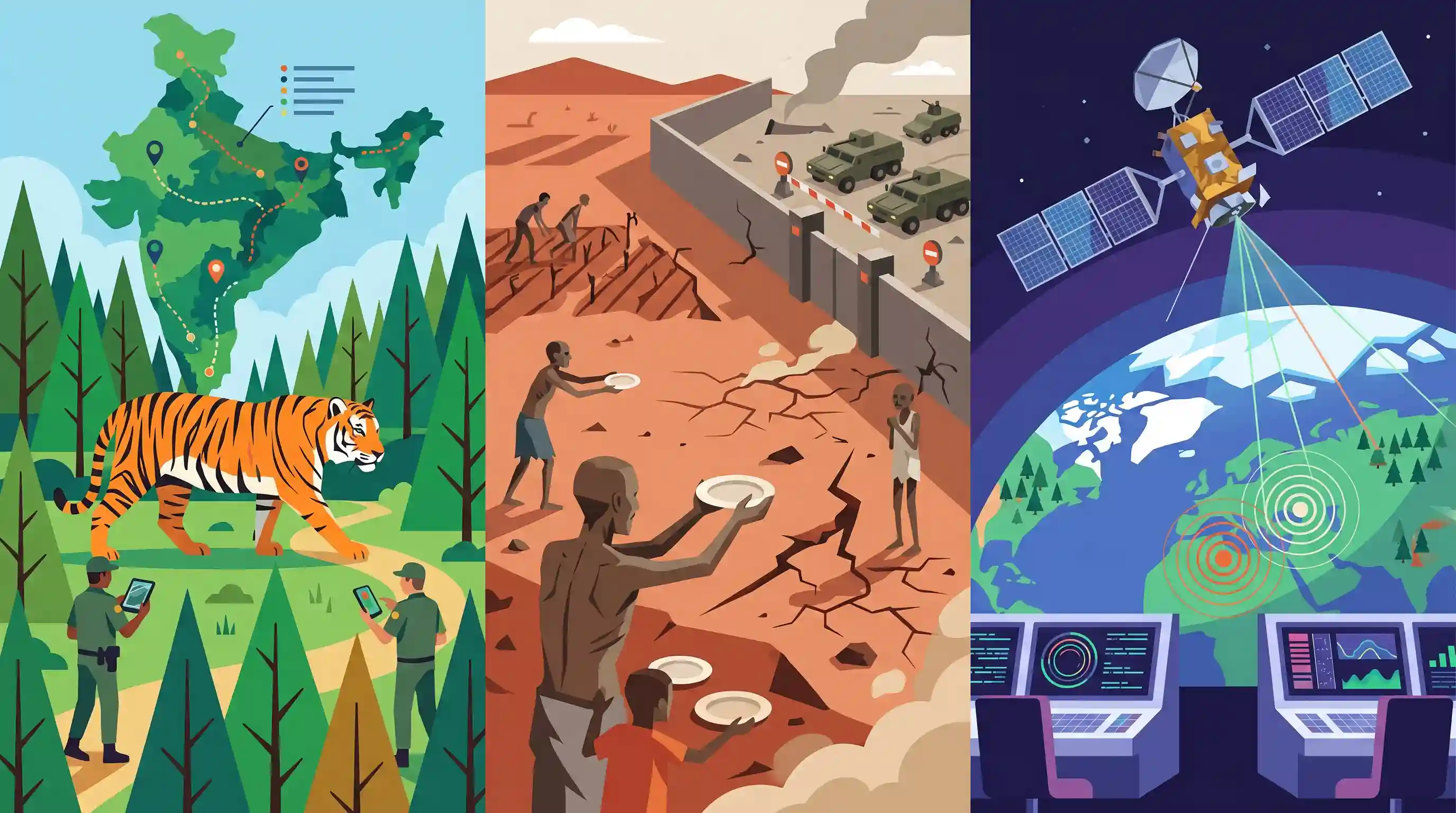
The article details three critical topics for UPSC preparation: M-STrIPES (a digital system for tiger conservation and patrolling in India), the concept and implications of man-made famines caused by conflicts and blockades, and the NISAR mission (a collaborative Earth observation satellite by NASA and ISRO using synthetic aperture radar).
Key Points
- M-STrIPES (Monitoring System for Tigers - Intensive Protection and Ecological Status) is a software-based system launched by NTCA for effective patrolling and ecological monitoring of tiger reserves.
- Man-made famines highlight severe humanitarian crises resulting from conflict, blockades, and political decisions that deliberately or inadvertently destroy food security and supply chains.
- NISAR (NASA-ISRO Synthetic Aperture Radar) is a joint space mission designed for advanced Earth observation to track ecosystem disturbances, ice-sheet collapses, and natural hazards.
Important Terms
M-STrIPES

Monitoring System for Tigers - Intensive Protection and Ecological Status; a software-based application using GPS and remote sensing for patrolling and surveillance in India's tiger reserves.
UPSC context
GS Paper 3 (Environment/Biodiversity); tested as a digital intervention in wildlife conservation (Prelims 2017).
NISAR
A joint Earth-observation mission by NASA and ISRO using dual-band radar to monitor global land and ice surfaces with high precision every 12 days.
UPSC context
GS Paper 3 (Science and Tech/Space); relevant for international space collaboration and climate change monitoring.
National Tiger Conservation Authority (NTCA)
A statutory body under the Ministry of Environment, Forest and Climate Change, established under the Wildlife (Protection) Act, 1972, to oversee tiger conservation and Project Tiger.
UPSC context
GS Paper 3 (Environment); key institutional framework for biodiversity governance and wildlife protection laws.
Synthetic Aperture Radar (SAR)
An active remote sensing technology that uses microwave pulses to create high-resolution images of Earth’s surface, functioning in all-weather conditions and day/night.
UPSC context
GS Paper 3 (Science and Tech); fundamental technology for Earth observation, disaster management, and defense.
Man-made Famine
A severe food crisis caused by human actions such as conflict, blockades, or policy failures rather than natural disasters like drought.
UPSC context
GS Paper 2 (Humanitarian Issues/IR) and GS Paper 3 (Food Security); critical for ethics and global governance.
Prelims Trap
NISAR relies on high-resolution optical sensors, limiting its Earth observation capabilities to daytime and clear weather.
NISAR uses Synthetic Aperture Radar (SAR), an active sensor emitting microwaves. It easily penetrates cloud cover and operates day and night, unlike passive optical sensors.
Static Concepts Connected
What is the difference between active and passive remote sensing?
- Active Sensors: Emit their own energy (like radar or LiDAR) to scan targets, enabling day, night, and all-weather operational capability.
- Passive Sensors: Detect naturally reflected or emitted energy (like sunlight), making them completely dependent on external light and clear skies.
What is the statutory basis and structure of the NTCA?
- Statutory Body: Established in 2005 via an amendment to the Wildlife (Protection) Act, 1972, giving it legal backing.
- Leadership: Chaired by the Union Minister for Environment, Forest and Climate Change.
- Core Mandate: Approves Tiger Conservation Plans prepared by states and implements uniform monitoring frameworks like M-STrIPES.
Cross-Topic Patterns
Active radar vs optical satellites
UPSC increasingly tests the functional differences between satellite payloads. NISAR’s L and S band active radars make it functionally distinct from standard passive optical imaging missions like Resourcesat.
Weaponization of food supply chains
Man-made famines in IR (e.g., Gaza, Sudan) intersect with global food security, linking conflict blockades directly to Mains GS2 humanitarian crises and GS3 supply chain disruptions.

Expect a 2026 Prelims question contrasting NISAR’s active SAR with passive optical satellites, focusing on cloud penetration features.
Linked PYQs · 3
Linked PYQs · 3
- 2017PrelimsGS1
The term 'M-STRIPES' is sometimes seen in the news in the context of
- 2024PrelimsGS1
Consider the following activities : 1. Identification of narcotics on passengers at airports or in aircraft 2. Monitoring of precipitation 3. Tracking the migration of animals In how many of the above activities can the radars be used?
- 2019MainsGS2
There is a growing divergence in the relationship between poverty and hunger in India. The shrinking of social expenditure by the government is forcing the poor to spend more on non-food essential items squeezing their food-budget. - Elucidate.
