El Nino Impact on Consumer Price Index and Inflation
Source:Indian Express ↗
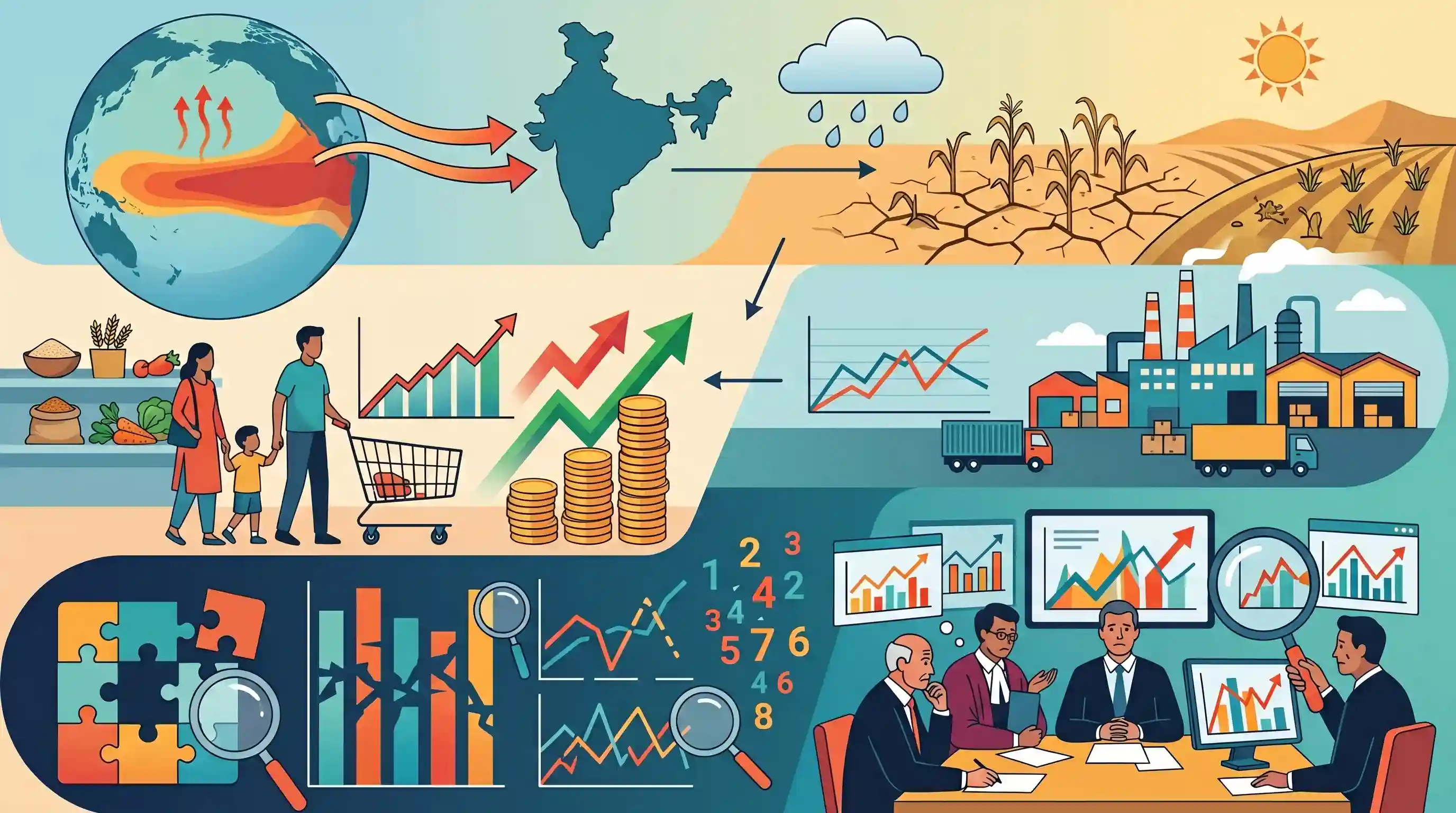
Why It Matters
The causal link between geography (weather events) and economy (inflation and monetary policy) is a recurring UPSC theme. Understanding how climatic anomalies disrupt agricultural supply chains and complicate inflation targeting is essential for GS1 and GS3.
Summary
The article explores the interplay between climatic patterns, inflation measurement, and statistical anomalies in economic data. It highlights how El Nino—a weather phenomenon causing deficit monsoons in India—directly affects agricultural yields, subsequently driving up food prices. Because food constitutes a major portion of the Consumer Price Index (CPI), this leads to high retail inflation. The piece further delves into 'logical discrepancies' in economic reporting, such as the frequent divergence between CPI and Wholesale Price Index (WPI), or gaps in national accounts, emphasizing the challenges policymakers face in interpreting data distorted by external shocks like climate change.
Key Points
- El Nino is characterized by the unusual warming of surface waters in the eastern tropical Pacific Ocean, which typically weakens the Indian Southwest Monsoon and negatively impacts agricultural output.
- The Consumer Price Index (CPI), which serves as the RBI's primary inflation gauge, is highly sensitive to agricultural shocks due to its large weightage (nearly 45%) for food and beverages.
- A 'logical discrepancy' often emerges in economic data when different indices diverge—such as WPI reflecting lower global commodity prices while CPI remains elevated due to domestic food inflation driven by climate events.
- Reconciling statistical discrepancies is critical for accurate macroeconomic forecasting and effective monetary policy formulation, particularly when climate anomalies introduce volatility into the economy.
Important Terms
El Niño

A climatic phenomenon involving the warming of surface waters in the eastern Pacific Ocean, often causing deficit monsoons, droughts, and reduced agricultural yields in India.
UPSC context
GS I (Climatology) & GS III (Agriculture); tested via its impact on Indian monsoon patterns and subsequent food inflation.
Consumer Price Index (CPI)
An index measuring the weighted average of prices of a basket of retail goods and services; it is the primary anchor for RBI’s inflation targeting.
UPSC context
GS III (Economy); fundamental for understanding retail inflation, monetary policy, and the cost of living.
National Statistical Office (NSO)
The nodal agency under the Ministry of Statistics and Programme Implementation (MoSPI) responsible for compiling and releasing key economic indicators like GDP and CPI.
UPSC context
GS III (Economic Data); relevant for understanding how national accounts and official statistics are formulated and reported.
Reserve Bank of India (RBI)
India's central bank, mandated to maintain price stability while supporting growth, primarily using the Repo Rate to manage inflation within the 4% (±2%) target.
UPSC context
GS III (Monetary Policy); central to questions on financial stability, inflation management, and banking regulation.
India Meteorological Department (IMD)
The principal government agency responsible for weather forecasting, monitoring monsoon dynamics, and issuing warnings for climatic events like cyclones or heatwaves.
UPSC context
GS I (Geography) & GS III (Disaster Management); crucial for agriculture planning and early warning systems.
Wholesale Price Index (WPI)
An index measuring price changes at the wholesale level, tracking only goods; it is published by the Office of Economic Adviser (DPIIT) rather than the NSO.
UPSC context
GS III (Economy); often compared with CPI to analyze "logical discrepancies" in inflation and supply-chain pressures.
Prelims Trap
"WPI assigns a higher weightage to food items compared to CPI."
Aspirants often confuse index weightages. CPI has a much higher weight for food (~45%) than WPI (~24%), making CPI far more sensitive to monsoon-driven agricultural shocks.
Static Concepts Connected
How do CPI and WPI differ in their basket composition and application?
- Services inclusion: CPI includes both goods and services (like housing and education), while WPI only covers traded goods.
- Food weightage: CPI-Combined allocates nearly 45% to food and beverages, whereas WPI allocates only roughly 24%.
- Policy anchor: The RBI explicitly uses CPI-Combined as its nominal anchor for the Flexible Inflation Targeting framework.
What is the mechanism behind El Nino's impact on the Indian Monsoon?
- Surface warming: It involves the unusual warming of sea surface temperatures in the central and eastern equatorial Pacific Ocean.
- Walker Circulation: This warming alters atmospheric pressure gradients, fundamentally weakening the Walker Circulation across the Pacific and Indian Oceans.
- Monsoon deficit: The altered pressure systems suppress moisture transport, typically resulting in a deficit Southwest Monsoon for the Indian subcontinent.
Cross-Topic Patterns
Climate Shocks & Monetary Policy
Extreme weather events disrupting agriculture (Geography) directly constrain the RBI's monetary easing cycles (Economy) due to persistent food inflation, creating a climate-macroeconomic feedback loop.
GDP Statistical Discrepancies
The gap between GDP (production) and GDP (expenditure) methods highlights structural informal sector data gaps, a frequent theme in Mains GS3 inclusive growth debates.

A 2026 Prelims question blending Geography (El Nino mechanisms) with Economy (CPI food weightages and RBI policy rates) is highly likely.
Linked PYQs · 4
Linked PYQs · 4
- 2017PrelimsGS1
With reference to 'Indian Ocean Dipole (IOD)' sometimes mentioned in the news while forecasting Indian monsoon, which of the following statements is/are correct? 1. IOD phenomenon is characterised by a difference in sea surface temperature between tropical Western Indian Ocean and tropical Eastern Pacific Ocean. 2. An IOD phenomenon can influence an El Nino's impact on the monsoon. Select the correct answer using the code given below:
- 2020PrelimsGS1
Consider the following statements: 1. The weightage of food in Consumer Price Index (CPI) is higher than that in Wholesale Price Index (WPI). 2. The WPI does not capture changes in the prices of services, which CPI does. 3. Reserve Bank of India has now adopted WPI as its key measure of inflation and to decide on changing the key policy rates. Which of the statements given above is/are correct?
- 2024MainsGS3
What are the causes of persistent high food inflation in India? Comment on the effectiveness of the monetary policy of the RBI to control this type of inflation.
- 2021MainsGS3
Explain the difference between computing methodology of India's Gross Domestic Product (GDP) before the year 2015 and after the year 2015.
