Legal Services Day, COP30 Climate Agenda, and Solid Waste Management
Source:Indian Express ↗
Why It Matters
The topics bridge core constitutional mandates (Article 39A/Free Legal Aid) with critical environmental challenges (Climate Change negotiations at COP, and urban solid waste management), making them highly relevant for GS2 (Governance/Polity) and GS3 (Environment/Ecology) preparations.
Summary
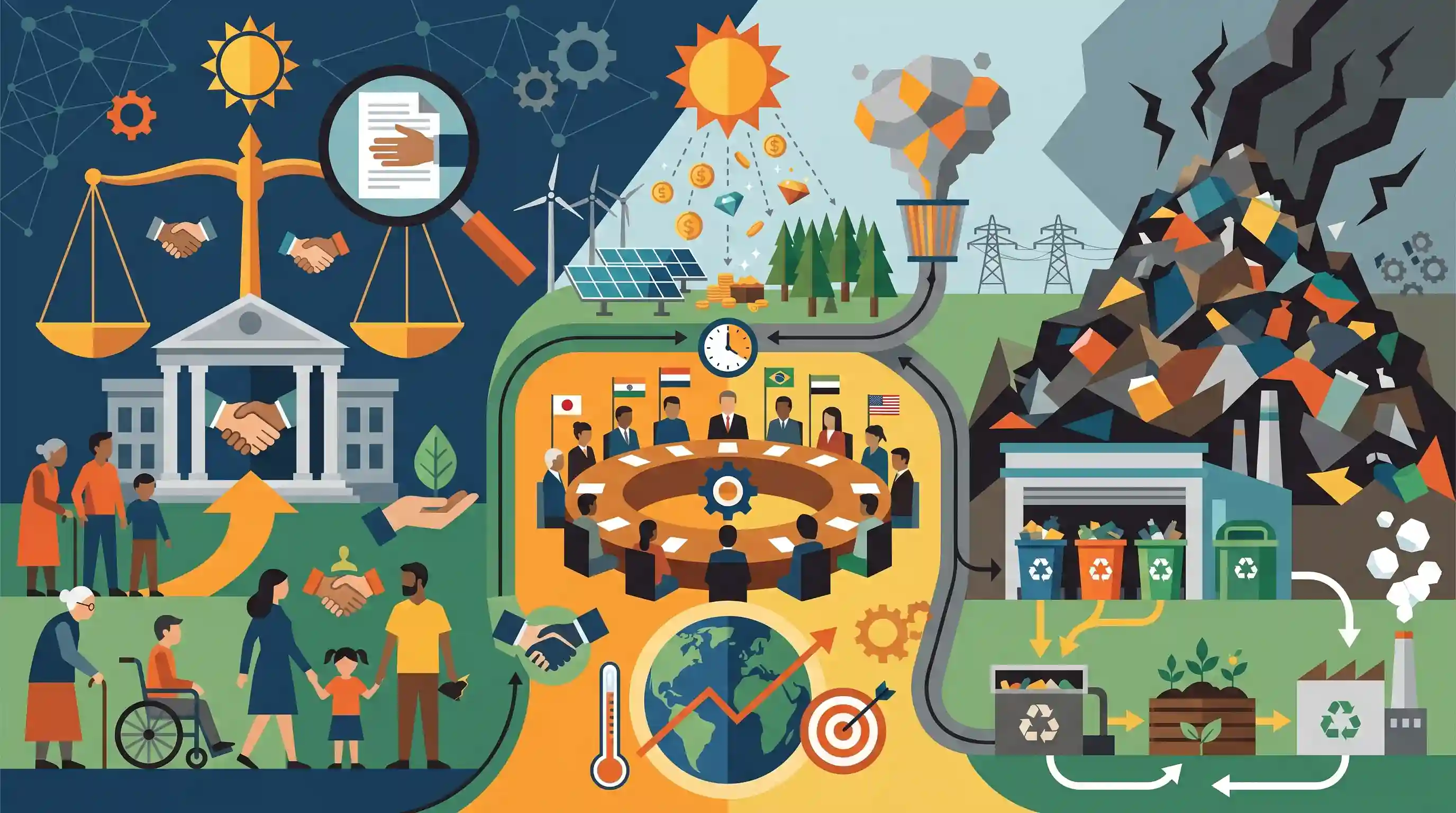
This UPSC-focused article highlights three pivotal issues: the significance of National Legal Services Day in promoting access to justice via NALSA, the global environmental agenda at the upcoming COP30 Leaders Summit concerning climate finance and emissions, and the pressing domestic challenge of urban landfills requiring sustainable solid waste management solutions.
Key Points
- National Legal Services Day commemorates the enactment of the Legal Services Authorities Act, 1987, which established NALSA to provide free legal aid to weaker sections under Article 39A.
- The upcoming COP30 Leaders Summit under the UNFCCC framework will emphasize global climate commitments, focusing on enhanced Nationally Determined Contributions (NDCs) and critical climate finance for developing nations.
- Urban landfills pose significant environmental and health hazards in India, necessitating urgent action on solid waste management, legacy waste remediation, and the promotion of circular economy models as envisioned in the Swachh Bharat Mission.
Important Terms
National Legal Services Authority (NALSA)

A statutory body established under the Legal Services Authorities Act, 1987, to provide free legal aid to weaker sections and organize Lok Adalats for amicable dispute resolution.
UPSC context
GS Paper II (Polity & Governance). Tests knowledge of statutory bodies ensuring 'Access to Justice' and alternative dispute resolution (ADR) mechanisms.
Article 39A of the Constitution
A Directive Principle of State Policy (DPSP) added by the 42nd Amendment (1976), mandating the State to ensure equal justice and provide free legal aid to the disadvantaged.
UPSC context
GS Paper II (Polity). Essential for understanding the constitutional mandate for welfare and the intersection of DPSPs with fundamental rights.
UNFCCC (COP30)
The 1992 international treaty aimed at stabilizing greenhouse gas concentrations. COP30 (2025 in Brazil) focuses on updating Nationally Determined Contributions (NDCs) and securing climate finance.
UPSC context
GS Paper III (Environment & Climate Change). Tests global climate governance, India's international commitments, and North-South climate finance dynamics.
Legal Services Authorities Act, 1987
The legislative framework that gives a statutory base to legal aid programs in India and establishes the hierarchy of National, State, and District Legal Services Authorities.
UPSC context
GS Paper II (Governance). Tests understanding of the legal-institutional framework designed to protect vulnerable sections and reduce judicial pendency.
Swachh Bharat Mission (SBM-U)
A flagship national campaign; SBM-Urban 2.0 specifically targets 'Garbage-Free Cities' through scientific solid waste management, remediation of legacy landfills, and circular economy principles.
UPSC context
GS Paper III (Environmental Pollution/Waste Management). Tests knowledge of urban governance and sustainable solutions for India's growing landfill crisis.
State Legal Services Authorities (SLSAs)
Statutory bodies at the state level headed by the High Court Chief Justice, responsible for implementing NALSA’s policies and providing grassroots legal assistance.
UPSC context
GS Paper II (Polity). Relevant for understanding the decentralized implementation of justice and the role of the judiciary at the state level.
Prelims Trap
"Free legal aid under NALSA is provided to women, children, and SC/ST communities only if their income falls below a specified threshold."
Eligibility for women, children, SC/STs, industrial workmen, and trafficking victims is absolute under the 1987 Act. No income ceiling applies to these specific categories.
Static Concepts Connected
What is the constitutional framework and statutory backing for free legal aid in India?
- Article 39A: Added by the 42nd Amendment, it directs the State to provide free legal aid to ensure justice is not denied due to economic or other disabilities.
- Legal Services Authorities Act: Created NALSA, SLSAs, and DLSAs to implement legal aid programs and organize Lok Adalats for swift dispute resolution.
- Article 14 & 22(1): Obligate the State to ensure equality before the law and a legal system which promotes justice based on equal opportunity.
What are Biomining and Bioremediation in the context of legacy waste management?
- Bioremediation: The use of microbes to degrade toxic contaminants in soil or water into less toxic forms, accelerating natural decomposition in legacy landfills.
- Biomining: Excavating, treating, and segregating aged municipal solid waste to recover valuable resources (like Refuse Derived Fuel) and clear land for alternative uses.
Cross-Topic Patterns
NALSA and Lok Adalat synergy
NALSA's statutory framework isn't just about free counsel; it directly empowers Lok Adalats, linking fundamental rights to the broader judicial pendency crisis and alternative dispute resolution mechanisms.
NCQG vs historical emissions burden
The shift from the $100B target to the NCQG will be tested alongside the UNFCCC's Common But Differentiated Responsibilities (CBDR) principle, bridging climate diplomacy with environmental justice.
SBM-U 2.0 and the 74th Amendment
Achieving "Garbage-Free Status" via legacy waste biomining directly ties to the 12th Schedule (public health, sanitation) empowering Urban Local Bodies under the 74th Amendment.

Expect a 2026 Prelims multi-statement question pairing NALSA's absolute eligibility for women/SC/STs with the 42nd Amendment's Article 39A.
Linked PYQs · 4
Linked PYQs · 4
- 2013PrelimsGS1
With reference to National Legal Services Authority, consider the following statements : 1. Its objective is to provide free and competent legal services to the weaker sections of the society on the basis of equal opportunity. 2. It issues guidelines for the State Legal Services Authorities to implement the legal programmes and schemes throughout the country. Which of the statements given above is/are correct?
- 2020PrelimsGS1
In India, Legal Services Authorities provide free legal services to which of the following type of citizens? 1. Person with an annual income of less than ₹ 1,00,000 2. Transgender with an annual income of less than ₹ 2,00,000 3. Member of Other Backward Classes (OBC) with an annual income of less than ₹ 3,00,000 4. All Senior Citizens Select the correct answer using the code given below:
- 2021MainsGS3
Describe the major outcomes of the 26th session of the Conference of the Parties (COP) to the United Nations Framework Convention on Climate Change (UNFCCC). What are the commitments made by India in this conference?
- 2018MainsGS3
What are the impediments in disposing the huge quantities of discarded solid wastes which are continuously being generated? How do we remove safely the toxic wastes that have been accumulating in our habitable environment?
