UPSC Highlights on Kudavolai System and Cheetah Conservation
Source:Indian Express ↗
Why It Matters
Understanding ancient administrative systems provides historical context for democratic decentralization. Tracking flagship conservation projects like Project Cheetah is crucial for biodiversity topics, while monitoring major bilateral trade deals helps analyze shifts in the global economic order and their impact on India.
Summary
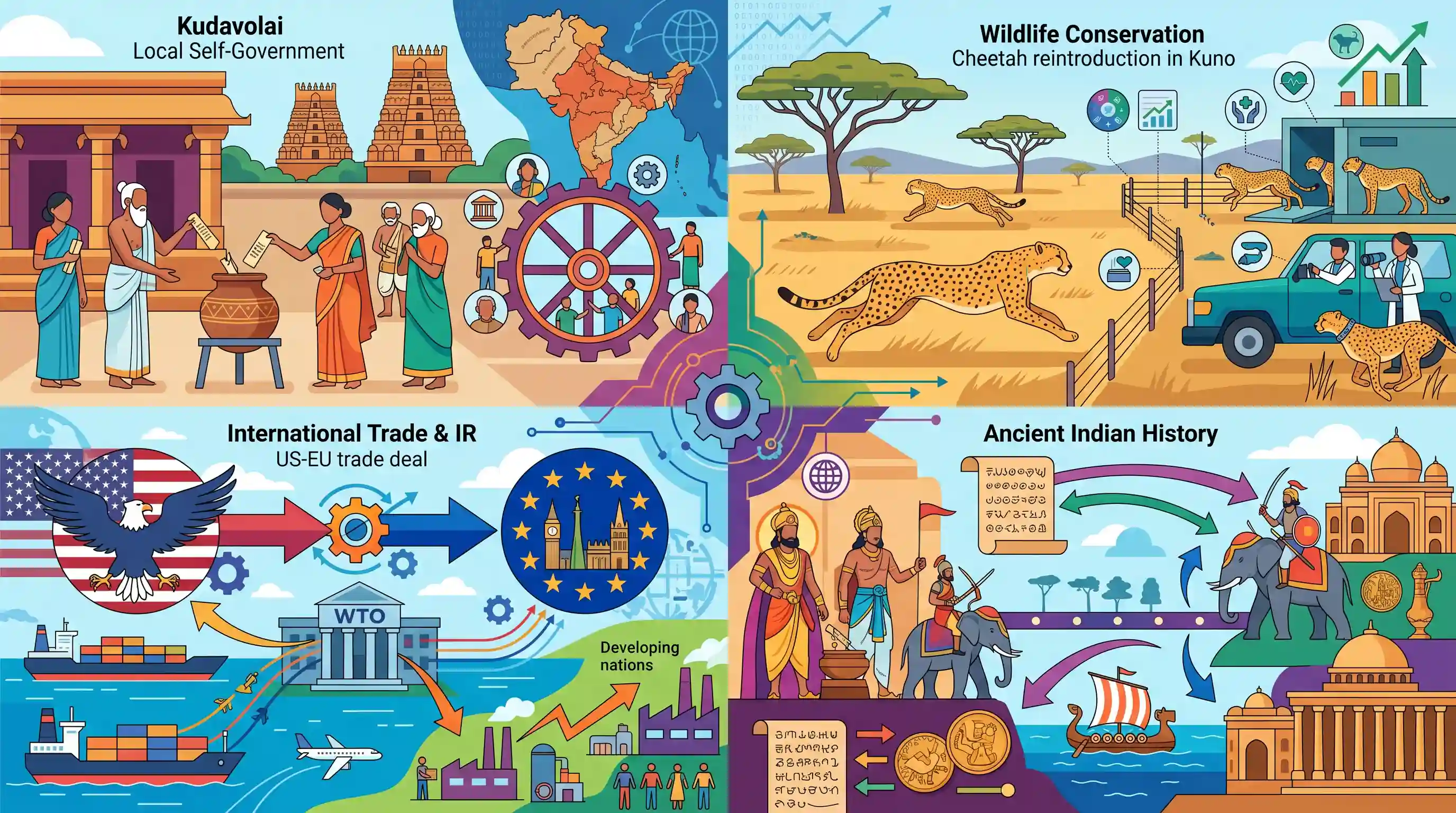
The article explores three diverse topics of relevance to civil services preparation. It delves into the Kudavolai system of the Cholas, highlighting ancient roots of democratic decentralization and local self-governance in India. On the environmental front, it discusses the reintroduction of Cheetahs in Kuno National Park, assessing the challenges and conservation dynamics of relocating apex predators. Finally, it analyzes the US-EU trade deal, examining its broader impact on international trade relations, the World Trade Organization (WTO), and the geopolitical positioning of developing countries.
Key Points
- The Kudavolai system of the Chola dynasty exemplifies ancient Indian practices of local self-government and democratic decentralization using a lot-drawing mechanism.
- The reintroduction of Cheetahs at Kuno National Park under Project Cheetah highlights the complexities of wildlife conservation, habitat adaptation, and translocating apex predators.
- Evolving US-EU trade agreements influence the global trade architecture and the WTO, presenting strategic and economic implications for developing nations like India.
Important Terms
Kudavolai System

An ancient Chola-era electoral method where candidates' names on palm leaves were placed in a pot and drawn by a child to select village assembly (Sabha) members.
UPSC context
GS Paper I (History); demonstrates ancient roots of local self-governance and democratic decentralization in India.
Project Cheetah
India’s flagship conservation initiative to reintroduce African cheetahs (extinct in India since 1952) into the wild, primarily at Kuno National Park, Madhya Pradesh.
UPSC context
GS Paper III (Environment/Biodiversity); tests understanding of species reintroduction challenges, habitat suitability, and conservation ethics.
U.S.-EU Trade and Technology Council (TTC)
A strategic forum established in 2021 to coordinate transatlantic approaches to global trade, economic, and technology issues, often influencing global standards and norms.
UPSC context
GS Paper II (International Relations); evaluates the impact of transatlantic partnerships on global trade governance and multilateralism.
World Trade Organization (WTO)
An international organization (est. 1995) that regulates global trade, provides a dispute settlement mechanism, and operates on the principle of non-discrimination (Most-Favored-Nation).
UPSC context
GS Paper II & III (IR/Economy); central to discussions on multilateralism, trade wars, and the interests of developing countries.
Chola Dynasty
A powerful South Indian dynasty (9th-13th century) renowned for its maritime empire, temple architecture, and highly sophisticated system of autonomous local administration.
UPSC context
GS Paper I (History/Culture); a frequent topic regarding administrative excellence, naval power, and village-level institutions.
Kuno National Park
A protected area in Madhya Pradesh selected as the primary site for Project Cheetah due to its suitable habitat and prey base for large carnivores.
UPSC context
GS Paper III (Environment); significant for wildlife management, inter-species competition (leopards/cheetahs), and eco-restoration projects.
Prelims Trap
The Kudavolai system was a democratic election based on universal adult franchise.
The system had strict exclusionary criteria, including property ownership, age (35-70), and Vedic knowledge. It was a lottery among eligible elites, not universal suffrage.
Static Concepts Connected
What were the key eligibility criteria for the Chola Kudavolai system?
- Age & Property: Candidates had to be aged 35 to 70, own tax-paying land, and possess a house built on their own legally owned site.
- Vedic Knowledge: Candidates required proficiency in the Vedas and Mantrabrahmana to ensure an educated administration.
- Strict Disqualification: Those failing to submit past committee accounts, or guilty of the five great sins, were barred for life.
How does the WTO's Most-Favored-Nation (MFN) principle operate under GATT?
- Core Rule: Under GATT Article I, any trade concession granted to one country must immediately and unconditionally be extended to all other WTO members.
- Allowed Exceptions: Free Trade Agreements (FTAs), customs unions, and preferential tariff treatment for developing nations are permitted exceptions to the MFN rule.
Cross-Topic Patterns
Chola Sabhas + 73rd Amendment
Mains answers on local self-governance fetch bonus marks by tracing democratic roots from the modern 73rd Amendment back to the village assemblies described in Chola Uthiramerur inscriptions.
Apex predators + Grassland ecology
Project Cheetah goes beyond species recovery; UPSC tests this as an umbrella ecological intervention aimed at restoring heavily degraded dry-deciduous and open grassland biomes in central India.
Bilateral deals + WTO paralysis
The rise of exclusive US-EU trade pacts bypassing the MFN principle highlights the broader crisis of WTO irrelevance, heavily impacting the strategic trade positioning of developing economies like India.

Expect a multi-statement Prelims 2026 question mixing the Chola Uthiramerur inscription's strict eligibility with modern Panchayat rules.
Linked PYQs · 4
Linked PYQs · 4
- 2017PrelimsGS1
Local self-government can be best explained as an exercise in
- 2017PrelimsGS1
Recently there was a proposal to translocate some of the lions from their natural habitat in Gujarat to which one of the following sites?
- 2018PrelimsGS1
The term "sixth mass extinction/sixth extinction" is often mentioned in the news in the context of the discussion of
- 2016MainsGS2
The broader aims and objectives of WTO are to manage and promote international trade in the era of globalization. But the Doha round of negotiations seem doomed due to differences between the developed and the developing countries." Discuss in the Indian perspective.
