Ken Betwa Link Project and Chabahar Port Strategic Significance
Source:Indian Express ↗
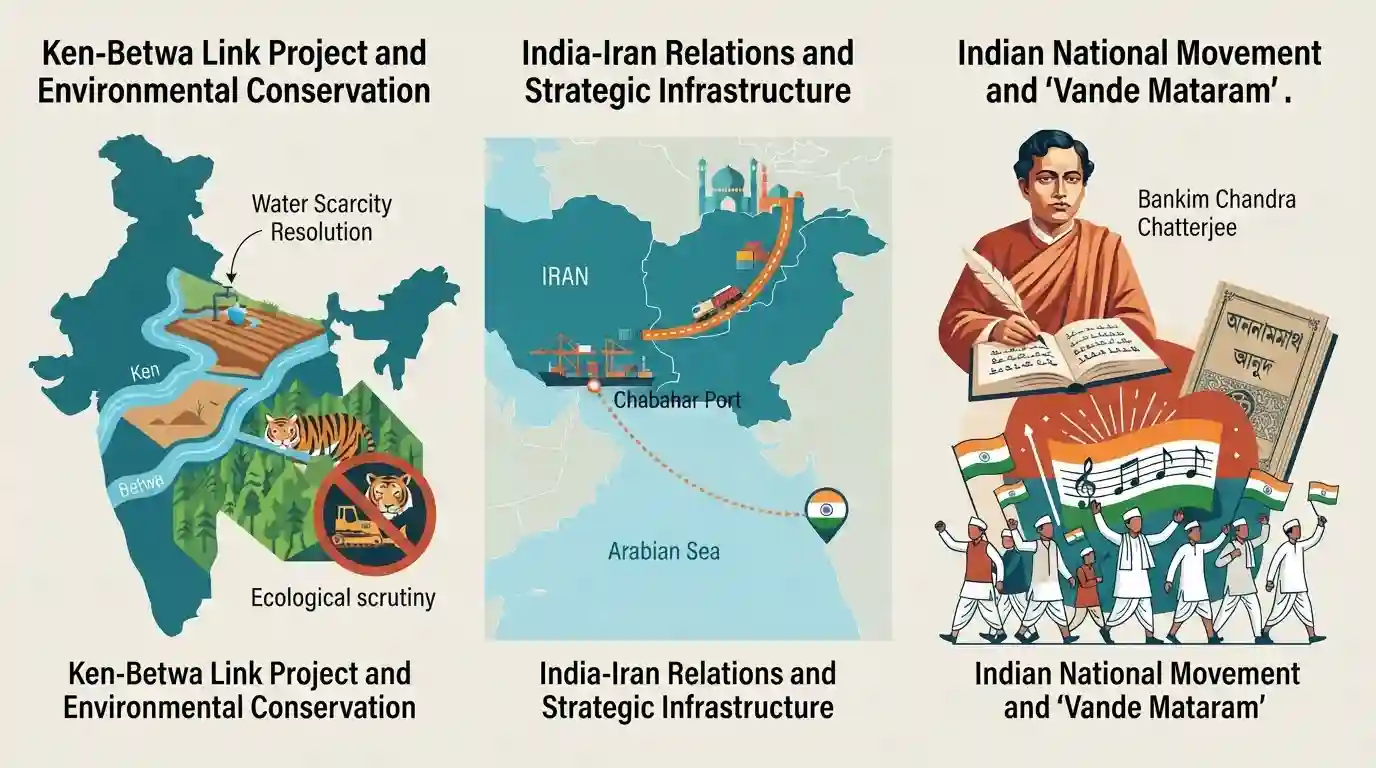
Why It Matters
It integrates core syllabus themes across multiple papers: the classic development versus environment debate (river linking vs. tiger reserves), India's geopolitical imperatives for regional connectivity (Chabahar), and factual historical facets of national symbols crucial for Prelims.
Summary
The article covers three essential UPSC topics spanning geography, international relations, and modern Indian history. The Ken-Betwa Link Project, India's first major river interlinking initiative under the National Perspective Plan, is designed to resolve water scarcity in the Bundelkhand region but faces ecological scrutiny over its impact on the Panna Tiger Reserve. Geopolitically, the development of Iran's Chabahar Port highlights India's strategic push to secure alternative trade routes to Afghanistan and Central Asia via the International North-South Transport Corridor (INSTC). Historically, the piece revisits the legacy of the National Song 'Vande Mataram', noting its origins in Bankim Chandra Chatterjee's Anandamath and its galvanizing role during the Swadeshi movement.
Key Points
- The Ken-Betwa Link Project aims to transfer surplus water from the Ken river in Madhya Pradesh to the Betwa river in Uttar Pradesh to alleviate water scarcity in the drought-prone Bundelkhand region.
- Environmental concerns remain regarding the Ken-Betwa project, particularly the submergence of critical tiger habitat within the Panna Tiger Reserve.
- Chabahar Port in Iran provides India with vital strategic and commercial access to Afghanistan and Central Asia, effectively bypassing Pakistan and serving as a gateway to the INSTC.
- Vande Mataram, composed by Bankim Chandra Chatterjee in his 1882 novel Anandamath, holds equal status with the National Anthem and played a profound role in mobilizing the Indian freedom struggle.
Important Terms
Ken-Betwa Link Project

India's first river-interlinking project, designed to transfer surplus water from the Ken River in Madhya Pradesh to the Betwa River in Uttar Pradesh, aiming to irrigate the drought-prone Bundelkhand region.
UPSC context
GS Paper I (Geography) and GS Paper III (Environment); tests knowledge of water resource management, irrigation, and ecological conservation.
National Perspective Plan
Formulated in 1980 by the Ministry of Irrigation (now Jal Shakti), this plan outlines the inter-basin transfer of water from surplus to deficit basins through Peninsular and Himalayan river-linking components.
UPSC context
GS Paper III (Infrastructure & Water Security); tests knowledge of long-term national planning, river-linking frameworks, and water resource management policies.
International North-South Transport Corridor (INSTC)
A 7,200-km multi-modal transportation network of ship, rail, and road routes established in 2000 by India, Iran, and Russia to facilitate trade between India, Central Asia, and Russia.
UPSC context
GS Paper II (International Relations & Strategic Infrastructure); tests understanding of regional connectivity, trade routes, and India’s foreign policy initiatives.
Constituent Assembly
A sovereign, partly elected and partly nominated body established in 1946 under the Cabinet Mission Plan to draft and formulate the Constitution of independent India.
UPSC context
GS Paper II (Indian Polity & Constitution); tests historical understanding of constitution-making, key administrative debates, and foundational democratic principles.
Indian National Congress
Founded in 1885 by Allan Octavian Hume, this political organization evolved from a moderate reform platform into the main vehicle leading India's struggle for independence from British rule.
UPSC context
GS Paper I (Modern Indian History); tests understanding of the national movement, leadership phases, and major freedom struggles.
Prelims Trap
Chabahar is India's first deep-water port project located within the Persian Gulf.
Chabahar is located on the Makran coast along the Gulf of Oman, outside the Persian Gulf, meaning it bypasses the geopolitical choke points of the Strait of Hormuz.
Static Concepts Connected
What is the National Perspective Plan for water resources?
- Origin and Agency: Formulated in 1980 by the Ministry of Water Resources to transfer water from surplus to deficit basins.
- Two Components: Consists of the Himalayan Rivers Development component and the Peninsular Rivers Development component.
- Ken-Betwa Status: It is the first major interlinking project taken up under the Peninsular component.
What was the Sannyasi Rebellion of 1763-1800?
- Primary Triggers: Sparked by the devastating 1770 Bengal famine and British restrictions on pilgrims visiting holy sites.
- Key Leaders: Led by religious mendicants, displaced peasants, and demobilized soldiers, including Majnum Shah and Bhawani Pathak.
- Literary Connection: Served as the historical backdrop for Bankim Chandra Chatterjee’s nationalistic 1882 novel, Anandamath.
Cross-Topic Patterns
Infrastructure versus Environmental Jurisprudence
Ken-Betwa’s clearance faces legal tests under the Wildlife Protection Act, balancing developmental utility against ecological damage in critical tiger habitats.
Chabahar and the IMEC alternative
While IMEC offers a route to Europe via West Asia, Chabahar and INSTC secure India's independent bypass route to Central Asia and Russia.

Chabahar’s location on the Gulf of Oman versus the Persian Gulf is highly likely to be tested in a multi-statement mapping question.
Linked PYQs · 5
Linked PYQs · 5
- 2017MainsGS3
Not many years ago, river linking was a concept but it is becoming a reality in the country. Discuss the advantages of river linking and its possible impact on the environment.
- 2019MainsGS3
Elaborate the impact of National Watershed Project in increasing agricultural production from water-stressed areas.
- 2024MainsGS2
Critically analyse India's evolving diplomatic, economic and strategic relations with the Central Asian Republics (CARs) highlighting their increasing significance in regional and global geopolitics.
- 2025MainsGS2
"Energy security constitutes the dominant kingpin of India's foreign policy, and is linked with India's overarching influence in Middle Eastern countries.” How would you integrate energy security with India's foreign policy trajectories in the coming years?
- 2003PrelimsGS1
Which one of the following statements is correct?
