Maritime Law Jurisdiction Pediatric Oncology and School Curriculum
Source:Indian Express ↗
Why It Matters
This compilation highlights the intersection of international maritime law with energy security, urgent public healthcare reforms needed for vulnerable demographics, and foundational education policies. These are all core syllabus areas across IR and Social Justice in GS Paper 2.
Summary
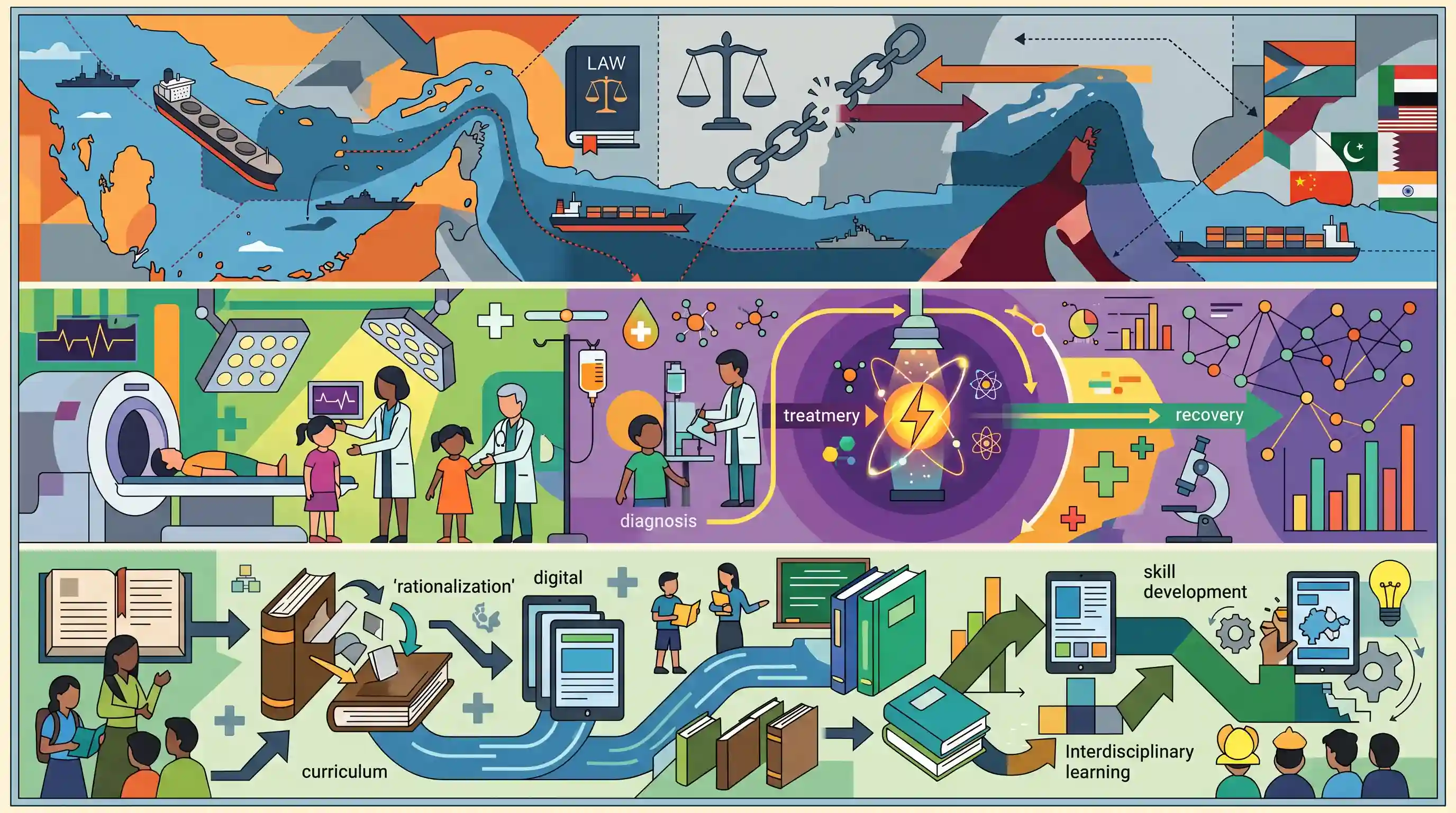
The article covers three diverse UPSC current affairs themes: the geopolitical and legal complexities of jurisdiction over the Strait of Hormuz under international maritime law (UNCLOS), the growing public health challenge of childhood cancers demanding specialized healthcare interventions, and the evolving educational landscape driven by NCERT's textbook rationalization and curriculum restructuring in line with NEP 2020.
Key Points
- The Strait of Hormuz acts as a critical geopolitical maritime chokepoint, with jurisdiction and navigation rights deeply intertwined with UNCLOS provisions on transit passage and territorial waters.
- The rising incidence and unique challenges of childhood cancers require enhanced focus from the state to build specialized pediatric oncology infrastructure and make treatments accessible within the public healthcare system.
- NCERT's ongoing syllabus rationalization and curriculum restructuring are crucial steps toward implementing the vision of the National Education Policy (NEP) 2020.
Important Terms
UNCLOS (United Nations Convention on the Law of the Sea)

An international treaty adopted in 1982 that establishes a comprehensive legal framework for ocean governance, defining maritime zones like Territorial Seas and Exclusive Economic Zones (EEZ) while balancing coastal sovereignty with navigational freedoms.
UPSC context
GS Paper II/International Relations; essential for understanding maritime disputes, freedom of navigation, and India's maritime strategy.
National Education Policy (NEP) 2020
A landmark 2020 policy aiming to transform India's education system into a holistic, flexible, and multidisciplinary structure, replacing the 1986 policy and introducing a 5+3+3+4 pedagogical framework.
UPSC context
GS Paper II/Social Justice; tests knowledge of educational reforms, governance, and human resource development in India.
NCERT
An autonomous government organization established in 1961 to provide academic support and publish textbooks for school education, currently spearheading textbook rationalization and curriculum updates under the NEP.
UPSC context
GS Paper II/Social Sector; relevant for understanding institutional roles in implementing national educational standards and curriculum reforms.
National Curriculum Framework (NCF)
A guiding document issued by NCERT that outlines the goals and principles for curriculum and teaching; NCF 2023 is specifically designed to implement the vision of NEP 2020.
UPSC context
GS Paper II/Education; tests awareness of pedagogical shifts, standardized learning outcomes, and implementation strategies of the NEP.
World Health Organization (WHO)
A specialized UN agency established in 1948 responsible for international public health, coordinating global disease response, setting health standards, and supporting member states in strengthening healthcare systems.
UPSC context
GS Paper II/Health; critical for topics on global health governance, disease management, and international health organizations.
International Maritime Organization (IMO)
A UN specialized agency responsible for regulating international shipping, ensuring safety at sea, preventing marine pollution from ships, and establishing global standards for maritime security.
UPSC context
GS Paper II/International Relations; relevant for maritime security, international trade routes, and environmental protection of oceans.
Prelims Trap
"Navigation through the Strait of Hormuz is governed by innocent passage, which bordering states can suspend."
The Strait falls under the 'transit passage' regime (non-suspendable), not 'innocent passage' (suspendable), due to overlapping territorial waters at a critical international chokepoint.
Static Concepts Connected
What is the difference between Innocent Passage and Transit Passage under UNCLOS?
- Innocent Passage: Applies to standard territorial waters; coastal states can temporarily suspend it for security reasons.
- Transit Passage: Applies to straits used for international navigation; guarantees continuous, non-suspendable navigation rights for all ships.
- Submarine Rules: Submarines must navigate on the surface during innocent passage, but may travel submerged during transit passage.
What are the key curricular shifts mandated by the NCF under NEP 2020?
- Pedagogical Structure: Shifts from the traditional 10+2 system to a 5+3+3+4 design covering ages 3 to 18.
- Language Policy: Mandates a three-language formula for Classes 9 and 10, requiring at least two native Indian languages.
- Assessment Focus: Moves away from rote memorization toward competency-based assessments and continuous formative evaluations.
Cross-Topic Patterns
Strait of Hormuz + India's Energy Security
Over 60% of India's crude oil imports transit the Strait of Hormuz. UNCLOS jurisdiction disputes here directly threaten India's macroeconomic stability, linking maritime law to energy security.
Pediatric Oncology + Health Marketisation
The lack of specialized pediatric oncology in NPCDCS forces severe out-of-pocket expenditure, highlighting the broader tension between DPSP public health mandates and private healthcare marketisation.

Expect a paired-geography question mapping West Asian straits (Hormuz, Bab-el-Mandeb) against UNCLOS passage regimes in Prelims 2026.
Linked PYQs · 4
Linked PYQs · 4
- 2024MainsGS2
In a crucial domain like the public healthcare system the Indian State should play a vital role to contain the adverse impact of marketisation of the system. Suggest some measures through which the State can enhance the reach of public healthcare at the grassroots level.
- 2020MainsGS2
National Education Policy 2020 is in conformity with the Sustainable Development Goal-4 (2030). It intends to restructure and reorient education system in India. Critically examine the statement.
- 2023MainsGS2
‘Sea is an important Component of the Cosmos’ Discuss in the light of the above statement the role of the IMO (International Maritime Organisation) in protecting environment and enhancing maritime safety and security.
- 2024PrelimsGS1
Consider the following statements : Statement-I : Sumed pipeline is a strategic route for Persian Gulf oil and natural gas shipments to Europe. Statement-II : Sumed pipeline connects the Red Sea with the Mediterranean Sea. Which one of the following is correct in respect of the above statements?
