India US Strategic Partnership and Nuclear Arms Control
Source:Indian Express ↗
Why It Matters
The topics represent a blend of India's strategic foreign policy, global nuclear security dynamics, and essential technological advancements needed to combat climate change, all of which are core areas in the UPSC syllabus across GS Paper 2 and GS Paper 3.
Summary
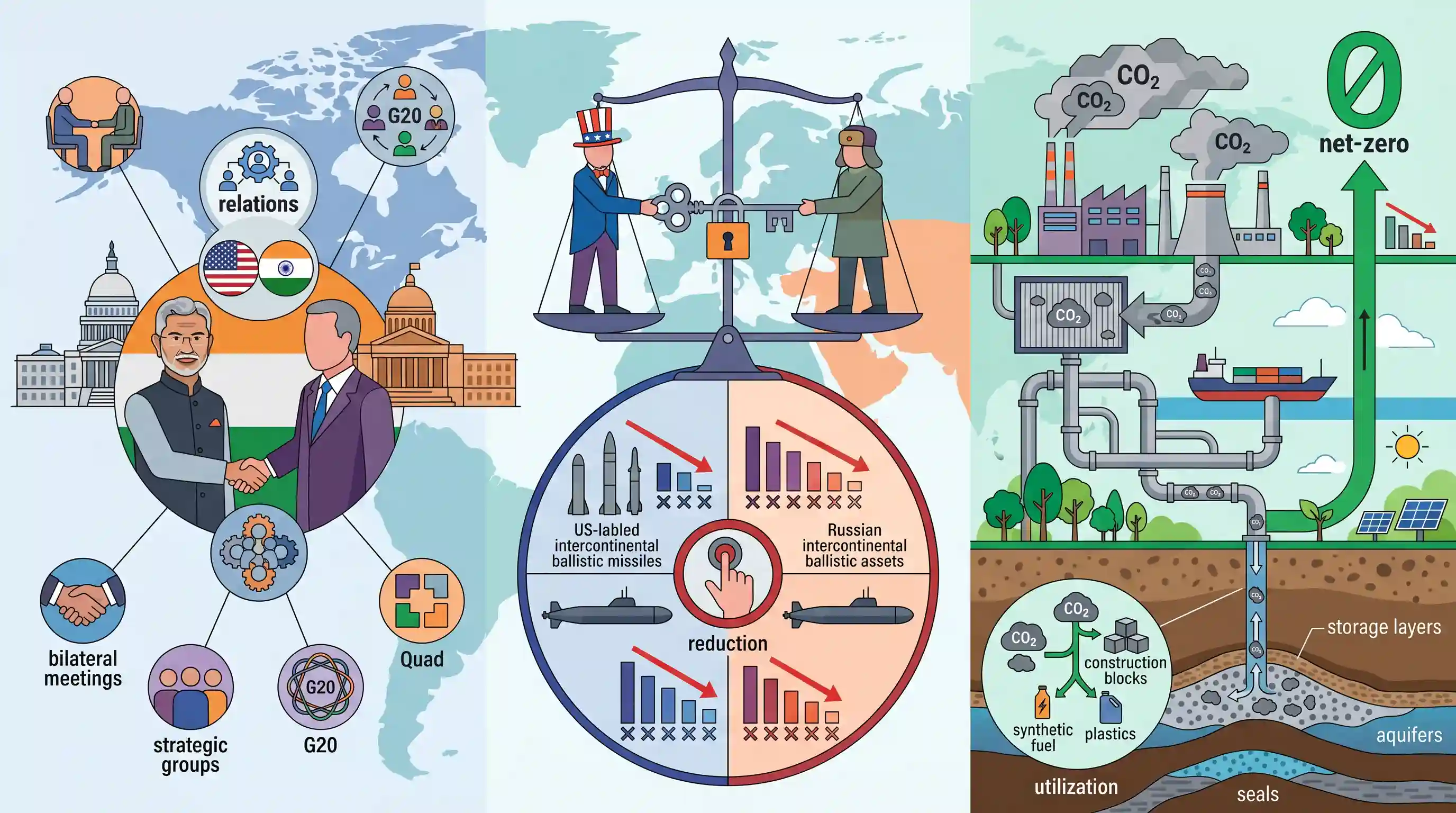
The article explores three major themes relevant to current affairs: international diplomacy, global security, and environmental technology. It covers External Affairs Minister S. Jaishankar's diplomatic engagements in Washington, highlighting the strengthening of India-US bilateral ties. It discusses the New START Treaty, underscoring its significance as a crucial nuclear arms control agreement between the US and Russia. Finally, it delves into Carbon Capture, Utilization, and Storage (CCUS) technologies, emphasizing their vital role in global efforts to mitigate climate change and achieve net-zero emission goals.
Key Points
- External Affairs Minister S. Jaishankar\'s talks in Washington reflect the ongoing deepening of the India-US Comprehensive Global Strategic Partnership.
- The New START Treaty is a pivotal bilateral nuclear arms reduction agreement between the United States and Russia, aimed at limiting the number of deployed strategic nuclear warheads.
- Carbon Capture, Utilization, and Storage (CCUS) technologies are critical for mitigating climate change by preventing CO2 emissions from entering the atmosphere and aiding in the transition to net-zero emissions.
Important Terms
New START Treaty

A bilateral nuclear arms reduction treaty between the US and Russia limiting deployed strategic warheads to 1,550. It includes rigorous verification measures like on-site inspections and data exchanges.
UPSC context
GS Paper II: International Relations. Tests knowledge of global security architectures and major treaties impacting strategic stability.
Carbon Capture, Utilization, and Storage (CCUS)
A suite of technologies that capture CO2 emissions from industrial sources (like power plants) to be either reused in manufacturing or permanently stored in deep geological formations.
UPSC context
GS Paper III: Environment & S&T. Tests understanding of climate mitigation technologies and India's transition to cleaner energy.
Net-Zero Emissions
A state where a country’s greenhouse gas emissions are perfectly balanced by the removal of an equivalent amount from the atmosphere through carbon sinks or technology.
UPSC context
GS Paper III: Environment. Tests awareness of international climate commitments (Paris Agreement) and India’s specific 2070 target.
Nuclear Arms Control
International efforts and agreements (like NPT or START) intended to limit the development, testing, deployment, and use of nuclear weapons to prevent global conflict.
UPSC context
GS Paper II: International Relations. Vital for questions on disarmament, global security, and India’s 'No First Use' doctrine.
India-US Bilateral Relations
The comprehensive strategic partnership between India and the US, covering defense (iCET), trade, and climate technology, shaped by shared democratic values and regional security interests.
UPSC context
GS Paper II: International Relations. A core syllabus topic testing the evolution of 'natural' alliances and strategic autonomy.
Prelims Trap
"The New START Treaty limits both strategic and tactical nuclear arsenals across the P5 nuclear-weapon states."
The treaty was strictly bilateral between the US and Russia. Crucially, it only capped deployed *strategic* nuclear weapons (long-range), leaving smaller *tactical* nuclear weapons completely unrestricted.
Static Concepts Connected
What are the 4 foundational defense agreements between India and the US?
- GSOMIA (2002): Facilitates the sharing of classified military information and intelligence between the two nations.
- LEMOA (2016): Allows both militaries to access each other's designated facilities for logistics, refueling, and replenishment.
- COMCASA (2018): Enables the transfer of highly secure encrypted communications equipment to India's military platforms for interoperability.
- BECA (2020): Permits the sharing of unclassified geospatial intelligence, nautical charts, and aeronautical data for precision targeting.
How is captured carbon 'utilized' in CCUS technologies?
- Industrial Chemicals: Captured CO2 serves as a direct raw material to synthesize methanol, urea fertilizers, and various synthetic polymers.
- Enhanced Oil Recovery: CO2 is injected into aging oil wells to increase pressure, effectively extracting residual crude oil while trapping the gas underground.
- Building Materials: CO2 is used in the curing process of concrete, permanently sequestering the gas while improving the structural integrity of the material.
Cross-Topic Patterns
Collapse of the global nuclear architecture
The 2026 expiry of New START joins the demise of the INF Treaty and Open Skies Treaty, raising alarms over unchecked nuclear proliferation and a renewed global arms race.
iCET and green tech synergy
Recent India-US diplomatic engagements frequently merge defense priorities with the Initiative on Critical and Emerging Technology (iCET), where clean tech like CCUS is a rising pillar of cooperation.

With New START's 2026 expiry, expect a Prelims matching question on nuclear arms treaties (NPT, CTBT, START, INF) and their signatories.
Linked PYQs · 3
Linked PYQs · 3
- 2011PrelimsGS1
The "New START" treaty was in the news. What is this treaty?
- 2025MainsGS3
What is Carbon Capture, Utilization and Storage (CCUS)? What is the potential role of CCUS in tackling climate change?
- 2023MainsGS2
‘The expansion and strengthening of NATO and a stronger US-Europe strategic partnership works well for India.’ What is your opinion about this statement ? Give reasons and examples to support your answer.
