Bilateral diplomacy and carbon capture technologies for sustainability
Source:Indian Express ↗
Why It Matters
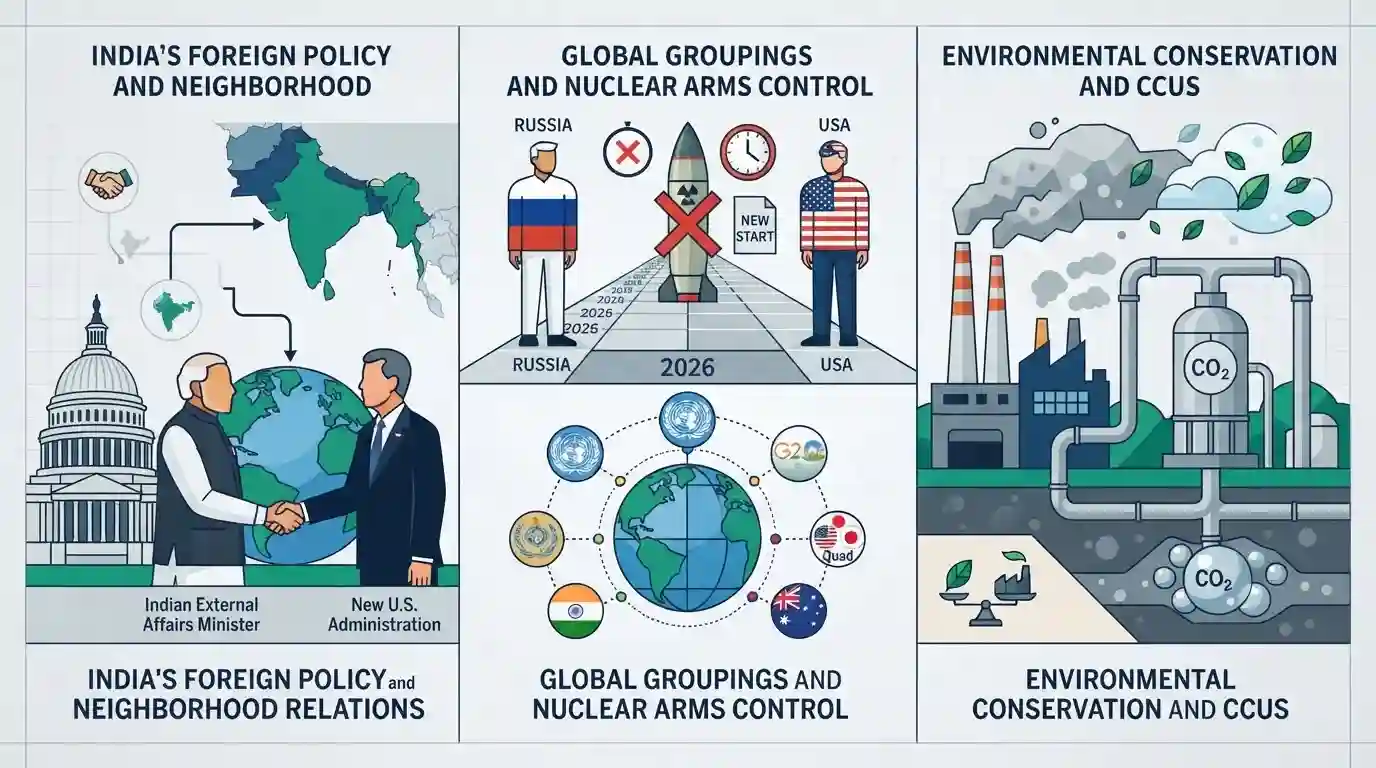
This article integrates core pillars of the UPSC syllabus: international diplomacy (transition in the US leadership and its impact on India), strategic security (threat of a nuclear arms race with the lapse of the New START), and scientific solutions to climate change (CCUS technology and its challenges).
Summary
The article covers key topics for UPSC preparation from February 2025, including S. Jaishankar's high-profile diplomatic visit to Washington D.C. under the new Trump administration, the strategic and geopolitical implications of the impending expiration of the New START Treaty between the USA and Russia, and the technology and policy dimensions of Carbon Capture, Utilization, and Storage (CCUS) as a tool for global decarbonization.
Key Points
- India-US Relations: External Affairs Minister S. Jaishankar visited Washington D.C. following the inauguration of the Trump 2.0 administration in early 2025 to discuss strategic partnerships, trade, defense, and the Initiative on Critical and Emerging Technology (iCET).
- New START Treaty: This bilateral nuclear arms control treaty between the US and Russia limits strategic nuclear warheads and delivery systems. With Russia suspending participation in 2023 and the treaty set to expire on February 5, 2026, the absence of a successor framework poses severe global security challenges.
- Carbon Capture, Utilization, and Storage (CCUS): CCUS is a critical suite of climate mitigation technologies to capture CO2 from point sources or the atmosphere (Direct Air Capture) and store or utilize it, which is essential to meet Net Zero goals in hard-to-abate sectors.
- CCUS Challenges: High upfront capital costs, substantial energy penalty, regulatory deficits, and the risks of geological storage leakage remain prominent barriers to large-scale deployment.
Important Terms
New START Treaty

The last remaining bilateral nuclear arms control agreement between the U.S. and Russia. It capped deployed strategic nuclear warheads and delivery systems, officially expiring on February 5, 2026.
UPSC context
GS Paper II (International Relations). Tests understanding of global nuclear disarmament, bilateral treaties, and international geopolitical stability.
Initiative on Critical and Emerging Technology (iCET)
A strategic bilateral framework launched in 2022 by India and the U.S. to foster cooperation in critical technology areas like AI, quantum computing, and semiconductors, upgraded to the TRUST framework in February 2025.
UPSC context
GS Paper II (Bilateral Relations, India-US). Tests knowledge of strategic technology partnerships and supply chain resilience.
Carbon Capture, Utilization, and Storage (CCUS)
A set of technologies designed to capture carbon dioxide emissions from industrial sources, transport them, and either permanently store them underground or convert them into useful commercial products.
UPSC context
GS Paper III (Environment, Climate Change). Tests understanding of technological solutions for carbon mitigation and achieving Net-Zero targets.
NITI Aayog
The premier policy think tank of the Government of India, established in 2015 to foster cooperative federalism and design strategic, long-term policy frameworks such as India's CCUS deployment guidelines.
UPSC context
GS Paper II (Governance) & GS Paper III (Economy). Tests understanding of institutional planning, federalism, and strategic national policies.
Ministry of External Affairs (MEA)
The Government of India ministry responsible for formulating and implementing the nation's foreign policy, managing diplomatic missions, and representing the country on global platforms.
UPSC context
GS Paper II (Bilateral & Global Groupings). Tests awareness of the institutional apparatus behind India's foreign policy and global diplomatic engagements.
Department of State (USA)
The executive department of the United States federal government responsible for leading foreign policy, representing the nation internationally, and managing diplomatic affairs.
UPSC context
GS Paper II (Bilateral Relations). Tests understanding of the administrative bodies driving foreign policy in key partner nations.
Prelims Trap
The New START Treaty capped the total stockpile of all nuclear warheads, including tactical and non-deployed weapons, held by the US and Russia.
The treaty strictly capped deployed strategic nuclear warheads (1,550 limit) and their delivery systems. It did not limit tactical (non-strategic) nuclear weapons or stockpile reserves.
Static Concepts Connected
What are the operational differences between Strategic and Tactical Nuclear Weapons?
- Strategic Weapons: Designed to target infrastructure, industrial bases, or cities far from the battlefield; they feature immense yields and are delivered via the strategic triad.
- Tactical Weapons: Intended for direct battlefield use to destroy troop concentrations or armored columns; they feature shorter ranges and lower yields, and are unregulated by New START.
- Verification Regime: Relied on intrusive on-site inspections, telemetric data exchanges, and National Technical Means (satellites) to verify compliance before its collapse.
What distinguishes Carbon Capture and Storage (CCS) from Carbon Capture, Utilization, and Storage (CCUS)?
- CCS objective: Focuses solely on capturing CO2 from point sources and permanently burying it in deep geological formations, such as saline aquifers or depleted fields, without reprocessing.
- CCUS objective: Goes beyond disposal to treat captured CO2 as a resource, converting it into commercial goods like e-fuels, building materials, chemicals, or food-grade gases.
- Economic viability: By generating marketable end-products, CCUS creates revenue streams that can offset the high capital and energy costs associated with carbon capture technologies.
Cross-Topic Patterns
Tech diplomacy + Strategic autonomy
The upgrade of iCET to TRUST highlights how India leverages high-tech partnerships with the US to boost domestic manufacturing while carefully maintaining its strategic autonomy and diversified defense imports.
Carbon utilization + Circular economy
Using captured carbon for synthetic e-fuels and industrial manufacturing links GS-3 environmental mitigation with industrial development, transforming a climate liability into a circular economy resource.

The lapse of New START and the US-India TRUST framework will likely feature in a 2026 GS-2 question on shifting global security balances.
Linked PYQs · 4
Linked PYQs · 4
- 2011PrelimsGS1
The "New START" treaty was in the news. What is this treaty?
- 2025MainsGS3
What is Carbon Capture, Utilization and Storage (CCUS)? What is the potential role of CCUS in tackling climate change?
- 2025PrelimsGS1
With reference to 'Direct Air Capture', an emerging technology, which of the following statements is/are correct? I. It can be used as a way of carbon sequestration. II. It can be a valuable approach for plastic production and in food processing. III. In aviation, it can be a source of carbon for combining with hydrogen to create synthetic low-carbon fuel. Select the correct answer using the code given below.
- 2023PrelimsGS1
Consider the following activities: 1. Spreading finely ground basalt rock on farmlands extensively 2. Increasing the alkalinity of oceans by adding lime 3. Capturing carbon dioxide released by various industries and pumping it into abandoned subterranean mines in the form of carbonated waters How many of the above activities are often considered and discussed for carbon capture and sequestration?
