Historical and Strategic Touchpoints in India Foreign Policy
Source:Indian Express ↗
Why It Matters
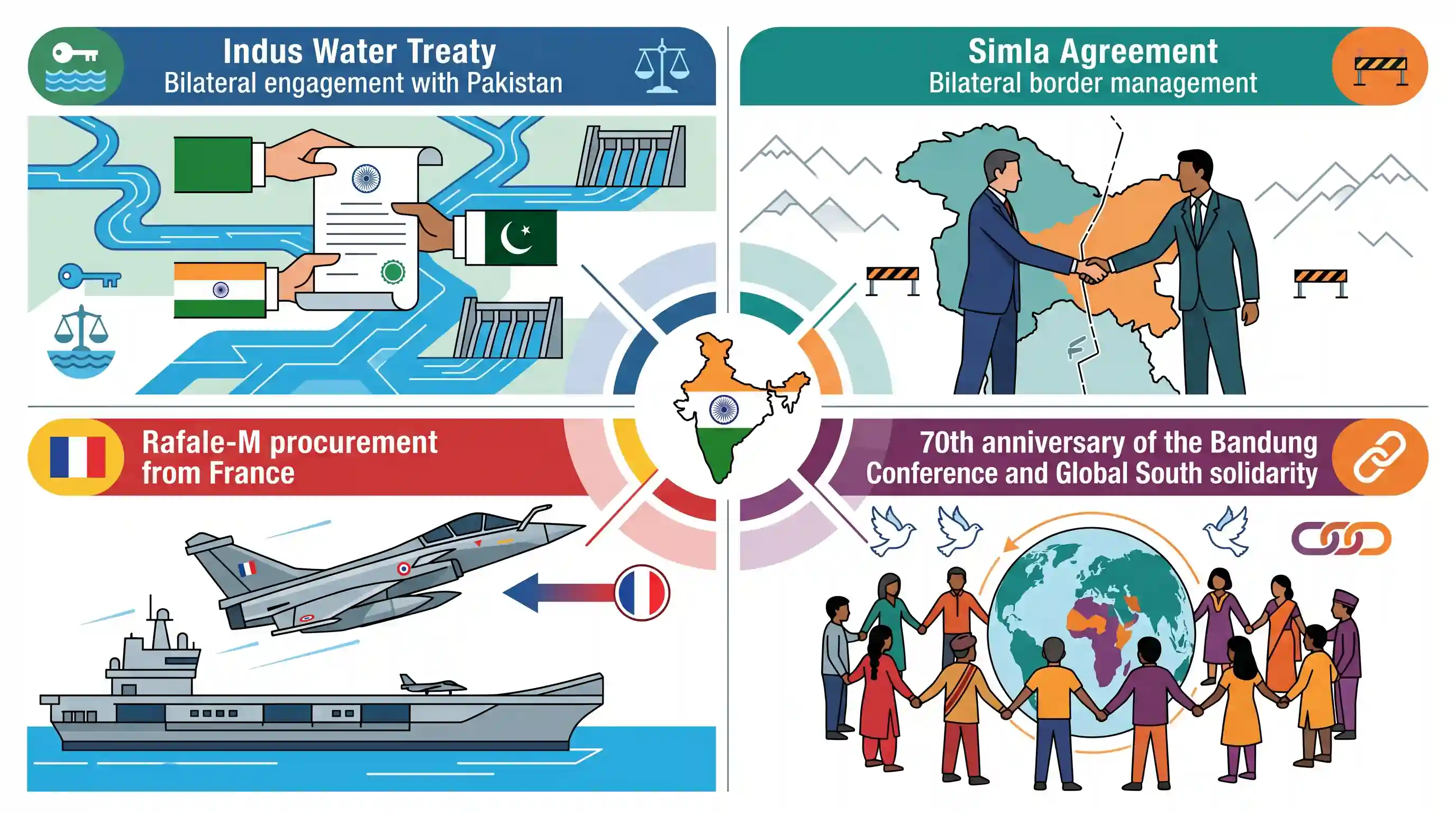
These topics are highly relevant for understanding the historical underpinnings of India's current foreign policy. The IWT and Simla Agreement are staple examples of bilateral dispute resolution mechanisms. The Rafale-M deal is a key defense modernization effort, while the Bandung anniversary provides necessary context for analyzing India's leadership role in the contemporary Global South.
Summary
The article outlines four major historical and strategic touchpoints critical to India's foreign policy and defense posture. It highlights the significance of the Indus Water Treaty and the Simla Agreement as defining pillars of bilateral engagement and water diplomacy with Pakistan. On the defense front, it discusses the Rafale-M procurement deal from France, underscoring its role in boosting the Indian Navy's maritime strike capabilities. Lastly, it reflects on the legacy of the 1955 Bandung Conference as it turns 70, celebrating its role in shaping Global South solidarity and the genesis of the Non-Aligned Movement.
Key Points
- The Indus Water Treaty (IWT) continues to serve as a pivotal framework for India-Pakistan water resource management, despite periodic frictions over hydroelectric project developments.
- The 1972 Simla Agreement cemented the principle of resolving disputes bilaterally between India and Pakistan following the 1971 war.
- The Indian Navy's acquisition of Rafale-M fighter jets from France is a strategic step to modernize its naval air arm and equip its aircraft carriers.
- The 70th anniversary of the 1955 Bandung Conference commemorates the foundational principles of Afro-Asian solidarity, which paved the way for the Non-Aligned Movement (NAM).
Important Terms
Indus Water Treaty (IWT)

A 1960 water-sharing pact between India and Pakistan brokered by the World Bank. It allocates the Eastern Rivers (Ravi, Beas, Sutlej) to India and Western Rivers (Indus, Jhelum, Chenab) to Pakistan.
UPSC context
GS Paper 2: International Relations; tests knowledge of transboundary water diplomacy and bilateral neighborhood relations.
Simla Agreement
A 1972 peace treaty between India and Pakistan following the 1971 War. It converted the ceasefire line into the Line of Control (LoC) and mandated bilateral resolution of disputes.
UPSC context
GS Paper 2: India and its neighborhood; critical for understanding India’s "bilateralism" stance on Jammu & Kashmir.
Panchsheel
The "Five Principles of Peaceful Coexistence" signed in 1954 between India and China. It emphasizes mutual respect for sovereignty, non-aggression, and non-interference in internal affairs.
UPSC context
GS Paper 2: International Relations; foundational for India’s foreign policy and the Non-Aligned Movement (NAM).
Non-Aligned Movement (NAM)
An organization of states, established in 1961, that chose not to formally align with either the US or USSR during the Cold War, focusing on sovereignty and decolonization.
UPSC context
GS Paper 2: Global groupings; relevant for India’s leadership in the Global South and multi-aligned foreign policy.
Bandung Conference
A 1955 meeting of 29 Asian and African nations in Indonesia. It promoted Afro-Asian economic and cultural cooperation and opposed colonialism, serving as a precursor to NAM.
UPSC context
GS Paper 1 (World History) & GS Paper 2; marks the genesis of South-South cooperation.
Rafale-M Deal
A naval variant of the French multi-role fighter jet by Dassault Aviation. India is procuring 26 units to enhance the maritime strike capabilities of aircraft carriers INS Vikrant and INS Vikramaditya.
UPSC context
GS Paper 3: Security & Defense; tests knowledge of maritime security and military modernization (Aatmanirbhar Bharat).
Dassault Aviation
A prominent French aerospace company and the manufacturer of the Rafale fighter jets. It is a key partner in India’s defense procurement and technology transfer (ToT) initiatives.
UPSC context
GS Paper 3: Internal Security; involves defense industrial base and strategic Inter-Governmental Agreements (IGA).
Prelims Trap
The Non-Aligned Movement (NAM) was officially established at the 1955 Bandung Conference.
Bandung (1955) was the Afro-Asian precursor that laid the diplomatic groundwork. NAM was formally founded six years later at the 1961 Belgrade Summit.
Static Concepts Connected
How are river waters allocated under the 1960 Indus Water Treaty?
- Eastern Rivers: Ravi, Beas, and Sutlej are allocated to India for unrestricted use.
- Western Rivers: Indus, Jhelum, and Chenab are allocated primarily to Pakistan.
- India's Western rights: India is permitted limited agricultural use and non-consumptive uses, including run-of-the-river hydroelectric projects, on the Western Rivers.
- World Bank role: The treaty was brokered and signed by the World Bank, which acts as a neutral third-party guarantor.
What were the core geopolitical outcomes of the 1972 Simla Agreement?
- Bilateralism principle: It established that all disputes between India and Pakistan must be resolved strictly through peaceful bilateral negotiations, rejecting third-party mediation.
- Line of Control: It formally converted the December 17, 1971 ceasefire line in Jammu and Kashmir into the Line of Control (LoC).
- POW release: It laid the diplomatic groundwork for the release of over 90,000 Pakistani prisoners of war captured during the 1971 Bangladesh Liberation War.
Cross-Topic Patterns
Bandung to modern Global South leadership
The 70th anniversary of Bandung provides historical context for India's recent diplomatic pivot toward championing the 'Voice of Global South' summits during and after its G20 presidency.
IWT disputes & Himalayan hydro-politics
Disputes over the IWT (e.g., Kishanganga, Ratle) frequently link bilateral diplomacy with India's internal renewable energy targets and the ecological fragility of Himalayan run-of-the-river dams.
Rafale-M synergy with INS Vikrant
The Rafale-M procurement connects imported strategic assets with the indigenization push, as these jets are specifically acquired to operationalize India's first indigenous aircraft carrier, INS Vikrant.

Expect a multi-statement prelims question confusing the Bandung (1955) and Belgrade (1961) origins of NAM, alongside Panchsheel.
Linked PYQs · 4
Linked PYQs · 4
- 2021PrelimsGS1
With reference to the Indus river system, of the following four rivers, three of them pour into one of them which joins the Indus direct. Among the following, which one is such river that joins the Indus direct?
- 2015MainsGS2
Terrorist activities and mutual distrust have clouded India-Pakistan relations. To what extent the use of soft power like sports and cultural exchanges could help generate goodwill between the two countries? Discuss with suitable examples.
- 2024PrelimsGS1
Consider the following aircraft : 1. Rafael 2. MiG-29 3. Tejas MK-1 How many of the above are considered fifth generation fighter aircraft?
- 2025MainsGS2
"With the waning of globalization, post-Cold War world is becoming a site of sovereign nationalism.” Elucidate.
