Key Geographical and Environmental Issues for UPSC
Source:Indian Express ↗
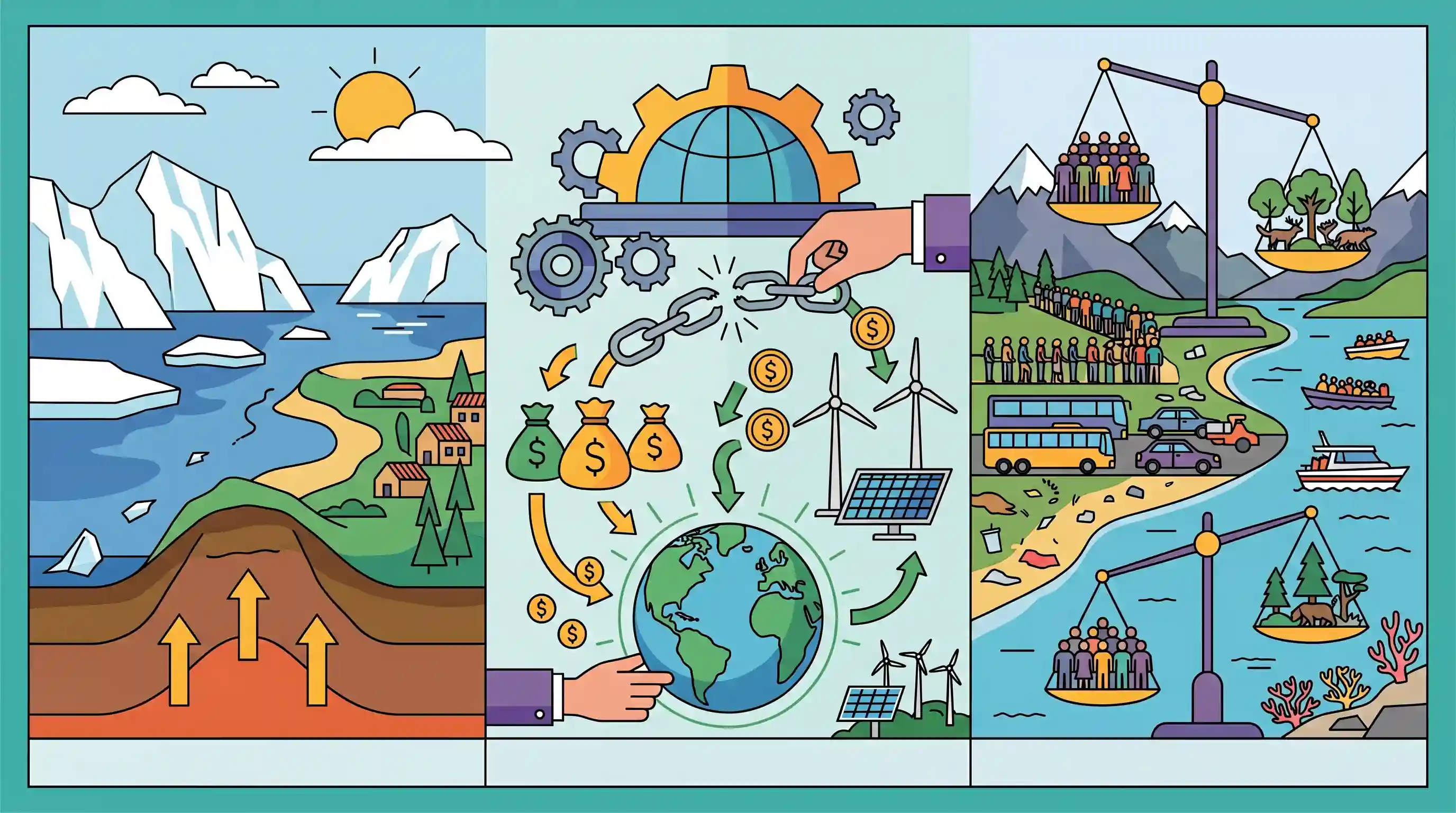
Why It Matters
Understanding isostatic rebound provides insight into the profound geological consequences of climate change. UNFCCC reforms are vital for global climate action and tracking commitments. The overtourism crisis is highly relevant to India's policy on sustainable development in ecologically fragile regions like the Himalayas, a recurring theme in UPSC exams.
Summary
The article highlights three critical geographical and environmental issues. First, it explains isostatic rebound—the geological uplift of landmasses triggered by massive glacial melting. Second, it delves into the pressing need for UNFCCC reforms to accelerate climate finance and enforce global commitments under the Paris Agreement. Finally, the piece addresses the growing crisis of overtourism, highlighting how unregulated footfall is breaching the ecological carrying capacity of vulnerable destinations.
Key Points
- Isostatic rebound is the geological process where Earth's crust rises after the heavy weight of glaciers and ice sheets is removed due to melting.
- Glacial melting redistributes mass globally, which not only causes sea-level rise but can also affect Earth's rotational axis and moment of inertia.
- Reforms in the United Nations Framework Convention on Climate Change (UNFCCC) are urgently needed to streamline negotiations, enhance climate finance access, and strictly enforce the Paris Agreement targets.
- Overtourism exceeds the ecological carrying capacity of tourist destinations, causing environmental degradation, water scarcity, and severe strain on local infrastructure.
- Promoting sustainable tourism and enforcing strict carrying capacity assessments are necessary to protect ecologically sensitive zones, such as the Himalayan region.
Important Terms
Isostatic Rebound

The gradual uplift of the Earth's crust following the removal of heavy loads, such as melting glaciers or eroded landmasses, to restore gravitational equilibrium.
UPSC context
GS Paper 1 (Geomorphology); tests concepts of isostasy, landform evolution, and its impact on mountain height and sea levels.
UNFCCC
An international treaty adopted in 1992 aimed at stabilizing greenhouse gas concentrations to prevent dangerous human interference with the climate system.
UPSC context
GS Paper 3 (Environment); focuses on global climate governance, annual COPs, and the principle of 'Common but Differentiated Responsibilities'.
Paris Agreement
A 2015 legally binding international treaty under the UNFCCC to limit global warming to well below 2°C, preferably 1.5°C, above pre-industrial levels.
UPSC context
GS Paper 3 (Environment); fundamental for questions on international climate treaties, mitigation, and global climate equity.
Nationally Determined Contributions (NDCs)
Self-determined climate action plans submitted every five years by countries under the Paris Agreement, outlining their specific emission reduction and adaptation targets.
UPSC context
GS Paper 3 (Environment); tests India's specific climate commitments (Panchamrit) and the effectiveness of bottom-up climate action.
Ecological Carrying Capacity
The maximum level of human activity or population that an ecosystem can sustain without undergoing long-term environmental degradation or resource depletion.
UPSC context
GS Paper 3 (Environment/Sustainable Development); relevant for analyzing overtourism, urban planning, and infrastructure in fragile regions like the Himalayas.
Climate Finance
Financial resources provided by developed countries to support climate mitigation and adaptation efforts in developing nations, recognizing varying capacities to address climate change.
UPSC context
GS Paper 3 (Environment/Economics); covers the North-South divide, global funds (GCF), and the $100 billion annual commitment.
Prelims Trap
Glacial melting redistributes mass from poles to the equator, which accelerates Earth's rotation and shortens the length of the day.
Mass moving from the poles to the equator increases Earth's moment of inertia. Like a spinning skater extending their arms, this actually slows down rotation.
Static Concepts Connected
What is Isostasy and Glacial Isostatic Rebound?
- Isostasy: The state of gravitational equilibrium between Earth's rigid lithosphere and the ductile, denser asthenosphere below it.
- Glacial Rebound: The localized geological uplift of the Earth's crust that occurs after the heavy weight of ice sheets or glaciers melts away.
- Rotational Impact: Global redistribution of mass (ice melting into oceans) alters Earth's moment of inertia, affecting its rotation speed and polar axis.
What is Ecological Carrying Capacity in the context of environment?
- Core Definition: The maximum population or tourist footprint a specific habitat can sustain indefinitely without degrading its natural resources or ecosystem services.
- Himalayan Context: Exceeding capacity leads to severe strain on local infrastructure, aquifer depletion, habitat fragmentation, and disasters like land subsidence.
- Policy Utility: It acts as a crucial policy tool for regulating unchecked urbanization and enforcing sustainable development in eco-sensitive zones.
Cross-Topic Patterns
Isostasy + Climate + Geophysics
Glacial melting intricately links geomorphology (crustal rebound) with geophysics by shifting Earth's mass, altering its moment of inertia, and slightly shifting its rotational axis.
Overtourism + Land Subsidence
The breach of ecological carrying capacity directly ties to disaster management, manifesting in extreme water stress and subsidence events in fragile zones like Joshimath.
UNFCCC Reforms + CBDR-RC
The push for structural UNFCCC reforms to scale climate finance highlights the ongoing struggle to operationalize Common But Differentiated Responsibilities (CBDR) via NDCs.

Expect a highly conceptual 2026 prelims question linking climate-induced glacial melt to changes in Earth's moment of inertia and day length.
Linked PYQs · 4
Linked PYQs · 4
- 2025PrelimsGS1
Consider the following statements : Statement I: Scientific studies suggest that a shift is taking place in the Earth's rotation and axis. Statement II: Solar flares and associated coronal mass ejections bombarded the Earth's outermost atmosphere with tremendous amount of energy. Statement III : As the Earth's polar ice melts, the water tends to move towards the equator. Which one of the following is correct in respect of the above statements?
- 2025MainsGS3
Write a review on India's climate commitments under the Paris Agreement (2015) and mention how these have been further strengthened in COP26 (2021). In this direction, how has the first Nationally Determined Contribution intended by India been updated in 2022?
- 2021MainsGS3
Describe the major outcomes of the 26th session of the Conference of the Parties (COP) to the United Nations Framework Convention on Climate Change (UNFCCC). What are the commitments made by India in this conference?
- 2015MainsGS1
The states of Jammu and Kashmir, Himachal Pradesh and Uttarakhand are reaching the limits of their ecological carrying capacity due to tourism. Critically evaluate.
