Iran Peace Plan CAPF Mandate and Constitutional Finance Bill Rules
Source:Indian Express ↗
Why It Matters
The distinction between legislative bills (Money vs. Finance) is a recurring theme in UPSC Prelims. Furthermore, Middle East geopolitics are central to India's foreign policy (GS2), and the mandate of CAPFs is vital for addressing internal security challenges (GS3).
Summary
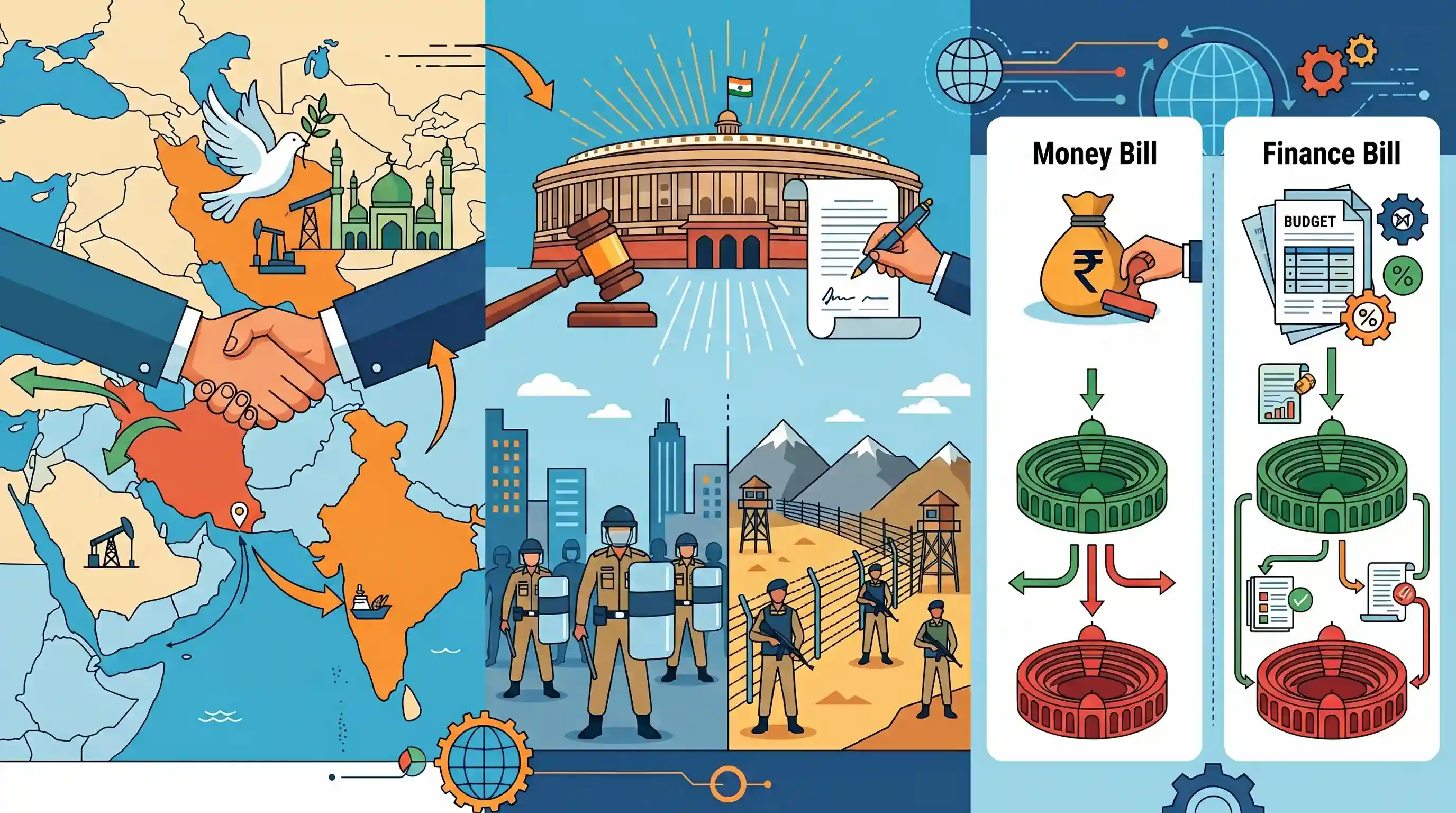
The article provides key insights for UPSC preparation covering three distinct subjects. Firstly, it discusses a proposed peace plan for Iran, highlighting its significance for Middle Eastern geopolitics and India's strategic interests. Secondly, it examines legislative developments regarding the Central Armed Police Forces (CAPF), focusing on operational roles in internal security and border management. Lastly, it details the nuances of the Finance Bill, drawing constitutional distinctions with the Money Bill and explaining the relevant parliamentary procedures in the Lok Sabha and Rajya Sabha.
Key Points
- The Iran peace plan holds significant implications for regional stability in the Middle East, directly impacting India's strategic interests and energy security.
- Reforming the Central Armed Police Forces (CAPF) through legislative means aims to enhance operational efficiency in tackling internal security and border management challenges.
- The Finance Bill is crucial for enacting the financial proposals of the Union Budget, and distinguishing it from a Money Bill (Article 110) is a core constitutional concept.
- While the Rajya Sabha possesses limited recommendatory powers regarding Money Bills, its jurisdiction over different categories of Finance Bills varies.
Important Terms
Finance Bill

A broader financial legislation (Article 117) dealing with taxation and expenditure. Unlike Money Bills, some types can be amended by Rajya Sabha and may require joint sittings.
UPSC context
GS Paper-2 (Polity); tests understanding of legislative procedures and constitutional distinctions between financial bills.
Money Bill
A specific financial bill (Article 110) certified by the Lok Sabha Speaker, dealing exclusively with taxation or government spending. Rajya Sabha cannot reject or amend it.
UPSC context
GS Paper-2 (Polity); fundamental concept regarding the Lok Sabha's supremacy in financial matters and Article 110.
CAPF Bill 2026
Proposed law to create a unified administrative framework for Group A officers across forces like BSF and CRPF, notably codifying IPS deputation quotas in senior ranks.
UPSC context
GS Paper-3 (Internal Security); relates to security force reforms and the debate over cadre management versus IPS leadership.
Central Armed Police Forces (CAPF)
Seven security forces (e.g., BSF, CRPF, CISF) under the Ministry of Home Affairs responsible for India's border management and internal security.
UPSC context
GS Paper-3 (Security); understanding the mandate and challenges of forces guarding borders and assisting in law and order.
Iran Peace Plan (2026)
A 15-point proposal submitted via Pakistan to resolve conflict, involving sanctions relief, nuclear rollbacks, and reopening the Strait of Hormuz to stabilize global oil prices.
UPSC context
GS Paper-2 (International Relations); significant for West Asian stability and India's energy security and strategic interests in the region.
IPS Deputation
The practice of assigning Indian Police Service officers to lead CAPFs. The 2026 Bill formalizes these quotas, despite cadre officers' concerns regarding promotion bottlenecks.
UPSC context
GS Paper-2 (Governance) & GS Paper-3; examines administrative friction and institutional autonomy within India's security architecture.
Prelims Trap
Rajya Sabha has no power to amend or reject a Finance Bill.
This is false. While Rajya Sabha cannot amend Money Bills, it has equal powers with the Lok Sabha to amend or reject a Finance Bill Category-II (Article 117(3)).
Static Concepts Connected
What is the constitutional difference between Finance Bill Category I and II?
- Category I (Art 117(1)): Contains Article 110 matters plus other legislation. Can only be introduced in Lok Sabha on the President's recommendation, but Rajya Sabha can amend/reject it.
- Category II (Art 117(3)): Contains provisions involving expenditure from the Consolidated Fund, but no Article 110 matters. Treated as an ordinary bill; Rajya Sabha has equal powers.
How is the mandate of India's Central Armed Police Forces (CAPFs) distributed?
- Border Guarding: BSF (Pakistan/Bangladesh), ITBP (China), SSB (Nepal/Bhutan), and Assam Rifles (Myanmar).
- Internal Security: CRPF handles riots and Left-Wing Extremism, CISF secures critical infrastructure and airports, and NSG is specialized for counter-terrorism.
- Dual Control Exception: Assam Rifles is unique—it functions administratively under the Ministry of Home Affairs but operationally under the Ministry of Defence (Indian Army).
Cross-Topic Patterns
CAPF deployment vs. State Autonomy
Deployment of central forces (like CRPF/BSF) in states often sparks federal friction (State List Entry 1 vs Article 355). UPSC frequently tests this intersection of security mandates and constitutional federalism.
Iran's stability & India's Energy Trilemma
Peace in Iran directly impacts crude oil pricing and the viability of the INSTC and Chabahar port, linking Middle East geopolitics directly to India's inflation targeting and energy security.

Expect a multi-statement prelims question distinguishing Finance Bill Types I/II and the Speaker’s discretionary powers on Money Bills.
Linked PYQs · 4
Linked PYQs · 4
- 2025MainsGS2
"Energy security constitutes the dominant kingpin of India's foreign policy, and is linked with India's overarching influence in Middle Eastern countries.” How would you integrate energy security with India's foreign policy trajectories in the coming years?
- 2020MainsGS3
Analyze internal security threats and transborder crimes along Myanmar, Bangladesh and Pakistan borders including Line of Control (LoC). Also discuss the role played by various security forces in this regard.
- 2023PrelimsGS1
With reference to Finance Bill and Money Bill in the Indian Parliament, consider the following statements: 1. When the Lok Sabha transmits Finance Bill to the Rajya Sabha, it can amend or reject the Bill. 2. When the Lok Sabha transmits Money Bill to the Rajya Sabha, it cannot amend or reject the Bill, it can only make recommendations. 3. In the case of disagreement between the Lok Sabha and the Rajya Sabha, there is no joint sitting for Money Bill, but a joint sitting becomes necessary for Finance Bill. How many of the above statements are correct?
- 2024PrelimsGS1
Which of the following statements are correct in respect of a Money Bill in the Parliament? 1. Article 109 mentions special procedure in respect of Money Bills. 2. A Money Bill shall not be introduced in the Council of States. 3. The Rajya Sabha can either approve the Bill or suggest changes but cannot reject it. 4. Amendments to a Money Bill suggested by the Rajya Sabha have to be accepted by the Lok Sabha. Select the answer using the code given below :
