समसामयिक मामलों में कराधान विसंगतियां और आंतरिक सुरक्षा चुनौतियां
स्रोत:इंडियन एक्सप्रेस ↗
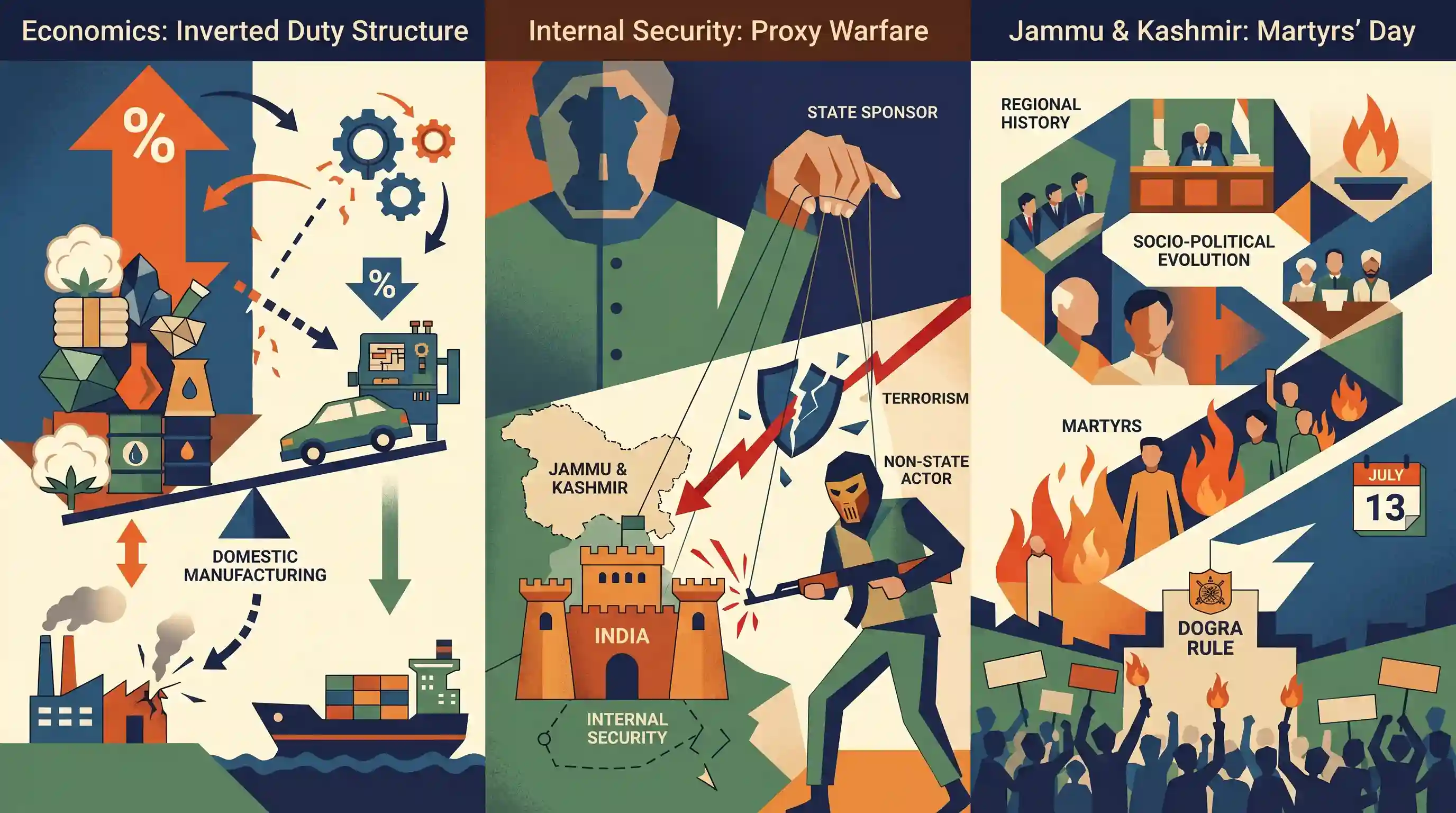
क्यों मायने रखता है
Understanding taxation anomalies is vital for assessing India's manufacturing competitiveness and GST reforms. Analyzing proxy warfare is essential for comprehending complex internal security threats, while regional historical events are important for understanding contemporary socio-political dynamics.
सारांश
The article highlights three critical areas for UPSC preparation: Economics, Internal Security, and Regional History. It explains the 'Inverted Duty Structure'—an economic anomaly where taxes on raw materials are higher than on finished products, undermining domestic manufacturing and complicating the GST framework. Second, it delves into 'Proxy Warfare', examining how states use non-state actors to achieve strategic goals asymmetrically, a persistent challenge for India's internal security due to cross-border terrorism. Finally, it touches upon 'Martyrs' Day' in Jammu and Kashmir, historically observed on July 13 to remember the 1931 protests against Dogra rule, contextualizing the region's socio-political evolution.
मुख्य बिंदु
- An inverted duty structure occurs when import duties or taxes on raw materials are higher than those on finished goods, which discourages domestic manufacturing and leads to input tax credit accumulation.
- Resolving taxation anomalies like the inverted duty structure is critical for the success of domestic initiatives such as 'Make in India' and for streamlining the GST regime.
- Proxy warfare involves states utilizing non-state actors (such as terrorist groups or militias) to conduct asymmetric warfare against adversaries without direct conventional military engagement.
- India faces continuous internal security threats from cross-border proxy warfare, requiring robust border management, counter-terrorism strategies, and diplomatic isolation of state sponsors of terrorism.
- Martyrs' Day (July 13) marks a historical event in Jammu and Kashmir, commemorating those who lost their lives in 1931 protesting against the Dogra rule, shaping the region's modern political history.
महत्वपूर्ण शब्द
Inverted Duty Structure

A tax anomaly where import duties or tax rates on raw materials and intermediate inputs are higher than those on the finished products.
UPSC context
GS-III (Economy); tests understanding of trade barriers, domestic manufacturing competitiveness, and GST Input Tax Credit imbalances.
Proxy Warfare
An indirect conflict where a state uses third parties—typically non-state actors or insurgents—to achieve strategic goals while maintaining plausible deniability.
UPSC context
GS-III (Internal Security); covers challenges of cross-border terrorism and the role of external actors in national security.
GST Council
A constitutional body under Article 279A that brings together the Union and States to recommend GST rates, exemptions, and rules.
UPSC context
GS-II (Polity/Federalism) and GS-III (Economy); evaluates the mechanism for consensus-based fiscal federalism.
Financial Action Task Force (FATF)
An international inter-governmental organization that sets global standards to combat money laundering and the financing of terrorism and proliferation.
UPSC context
GS-II (International Relations) and GS-III (Security); crucial for assessing global pressure on terror-sponsoring states.
Martyrs’ Day (Jammu and Kashmir)
Observed on July 13 to honor 22 protesters killed in 1931 during a revolt against the autocratic Dogra Maharaja’s rule in Kashmir.
UPSC context
GS-I (Modern Indian History); tests knowledge of the socio-political evolution and key resistance movements in princely states.
Make in India
A national program launched in 2014 to encourage domestic manufacturing, foster innovation, and make India a global manufacturing hub.
UPSC context
GS-III (Economy); tests knowledge of industrial policy, employment generation, and Ease of Doing Business.
प्रारंभिक ट्रैप
"An inverted duty structure implies higher taxes on luxury finished goods compared to essential raw materials."
Inverted duty refers to the tax rate on inputs being higher than the output, not a comparison of luxury vs. essential goods. It leads to accumulated Input Tax Credit.
संबंधित अवधारणाएँ
What is Input Tax Credit (ITC) and how does IDS disrupt it?
- Mechanism: ITC allows businesses to deduct the tax they have already paid on inputs from the final tax payable on their output.
- IDS Disruption: Because inputs are taxed higher than outputs, the ITC exceeds the final tax liability, leading to a massive accumulation of unutilized credit.
- Economic Impact: This accumulation blocks crucial working capital for manufacturers and forces the government into a complicated, continuous refund process.
What triggered the July 1931 uprising against Dogra rule in Kashmir?
- Context: The uprising was a mass protest against the autocratic rule of Maharaja Hari Singh, demanding better socio-economic rights and political representation.
- Trigger: The immediate trigger was the arrest and trial of Abdul Qadeer, who delivered a speech inciting the public against the Dogra administration.
- Political Impact: This watershed event catalyzed the formation of organized political movements in the region, leading to the creation of the All J&K Muslim Conference.
अंतर-विषय पैटर्न
FTAs exacerbating Inverted Duty Structures
Poorly negotiated FTAs often eliminate import duties on finished goods while raw materials remain taxed domestically or via customs, exacerbating the inverted duty structure and undermining 'Make in India'.
Proxy Warfare and FATF Economic Deterrence
India utilizes multilateral forums like the FATF to squeeze the state-sponsored terror-financing networks of hostile neighbors, effectively merging internal security objectives with economic diplomacy.

Expect a conceptual Prelims question linking Inverted Duty Structure to working capital blockages and GST Input Tax Credit.
संबद्ध PYQ · 4
संबद्ध PYQ · 4
- 2019MainsGS3
Enumerate the indirect taxes which have been subsumed in the Goods and Services Tax (GST) in India. Also, comment on the revenue implications of the GST introduced in India since July 2017.
- 2017MainsGS3
Account for the failure of manufacturing sector in achieving the goal of labour-intensive exports. Suggest measures for more labour-intensive rather than capital-intensive exports.
- 2021MainsGS3
Analyse the multidimensional challenges posed by external state and non-state actors, to the internal security of India. Also discuss measures required to be taken to combat these threats.
- 2020MainsGS3
Analyze internal security threats and transborder crimes along Myanmar, Bangladesh and Pakistan borders including Line of Control (LoC). Also discuss the role played by various security forces in this regard.
