Yoga Day Soft Power and BharatNet Digital Infrastructure Strategy
Source:Indian Express ↗
Why It Matters
Understanding these issues is crucial as they intersect multiple syllabus areas: India's neighborhood first policy and border security challenges (GS2/GS3), digital infrastructure development (GS3), and the deployment of cultural diplomacy (GS2).
Summary
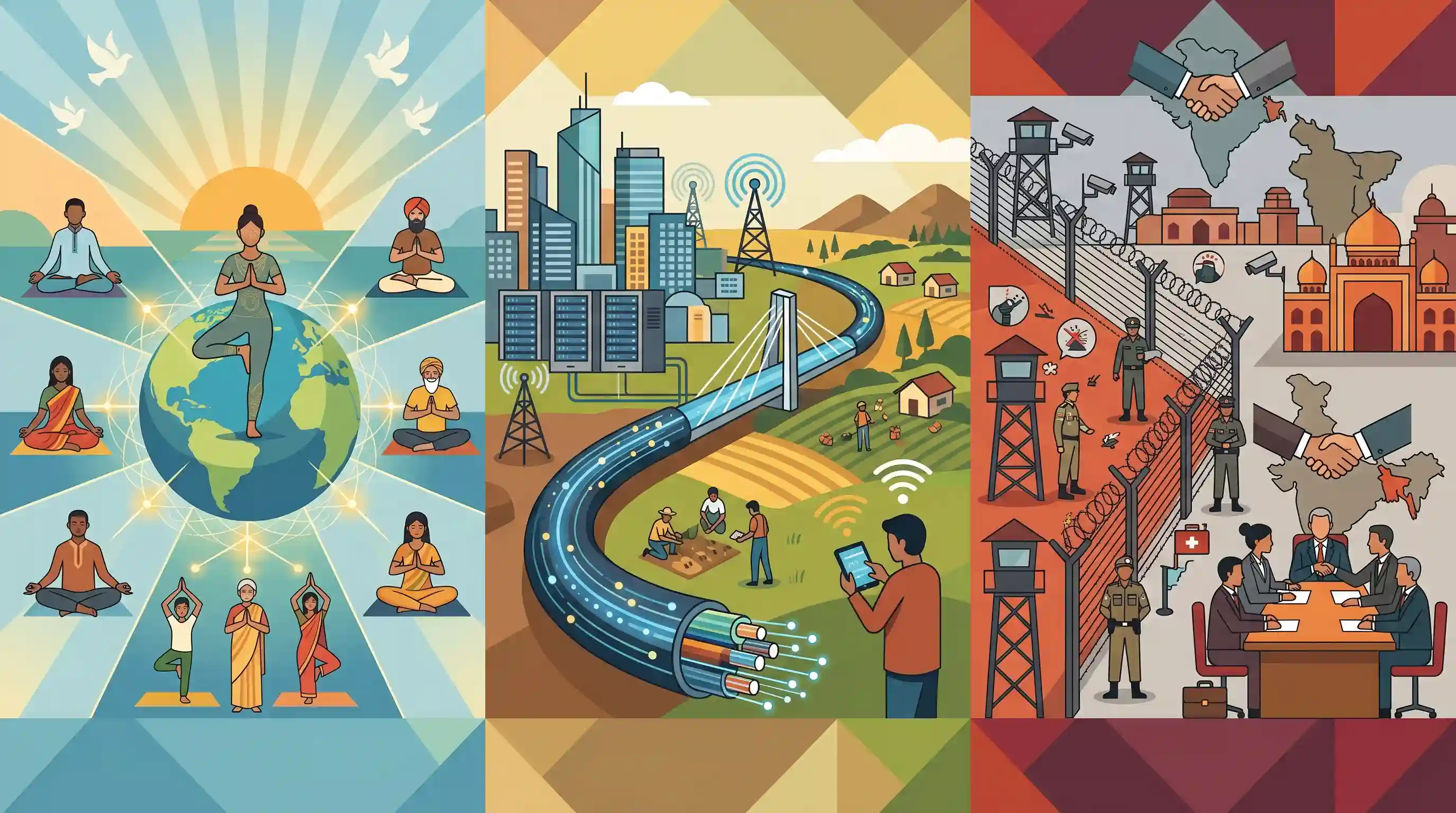
The article covers significant current affairs topics for UPSC, focusing on International Yoga Day as an instrument of cultural diplomacy, the strategic importance of the BharatNet project in bridging the rural-urban digital divide, and the ongoing security and diplomatic challenges concerning India-Bangladesh border tensions.
Key Points
- International Yoga Day plays a vital role in projecting India's soft power and cultural diplomacy on a global stage.
- The BharatNet project aims to provide high-speed broadband connectivity to rural areas, facilitating e-governance and the Digital India initiative.
- India-Bangladesh border management faces continuous challenges due to illegal migration, trans-border smuggling, and occasional border tensions, necessitating robust surveillance and diplomatic engagement.
Important Terms
BharatNet Project

The world's largest rural broadband project, it aims to connect all 2.5 lakh+ Gram Panchayats with high-speed optical fiber to bridge the rural-urban digital divide.
UPSC context
GS3 (Infrastructure/IT); tests understanding of digital connectivity as a tool for inclusive rural development and e-governance.
Border Security Force (BSF)
India's primary border guarding organization (CAPF) under the Ministry of Home Affairs, responsible for securing borders with Pakistan and Bangladesh as the "First Line of Defence."
UPSC context
GS3 (Internal Security); tests knowledge of border management, trans-border crimes, and security challenges in riverine/porous terrains.
Soft Power
A nation's ability to influence international preferences through attraction and persuasion—leveraging culture, values, and diplomacy—rather than military or economic coercion (hard power).
UPSC context
GS2 (International Relations); tests analysis of India's global influence via Yoga, diaspora, and civilizational heritage.
Digital India
A flagship umbrella program launched in 2015 to transform India into a digitally empowered society and knowledge economy through infrastructure, service delivery, and literacy.
UPSC context
GS3 (ICT/Economy); tests knowledge of digital public infrastructure and the integration of technology in governance.
Gram Panchayats
The basic unit of local self-government at the village level in India, serving as the primary implementation point for last-mile digital connectivity projects.
UPSC context
GS2 (Polity) and GS3 (Infrastructure); tests understanding of decentralized governance and grassroots service delivery.
Cultural Diplomacy
A field of public diplomacy that uses the exchange of culture, ideas, and information to foster mutual understanding and advance national interests.
UPSC context
GS2 (International Relations); tests the ability to evaluate non-traditional instruments of foreign policy like International Yoga Day.
Prelims Trap
"BharatNet is funded through the regular budgetary allocation of the Ministry of Electronics & IT."
BharatNet is not funded by regular MeitY budgets. It is financed by the Universal Service Obligation Fund (USOF) under the Department of Telecommunications.
Static Concepts Connected
What are the core components of the Comprehensive Integrated Border Management System (CIBMS)?
- Tech-Driven Surveillance: Uses thermal imagers, infrared, laser alarms, and radar to monitor non-feasible terrains 24/7.
- Command & Control: Integrates raw data from various ground sensors into a unified operational picture for the BSF.
- Target Areas: Specifically deployed in difficult geographies like riverine gaps and marshy lands along the Pakistan and Bangladesh borders.
How does the Universal Service Obligation Fund (USOF) operate?
- Statutory Backing: Given statutory status by the Indian Telegraph (Amendment) Act, 2003.
- Funding Mechanism: Financed via a Universal Access Levy (UAL) charged on the adjusted gross revenue of telecom service providers.
- Primary Objective: Ensures widespread, non-discriminatory, and affordable access to ICT services in rural and remote areas (like the BharatNet project).
Cross-Topic Patterns
Digital Infra & Internal Security
Extending BharatNet to border areas (under the Vibrant Villages Programme) directly intertwines rural digital governance with strategic border security and intelligence gathering.
Cultural Diplomacy & Multilateralism
International Yoga Day is leveraged alongside traditional diplomatic efforts to consolidate India's soft-power and counterbalance hard-power limitations in multilateral forums.

Expect a 2026 prelims question merging the geography of India-Bangladesh border states with CIBMS tech and USOF's funding mandate.
Linked PYQs · 4
Linked PYQs · 4
- 2015MainsGS2
Terrorist activities and mutual distrust have clouded India-Pakistan relations. To what extent the use of soft power like sports and cultural exchanges could help generate goodwill between the two countries? Discuss with suitable examples.
- 2017PrelimsGS1
What is the aim of the programme 'Unnat Bharat Abhiyan'?
- 2020MainsGS3
Analyze internal security threats and transborder crimes along Myanmar, Bangladesh and Pakistan borders including Line of Control (LoC). Also discuss the role played by various security forces in this regard.
- 2024MainsGS3
India has a long and troubled border with China and Pakistan fraught with contentious issues. Examine the conflicting issues and security challenges along the border. Also give out the development being undertaken in these areas under the Border Area Development Programme (BADP) and Border Infrastructure and Management (BIM) Scheme.
