Global Economic Governance, Space Missions and Monsoon Dynamics
Source:Indian Express ↗
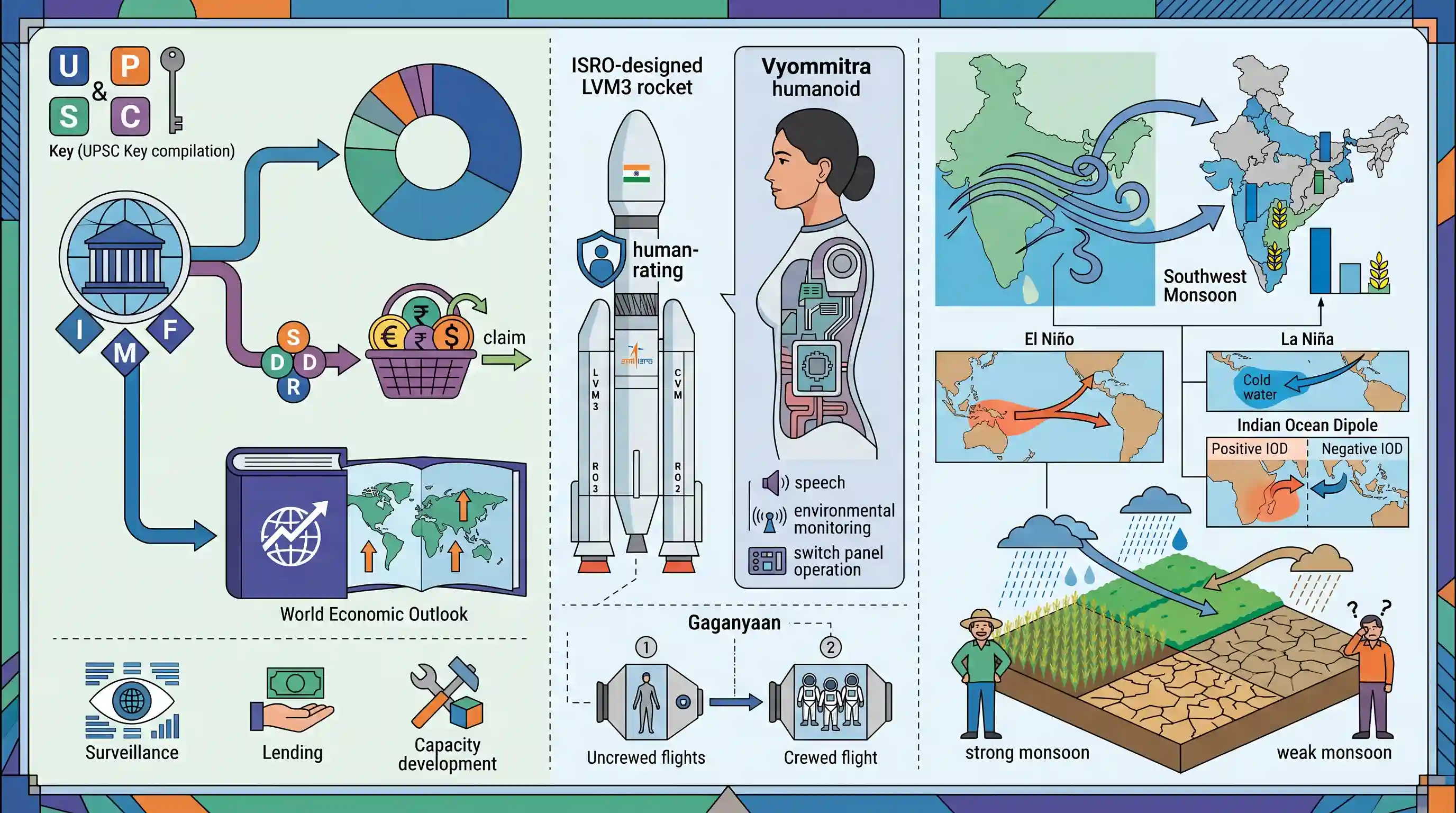
Why It Matters
This article consolidates core UPSC syllabus topics: global economic governance (IMF), India's strategic advancements in space technology (Gaganyaan), and physical geography directly affecting the Indian economy (Monsoon dynamics). Understanding these interconnected themes is essential for Prelims factual questions and Mains analytical answers.
Summary
This UPSC Key compilation covers three significant themes across economy, science, and geography. First, it highlights the International Monetary Fund's (IMF) functions, including its quota system, Special Drawing Rights (SDRs), and the World Economic Outlook report. Second, it details ISRO's Gaganyaan Mission, outlining India's steps toward human spaceflight, the human-rating of the LVM3 rocket, and the use of the Vyommitra humanoid. Third, it discusses the dynamics of the Southwest Monsoon, explaining how complex ocean-atmospheric interactions like El Niño, La Niña, and the Indian Ocean Dipole impact Indian rainfall and agriculture.
Key Points
- The International Monetary Fund (IMF) plays a vital role in global financial stability, providing emergency loans, managing Special Drawing Rights (SDRs), and publishing the World Economic Outlook.
- ISRO's Gaganyaan Mission represents India's first human spaceflight endeavor, aiming to launch astronauts to a Low Earth Orbit (LEO) and ensure their safe return.
- The Gaganyaan program involves extensive technological development, including human-rating the LVM3 launch vehicle and conducting test flights with the humanoid robot Vyommitra.
- The Indian Southwest Monsoon is crucial for the nation's agriculture and water resources, with its intensity significantly modulated by global climatic phenomena like El Niño, La Niña, and the Indian Ocean Dipole (IOD).
Important Terms
International Monetary Fund (IMF)

An international organization established in 1944 to foster global monetary cooperation, secure financial stability, and facilitate trade. It provides policy advice and financial assistance to member countries, particularly those facing balance-of-payments crises.
UPSC context
GS Paper 2 (International Institutions) and GS Paper 3 (Economy); tests knowledge of global financial governance and economic surveillance.
Gaganyaan Mission
India’s maiden human spaceflight program by ISRO, designed to send a crew to Low Earth Orbit (400 km) for three days. It demonstrates indigenous capability in human-rated launch vehicles and environmental life-support systems.
UPSC context
GS Paper 3 (Science and Technology); tests developments in indigenous space technology and milestones in India’s human spaceflight program.
Special Drawing Rights (SDR)
An international reserve asset created by the IMF in 1969 to supplement member countries' official reserves. It is defined by a basket of five major currencies: US dollar, Euro, Chinese yuan, Japanese yen, and British pound.
UPSC context
GS Paper 3 (Economy); tests understanding of international liquidity, reserve management, and the IMF's accounting system.
Indian Space Research Organisation (ISRO)
The national space agency of India, established in 1969. It focuses on satellite development, launch vehicles, and planetary exploration to harness space technology for socio-economic development and advanced scientific research.
UPSC context
GS Paper 3 (Science and Technology); tests institutional mandates, indigenous technological advancements, and major space mission milestones.
India Meteorological Department (IMD)
The nodal government agency under the Ministry of Earth Sciences for meteorological observations, weather forecasting, and seismology. It provides critical data for agriculture, aviation, and disaster management, including early cyclone warnings.
UPSC context
GS Paper 1 (Geography) and GS Paper 3 (Disaster Management); tests understanding of monsoon systems and disaster early-warning frameworks.
Southwest Monsoon
A seasonal wind system bringing significant rainfall to India between June and September. Driven by thermal differences between the land and ocean, it is the primary source of water for Indian agriculture.
UPSC context
GS Paper 1 (Geography); tests conceptual clarity on atmospheric dynamics, IOD, and El Niño impacts on India.
Prelims Trap
"Special Drawing Rights (SDRs) are an international currency issued by the IMF."
SDR is neither a currency nor a claim on the IMF. It is merely a potential claim on the freely usable currencies of IMF member states.
Static Concepts Connected
What constitutes the SDR currency basket and its valuation?
- Five currencies: US Dollar, Euro, Chinese Renminbi, Japanese Yen, and British Pound Sterling.
- Valuation mechanism: Calculated daily; basket weights are reviewed every five years based on members' export volumes and the currency's usability in global financial transactions.
How does the Indian Ocean Dipole (IOD) interact with the Indian monsoon?
- Positive IOD: Warmer western Indian Ocean brings enhanced rainfall to India, often mitigating the drought effects of an El Niño year.
- Negative IOD: Cooler western Indian Ocean causes subdued monsoon conditions, which can exacerbate rainfall deficits during La Niña or normal years.
Cross-Topic Patterns
Monsoon anomalies & RBI Inflation Targeting
Irregular monsoons driven by El Niño/IOD directly impact agricultural yields, forcing the RBI to adjust monetary policy to combat food-driven headline inflation.
Gaganyaan & Commercial Space Sector
Human-rating the LVM3 rocket not only serves ISRO's scientific goals but enhances NSIL's commercial appeal for global heavy-lift satellite launches.

Expect a multi-statement question correlating ENSO/IOD phases with domestic food inflation and RBI's monetary policy adjustments in 2026.
Linked PYQs · 5
Linked PYQs · 5
- 2014PrelimsGS1
Which of the following organizations brings out the publication known as 'World Economic Outlook'?
- 2014MainsGS2
Some of the International funding agencies have special terms for economic participation stipulating a substantial component of the aid to be used for sourcing equipment from the leading countries. Discuss on merits of such terms and if, there exists a strong case not to accept such conditions in the Indian context.
- 2025PrelimsGS1
Consider the following space missions : I. Axiom-4 II. SpaDeX III. Gaganyaan How many of the space missions given above encourage and support micro-gravity research?
- 2017MainsGS3
India has achieved remarkable successes in unmanned space missions including the Chandrayaan and Mars Orbitter Mission, but has not ventured into manned space missions. What are the main obstacles to launching a manned space mission, both in terms of technology and logistics? Examine critically.
- 2017PrelimsGS1
With reference to 'Indian Ocean Dipole (IOD)' sometimes mentioned in the news while forecasting Indian monsoon, which of the following statements is/are correct? 1. IOD phenomenon is characterised by a difference in sea surface temperature between tropical Western Indian Ocean and tropical Eastern Pacific Ocean. 2. An IOD phenomenon can influence an El Nino's impact on the monsoon. Select the correct answer using the code given below:
