Clean Cooking Tech Western Disturbances and Fertility Trends
Source:Indian Express ↗
Why It Matters
Understanding these three concepts is essential for UPSC aspirants as they cover core syllabus areas: clean energy transition (GS3), Indian monsoon and climate systems (GS1 Geography), and population dynamics and social issues (GS1 Society/GS2 Policy).
Summary
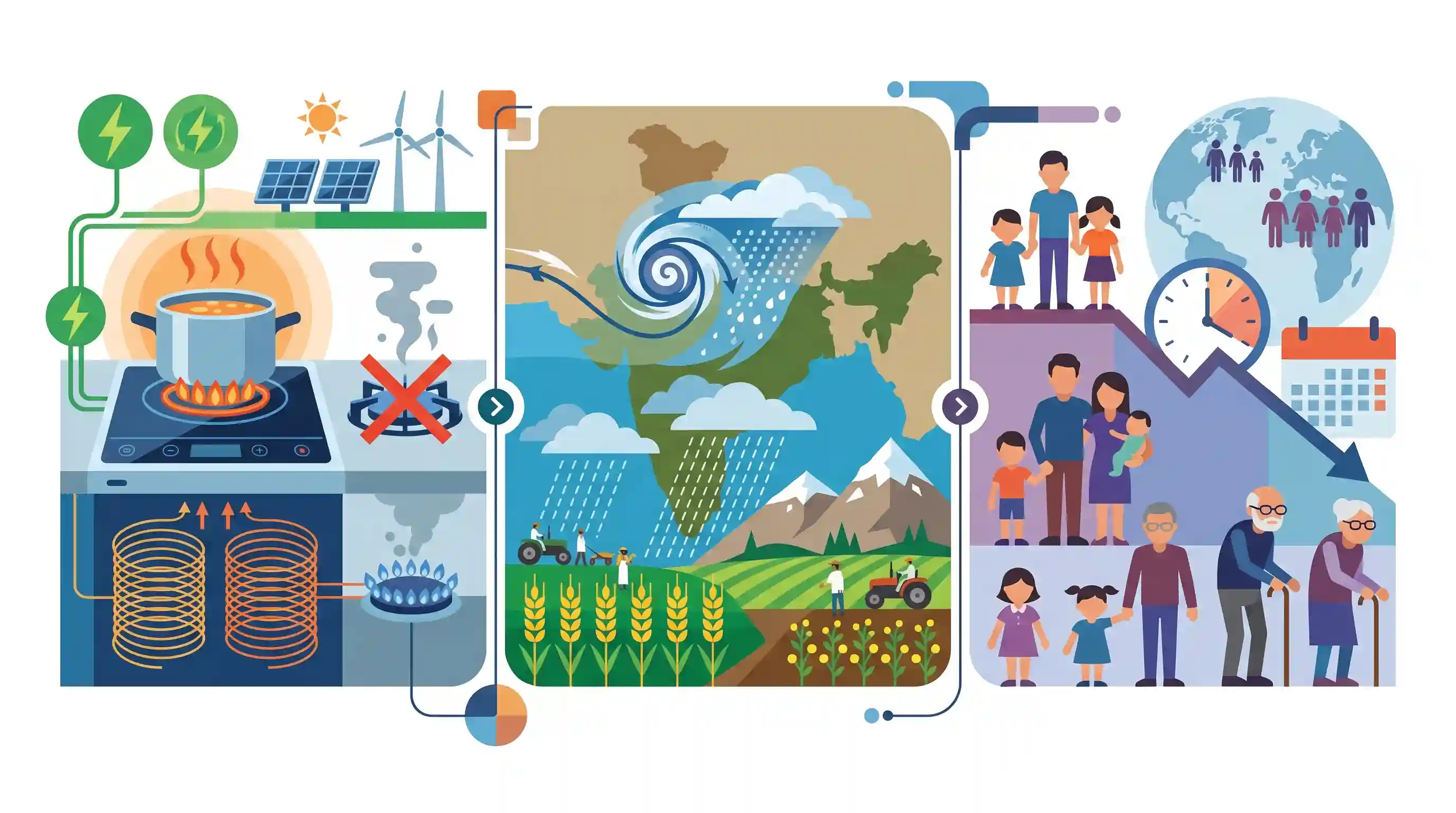
The article highlights three major topics for UPSC preparation: the science and environmental benefits of Induction Cooking Technology, the geographical mechanism and agricultural importance of Western Disturbances, and the demographic implications of a declining Total Fertility Rate (TFR). These topics bridge science, geography, and society, emphasizing energy transitions, climate patterns affecting Indian agriculture, and global population trends moving towards a 'demographic winter'.
Key Points
- Induction cooking technology is gaining prominence as an energy-efficient alternative, contributing to reduced indoor air pollution and energy transition goals.
- Western Disturbances are extratropical storms originating in the Mediterranean region that bring sudden winter rain to the northwestern parts of the Indian subcontinent, which is crucial for Rabi crops.
- Total Fertility Rate (TFR) refers to the average number of children a woman would have in her lifetime; recent trends show a global and national decline towards or below the replacement level of 2.1.
- A declining TFR leads to long-term demographic shifts, including an ageing population and what is termed a 'demographic winter', impacting future workforce and economic planning.
Prelims Trap
"India's Total Fertility Rate (TFR) remains above the replacement level, causing continued population growth."
India's TFR has already fallen below the replacement level of 2.1 (currently at 2.0 per NFHS-5). The population still grows solely due to "population momentum".
Static Concepts Connected
How do Western Disturbances impact Indian weather and agriculture?
- Origin & Mechanism: They are extratropical (temperate) cyclones originating over the Mediterranean Sea, transported to India by Subtropical Westerly Jet Streams.
- Winter Precipitation: They bring non-monsoonal winter rain to northwestern India and vital snowfall to the Himalayas, feeding perennial rivers.
- Rabi Crop Lifeline: This rainfall is highly beneficial for winter (Rabi) crops like wheat and mustard, though associated hailstorms can cause damage.
What are Total Fertility Rate (TFR) and Population Momentum?
- TFR Definition: TFR is the average number of children born to a woman over her reproductive lifetime.
- Replacement Level: A TFR of 2.1 is considered the exact rate needed for a population to exactly replace itself from one generation to the next.
- Population Momentum: The phenomenon where a population continues to grow despite sub-replacement fertility, because a large percentage of the population is still in their reproductive years.
Cross-Topic Patterns
Demographic Dividend vs Aging Workforce
India's declining TFR connects Demography to Economy. It signals a narrowing window for the demographic dividend, requiring urgent skill-development policies before a 'demographic winter' and aging population set in.
Climate Shifts and Rabi Crop Security
Geography meets Economy. Western Disturbance anomalies (delayed or excessive) directly impact India's food security, specifically winter wheat yields, inflation, and subsequent MSP procurement strategies.
Applied Tech & Health Intersections
Science (Induction Tech) meets Environment and Women's Health. Transitioning to clean cooking links PM2.5 reduction to a lower respiratory disease burden in rural households, complementing schemes like PM Ujjwala.

Expect a 2026 multi-statement question linking NFHS-5 TFR data to 'population momentum' and the socioeconomic impacts of an aging society.
Linked PYQs · 5
Linked PYQs · 5
- 2024PrelimsGS1
The total fertility rate in an economy is defined as:
- 2024PrelimsGS1
Consider the following countries : 1. Italy 2. Japan 3. Nigeria 4. South Korea 5. South Africa Which of the above countries are frequently mentioned in the media for their low birth rates, or ageing population or declining population?
- 2012PrelimsGS1
Consider the following specific stages of demographic transition associated with economic development: 1. Low birthrate with low death rate 2. High birthrate with high death rate 3. High birthrate with low death rate Select the correct order of the above stages using the codes given below:
- 2024MainsGS1
What is the concept of a 'demographic winter'? Is the world moving towards such a situation? Elaborate.
- 2019MainsGS1
“Empowering women is the key to control population growth.” Discuss.
