Russian Oil Imports and Ground Level Ozone Challenges for India
Source:Indian Express ↗
Why It Matters
These topics represent the core of India's current developmental and diplomatic balancing acts—securing affordable energy for its population, mitigating environmental degradation, and building critical infrastructure for long-term economic growth.
Summary
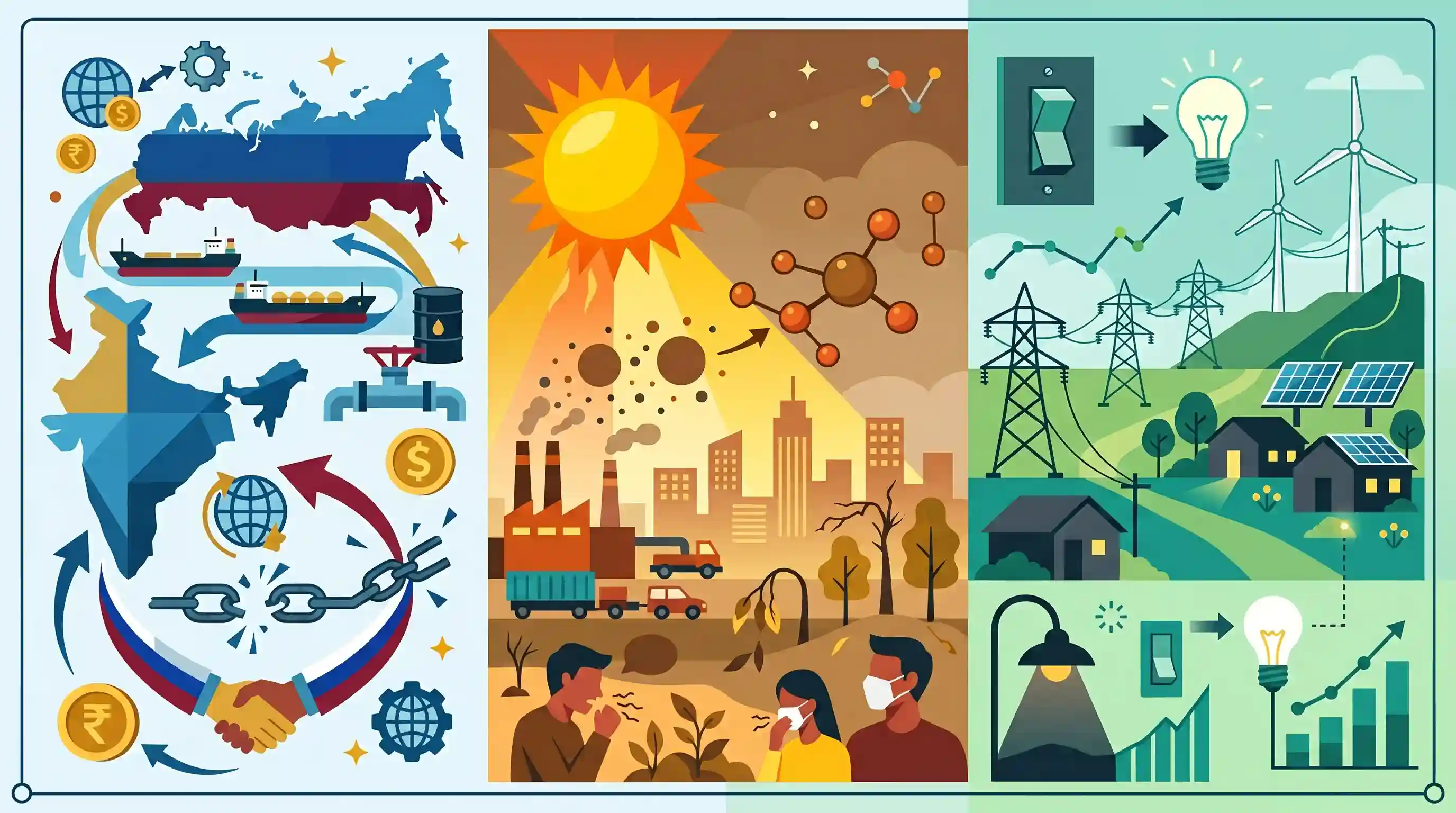
The 'UPSC Key' article for June 20th, 2026, highlights three critical themes for civil services aspirants: the geopolitics and economic rationale behind India's continued imports of Russian oil amidst global sanctions; the environmental and health impacts of ground-level ozone as a secondary pollutant exacerbated by summer heat; and the progress and challenges of electrification in India, aligning with rural development and clean energy transitions.
Key Points
- India's strategic autonomy is reflected in its Russian oil imports, balancing domestic energy security needs against Western sanctions and geopolitical pressures.
- Ground-level ozone (O3) is highlighted as a harmful secondary pollutant formed by the reaction of NOx and VOCs in the presence of sunlight, posing severe respiratory risks, especially during summer.
- Electrification initiatives focus on extending grid connectivity and promoting renewable energy sources, which are crucial for achieving India's energy transition goals and rural upliftment.
- The intersection of energy security, climate change commitments, and economic growth remains a highly relevant focus area for UPSC examinations across GS2 and GS3.
Important Terms
Ground-level Ozone (Tropospheric Ozone)

Harmful pollutant formed near the ground when nitrogen oxides (NOx) and volatile organic compounds (VOCs) react in intense sunlight and heat.
UPSC context
GS III (Environment); relevant for summertime air pollution and public health impacts.
Strategic Autonomy
A foreign policy principle allowing a state to make independent decisions based on national interest, free from external coercion or rigid alliance systems.
UPSC context
GS II (International Relations); critical for India-Russia and India-US bilateral ties.
Energy Security
Ensuring reliable, affordable, and sustainable access to energy sources to support economic stability and national growth.
UPSC context
GS III (Infrastructure/Energy); essential for evaluating India's crude oil import strategy.
Secondary Pollutant
Pollutants formed in the atmosphere through reactions between primary pollutants (like NOx) and environmental factors rather than being directly emitted.
UPSC context
GS III (Environment); key for atmospheric chemistry and pollution regulation.
PM-KUSUM Scheme
A major agricultural solarization scheme providing energy security to farmers via solar pumps and grid-connected renewable energy projects.
UPSC context
GS III (Agriculture/Renewable Energy); tests knowledge of rural electrification and clean energy targets.
National Ambient Air Quality Standards (NAAQS)
Ambient air quality limits set by the CPCB for various pollutants to protect public health and the environment across India.
UPSC context
GS III (Pollution/Governance); relevant for standardizing air quality measurements.
Strait of Hormuz
A strategic global chokepoint between the Persian Gulf and Gulf of Oman, essential for global oil and gas shipments.
UPSC context
GS I (Geography) & GS II (IR); central to global trade and energy chokepoints.
Prelims Trap
"A village is declared officially electrified only when 100% of its households are connected to the grid."
False. Under official Indian criteria, a village is considered electrified if basic infrastructure exists, public places are connected, and merely 10% of households have electricity.
Static Concepts Connected
How does Tropospheric Ozone differ from Stratospheric Ozone?
- Good vs Bad: Stratospheric ozone protects the Earth from harmful UV radiation, while tropospheric (ground-level) ozone is a toxic greenhouse gas.
- Secondary Formation: Tropospheric ozone is a secondary pollutant formed via complex photochemical reactions between nitrogen oxides (NOx) and volatile organic compounds (VOCs).
- Health & Ecological Impact: Ground-level ozone triggers severe respiratory distress, asthma exacerbation, and significantly reduces agricultural crop yields.
What are the key pillars of India's Deen Dayal Upadhyaya Gram Jyoti Yojana (DDUGJY)?
- Feeder Separation: Separating agriculture and non-agriculture feeders to ensure judicious supply to agricultural consumers and continuous power to rural households.
- Infrastructure Augmentation: Strengthening and augmenting sub-transmission and distribution networks in rural areas, including metering at distribution transformers.
Cross-Topic Patterns
Summer Heatwaves + Secondary Pollutants
Rising urban heat island effects directly amplify the photochemical formation of ground-level ozone, linking climate change impacts to acute urban air quality crises.
Energy Security + Western Sanctions
India's Russian oil purchases bypass Western financial sanctions, echoing past diplomatic navigation of CAATSA waivers during the S-400 missile system procurement.

Expect a multi-statement Prelims question mixing ozone formation chemistry (NOx + VOCs + sunlight) with seasonal summer heatwave patterns.
Linked PYQs · 3
Linked PYQs · 3
- 2025MainsGS2
"Energy security constitutes the dominant kingpin of India's foreign policy, and is linked with India's overarching influence in Middle Eastern countries.” How would you integrate energy security with India's foreign policy trajectories in the coming years?
- 2022PrelimsGS1
In the context of WHO Air Quality Guidelines, consider the following statements: 1. The 24-hour mean of PM2.5 should not exceed 15 µg/m³ and annual mean of PM2.5 should not exceed 5 µg/m³. 2. In a year, the highest levels of ozone pollution occur during the periods of inclement weather. 3. PM10 can penetrate the lung barrier and enter the bloodstream. 4. Excessive ozone in the air can trigger asthma. Which of the statements given above are correct?
- 2022MainsGS3
Do you think India will meet 50 percent of its energy needs from renewable energy by 2030 ? Justify your answer. How will the shift of subsidies from fossil fuels to renewables help achieve the above objective ? Explain.
