India counter terrorism doctrine and WTO most favoured nation rule
Source:Indian Express ↗
Why It Matters
These concepts are crucial for both Prelims and Mains, covering India's evolving internal security strategies as well as vital international trade dynamics that impact global economic stability and diplomacy.
Summary
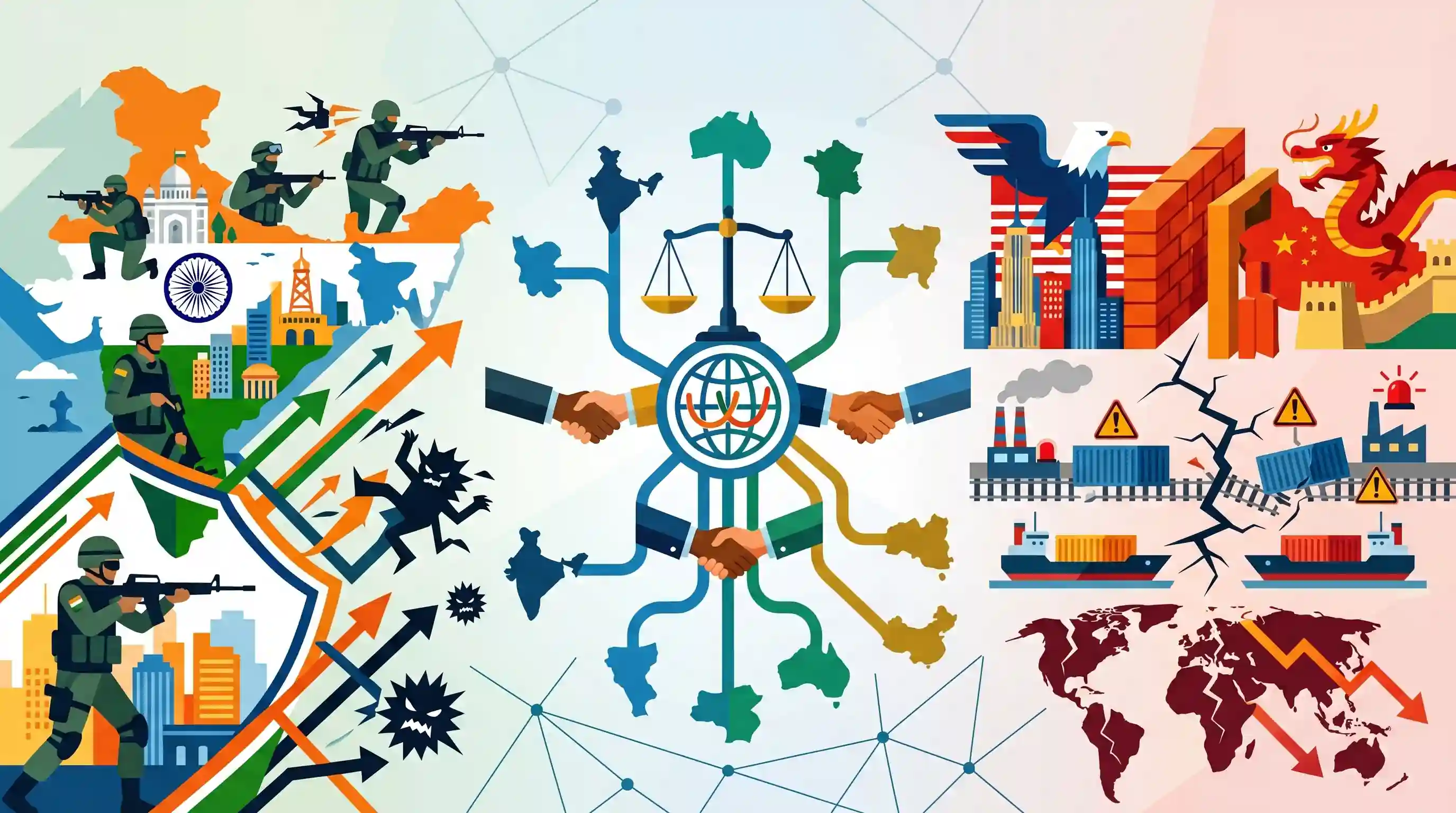
The article examines three key issues relevant to UPSC: India's new counter-terrorism doctrine, the Most Favoured Nation (MFN) trade principle, and the US-China tariff war. It highlights India's increasingly proactive stance against cross-border terrorism. Furthermore, it details how the MFN status functions within the WTO framework to prevent trade discrimination, and analyzes the global economic fallout of the US-China trade war, which is marked by rising protectionism and disrupted supply chains.
Key Points
- India's evolving counter-terrorism doctrine focuses on a proactive approach to address cross-border terrorism and internal security threats.
- The Most Favoured Nation (MFN) principle under the WTO mandates that any trade concession granted to one member must be extended to all other members, ensuring non-discrimination.
- The US-China tariff war highlights a trend towards protectionism, impacting global supply chains, international trade rules, and the economies of developing nations like India.
- These developments underscore the interconnectedness of national security policy and international economic diplomacy.
Important Terms
Most Favoured Nation (MFN)

A WTO principle requiring a country to provide equal trade advantages to all member nations. It prevents discrimination among trading partners, ensuring a level playing field in international commerce.
UPSC context
GS Paper 2 (International Relations) and GS Paper 3; tests understanding of non-discriminatory trade and WTO foundational principles.
World Trade Organization (WTO)
An international organization established in 1995 to regulate global trade. It provides a framework for negotiating trade agreements and a dispute settlement mechanism for its 164 member nations.
UPSC context
GS Paper 2 (International Institutions) and GS Paper 3; important for trade negotiations, dispute resolution, and India's global positioning.
General Agreement on Tariffs and Trade (GATT)
A 1947 multilateral treaty aimed at reducing trade barriers. It served as a provisional framework for international trade in goods before being replaced by the WTO in 1995.
UPSC context
GS Paper 2 and 3; tests historical evolution of global trade regimes and international institutional frameworks.
Prahaar (Doctrine)
India’s first comprehensive counter-terrorism doctrine. It institutionalizes a proactive, zero-tolerance approach, focusing on multi-agency coordination, intelligence-led prevention, and dismantling financial and logistical terror networks.
UPSC context
GS Paper 3 (Internal Security); tests knowledge of India's evolving national security strategy and multi-departmental coordination against terrorism.
Protectionism
Economic policies, such as tariffs and quotas, used to restrict imports and protect domestic industries from foreign competition. It prioritizes national interests over global free trade.
UPSC context
GS Paper 3 (Indian Economy); tests ability to analyze global trade trends and their impact on India’s exports and domestic industry.
Trade War
A conflict where nations retaliate against each other by raising import duties or setting trade barriers. It typically leads to disrupted global supply chains and economic instability.
UPSC context
GS Paper 2 (Effect of policies of developed countries); tests analysis of geopolitical trade tensions and their global economic impact.
Prelims Trap
Under WTO rules, granting Most Favoured Nation status allows a member to offer exclusive lower tariffs to that specific country over others.
The term is a misnomer. MFN actually mandates equal treatment for all WTO members. A tariff reduction given to one must be unconditionally extended to all, preventing exclusive favors.
Static Concepts Connected
What is the difference between MFN and National Treatment in WTO rules?
- MFN: Prohibits discrimination between foreign trading partners. If you grant a trade advantage to one country, you must do so for all WTO members.
- National Treatment: Prohibits discrimination between imported and domestic products. Once foreign goods clear customs and enter the market, they must be treated equally to locally-produced goods.
- MFN Exceptions: MFN has explicit exceptions, such as forming Free Trade Agreements (FTAs) and offering the Generalized System of Preferences (GSP) to developing nations.
What are the core institutional pillars of India's counter-terrorism framework?
- Investigative body: The National Investigation Agency (NIA) acts as the central body to investigate and prosecute terrorism-related offenses across states without requiring state permission.
- Intelligence sharing: The National Intelligence Grid (NATGRID) is an integrated intelligence-sharing network linking databases of core security agencies to track terror suspects.
- Legal framework (UAPA): The Unlawful Activities (Prevention) Act is the primary anti-terror legislation, notably amended in 2019 to allow designating specific individuals, not just organizations, as terrorists.
Cross-Topic Patterns
Trade Wars & China-Plus-One strategy
Rising US-China protectionism accelerates the 'China-Plus-One' strategy, directly linking global tariff shifts to India's domestic Production Linked Incentive (PLI) schemes aimed at capturing migrating supply chains.
National Security Exceptions in WTO
Security doctrines are increasingly merging with trade policy. GATT Article XXI allows breaching MFN for national security concerns—a clause India notably invoked to revoke Pakistan's MFN status post-Pulwama.

Expect a 2026 prelims question testing the subtle difference between WTO's MFN principle, National Treatment, and exact exemptions.
Linked PYQs · 4
Linked PYQs · 4
- 2021MainsGS3
Analyse the complexity and intensity of terrorism, its causes, linkages and obnoxious nexus. Also suggest measures required to be taken to eradicate the menace of terrorism.
- 2020MainsGS3
Analyze internal security threats and transborder crimes along Myanmar, Bangladesh and Pakistan borders including Line of Control (LoC). Also discuss the role played by various security forces in this regard.
- 2018MainsGS2
What are the key areas of reform if the WTO has to survive in the present context of "Trade War', especially keeping in mind the interest of India?
- 2016MainsGS2
The broader aims and objectives of WTO are to manage and promote international trade in the era of globalization. But the Doha round of negotiations seem doomed due to differences between the developed and the developing countries." Discuss in the Indian perspective.
