India US Trade Negotiations and Historical Chola Administration Legacy
Source:Indian Express ↗
Why It Matters
The article presents a classic mix of dynamic GS2 topics (international trade relations and digital justice delivery) and static GS1 topics (colonial military history and Chola administration), making it highly relevant for both Prelims and Mains preparation.
Summary
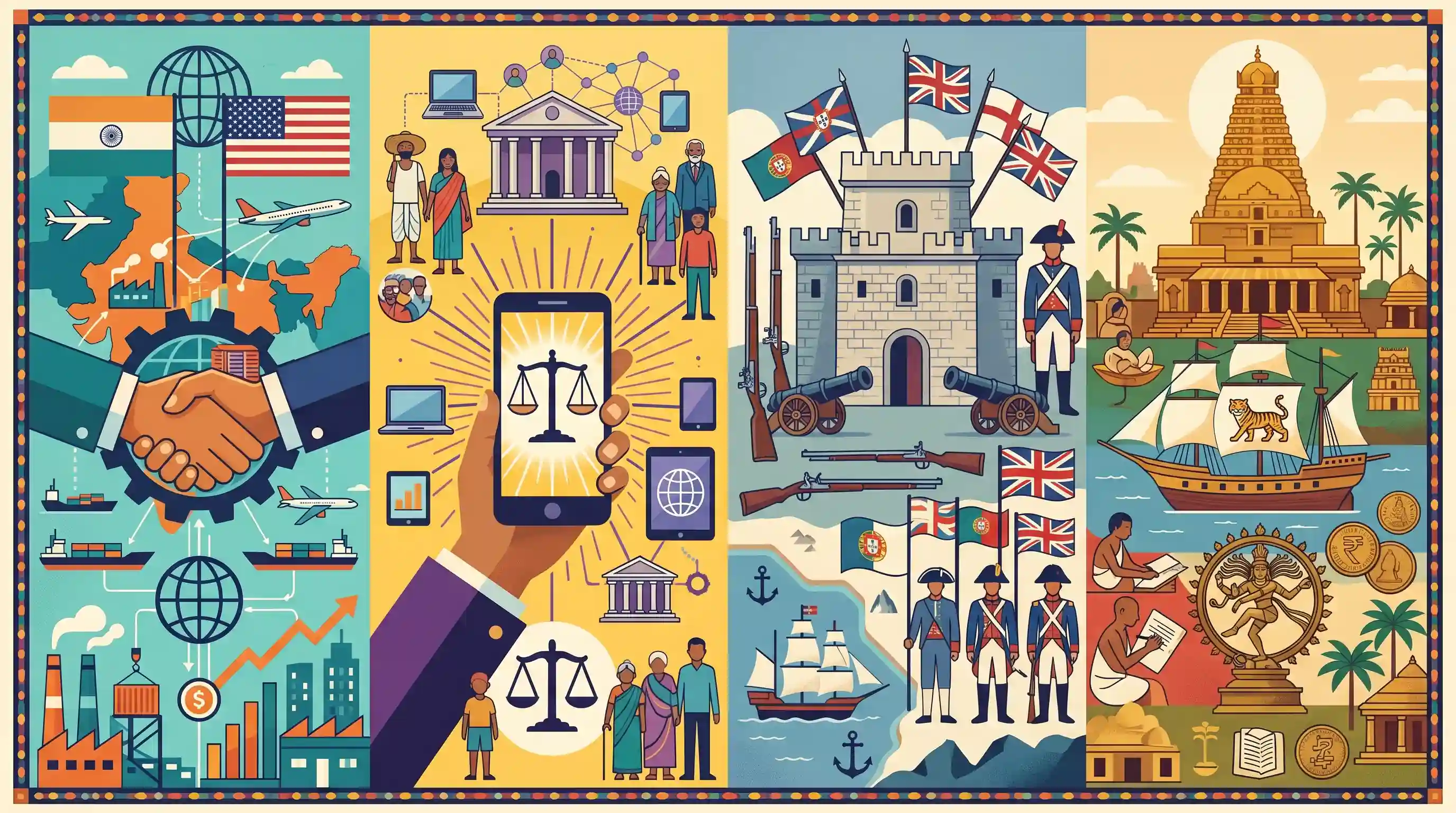
This edition of 'UPSC Key' synthesizes important current affairs and historical topics relevant for civil services preparation. It examines the economic and geopolitical implications of a prospective India-US trade deal. In the realm of polity and governance, it discusses how digital platforms are revolutionizing the provision of free legal aid to marginalized sections. Historically, the article covers the colonial era through the lens of a Portuguese-era arsenal, reflecting on European military history in India, and revisiting the cultural and administrative legacy of the Chola Empire.
Key Points
- Negotiations surrounding an India-US trade deal highlight the ongoing efforts to resolve tariff disputes, enhance market access, and secure resilient bilateral supply chains.
- 'Legal Aid in the Digital Age' emphasizes the role of technology and e-governance (like the Tele-Law initiative) in democratizing access to justice and fulfilling the mandate of Article 39A.
- The exploration of a Portuguese-era arsenal provides crucial historical insights into 16th-century European military strategies, coastal fortifications, and early colonial dominance in India.
- The Chola Empire remains a highly significant historical topic, noted for its sophisticated local self-government, maritime expansion, and monumental Dravidian architecture.
Important Terms
National Legal Services Authority (NALSA)

The apex statutory body established under the Legal Services Authorities Act, 1987, to provide free legal aid to marginalized sections and oversee the nationwide legal aid network.
UPSC context
GS Paper 2 (Polity); crucial for understanding judicial accessibility and welfare mechanisms for vulnerable groups.
Legal Services Authorities Act, 1987
A 1987 legislation that operationalized the constitutional mandate of Article 39A, providing the framework for free legal services and the establishment of statutory Lok Adalats.
UPSC context
GS Paper 2 (Polity); fundamental for questions on statutory bodies and social justice frameworks.
Tele-Law Initiative
An e-interface platform by the Ministry of Law and Justice that connects citizens in rural areas with panel lawyers via Common Service Centres (CSCs).
UPSC context
GS Paper 2 (Governance); tests knowledge of e-governance and technology-driven service delivery in remote areas.
World Trade Organization (WTO)
The primary global international organization governing trade rules between nations, facilitating negotiations, and resolving trade disputes among its 164 member states.
UPSC context
GS Paper 2 & 3; critical for international relations, economic diplomacy, and global trade negotiations.
Article 39A
A Directive Principle of State Policy (DPSP) that mandates the state to provide free legal aid to ensure justice is not denied due to economic disabilities.
UPSC context
GS Paper 2 (Polity); frequently tested regarding DPSPs, constitutional philosophy, and the right to justice.
Chola Administration
The administrative system of the Chola Empire, renowned for its pioneering local self-government through village assemblies (Ur and Sabha) and significant maritime dominance.
UPSC context
GS Paper 1 (History); tests knowledge of medieval administrative innovations and the legacy of South Indian dynasties.
Prelims Trap
"The Tele-Law initiative guarantees free court representation for all citizens across India."
Tele-Law provides pre-litigation advice via CSCs, not direct court representation. Additionally, statutory free legal aid under NALSA is restricted to specific vulnerable categories, not all citizens.
Static Concepts Connected
What are the constitutional and statutory frameworks for Free Legal Aid?
- Article 39A: Added by the 42nd Amendment, it directs the State to ensure equal justice and provide free legal aid to prevent justice denial.
- LSA Act 1987: Enacted to establish NALSA and Lok Adalats, creating a nationwide network for legal aid delivery.
- NALSA Beneficiaries: Section 12 restricts aid to women, children, SC/ST, victims of human trafficking, industrial workmen, and low-income individuals.
How did the Chola village assembly system function?
- Assembly Types: The Ur (general peasant settlements), Sabha/Mahasabha (Brahmin villages), and Nagaram (merchant settlements) governed local affairs.
- Uttaramerur Inscription: Laid down by Parantaka I, it details the kudavolai (pot-ticket) lottery system for electing committee members.
- Variyams (Committees): Specialized executive committees handled specific tasks like tank maintenance (Eri-variyam) and gardens (Thotta-variyam).
Cross-Topic Patterns
E-Governance meets DPSP
The Tele-Law initiative merges digital public infrastructure (Common Service Centres) with welfare state obligations (Article 39A), mirroring the broader e-Courts Mission Mode Project.
Maritime Power Across Eras
Linking the historical Chola naval expeditions against Srivijaya with the Portuguese 'Blue Water Policy' and modern Indo-Pacific/Quad maritime security strategies.

Expect a multi-statement prelims question in 2026 contrasting Chola local self-government (Uttaramerur) with modern Panchayati Raj.
Linked PYQs · 5
Linked PYQs · 5
- 2020PrelimsGS1
Consider the following events in the history of India: 1. Rise of Pratiharas under King Bhoja 2. Establishment of Pallava power under Mahendravarman - I 3. Establishment of Chola power by Parantaka - I 4. Pala dynasty founded by Gopala What is the correct chronological order of the above events, starting from the earliest time?
- 2022PrelimsGS1
With reference to Indian history, consider the following statements: 1. The Dutch established their factories/warehouses on the east coast on lands granted to them by Gajapati rulers. 2. Alfonso de Albuquerque captured Goa from the Bijapur Sultanate. 3. The English East India Company established a factory at Madras on a plot of land leased from a representative of the Vijayanagara empire. Which of the statements given above are correct?
- 2024PrelimsGS1
Who of the following rulers of medieval India gave permission to the Portuguese to build a fort at Bhatkal?
- 2023MainsGS2
Who are entitled to receive free legal aid? Assess the role of the National Legal Services Authority (NALSA) in rendering free legal aid in India.
- 2020MainsGS2
What is the significance of Indo-US defence deals over Indo-Russian defence deals? Discuss with reference to stability in the Indo-Pacific region.
