India US Interim Trade Deal ISM 2.0 and Ministerial Provisions
Source:Indian Express ↗
Why It Matters
The article touches upon critical GS-2 and GS-3 intersections—navigating crucial economic diplomacy with the US, establishing self-reliance in critical technologies (semiconductors), and understanding fundamental Constitutional provisions regarding the Union executive.
Summary
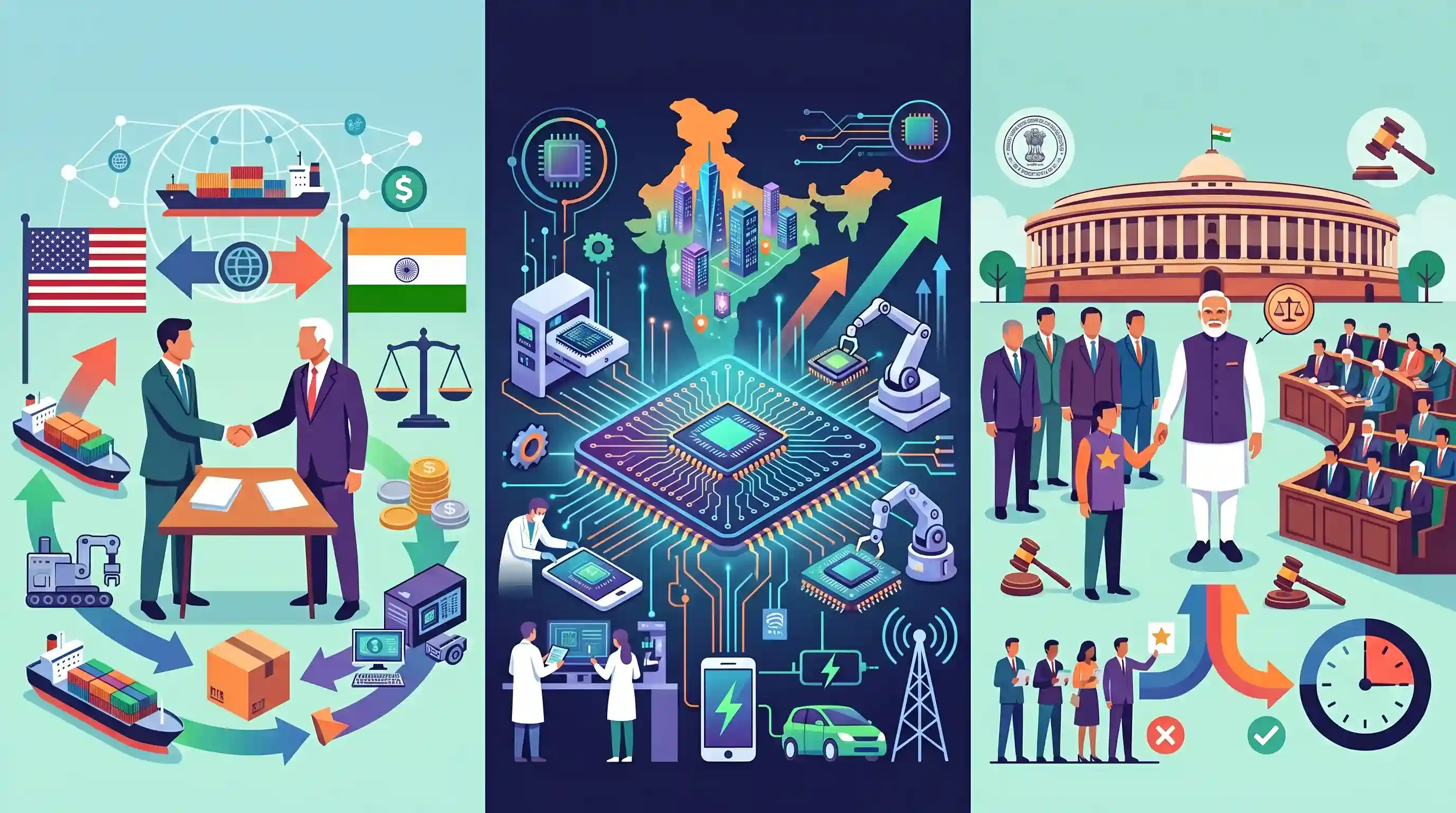
This UPSC Key compilation highlights three major developments: bilateral trade negotiations between India and the US focusing on an interim trade deal; the evolution of India's electronics manufacturing push via the India Semiconductor Mission 2.0 (ISM 2.0); and the constitutional mechanisms surrounding the appointment of a Minister without them being a current member of Parliament.
Key Points
- India and the US are actively exploring an interim trade agreement (or early-harvest deal) to address immediate market access issues and non-tariff barriers, laying the groundwork for a broader Free Trade Agreement.
- The second phase of the India Semiconductor Mission (ISM 2.0) focuses on expanding semiconductor manufacturing, upgrading the PLI scheme, and building a comprehensive domestic ecosystem for electronics and chip design.
- Under Article 75(5) and Article 164(4) of the Constitution, a person can be appointed to the Council of Ministers without being a member of the Parliament or State Legislature, provided they secure a seat within six consecutive months.
- The provision for a 'Minister without a House seat' balances executive flexibility in acquiring talent with the core democratic principle of legislative accountability.
Important Terms
India Semiconductor Mission (ISM) 2.0

The second phase of India's semiconductor program (launched 2026), shifting focus from initial setup to technological sovereignty, domestic equipment manufacturing, and indigenous chip design IP.
UPSC context
GS Paper 3 (Science & Tech/Economy); tests industrial policy, strategic autonomy, and high-tech manufacturing ecosystems.
India-US Interim Trade Deal
A 2026 'early harvest' framework aimed at de-escalating trade tensions through reciprocal tariff reductions (e.g., US lowering duties to 18%) and increased market access for goods.
UPSC context
GS Paper 2 (International Relations); tests bilateral diplomacy, 'friendshoring' strategies, and trade deficit management.
Article 75
Constitutional provision governing Union Ministers' appointment; Clause (5) permits a non-Member of Parliament to serve as a Minister for a maximum of six consecutive months.
UPSC context
GS Paper 2 (Polity); tests the executive-legislative relationship, collective responsibility, and mechanisms for government expertise.
Production Linked Incentive (PLI) Scheme
A flagship fiscal initiative providing financial incentives to companies based on incremental sales from products manufactured in 14 strategic domestic sectors to boost exports.
UPSC context
GS Paper 3 (Economy); tests policy-driven industrialization, import substitution, and global value chain integration.
Council of Ministers
The supreme executive body headed by the Prime Minister; it is collectively responsible to the Lok Sabha and embodies the principle of responsible government.
UPSC context
GS Paper 2 (Polity); tests parliamentary governance structures, executive accountability, and constitutional limits on cabinet size.
Prelims Trap
A non-member appointed as a Minister is not subject to collective responsibility until they are elected to Parliament.
Article 75(3) applies to the entire Council of Ministers. A non-MP Minister is still fully subject to collective responsibility to the Lok Sabha during this grace period.
Static Concepts Connected
What are the constitutional rules for a non-MP serving as a Union Minister?
- Article 75(5): A person can be a Minister without being an MP, but must secure a seat within six consecutive months or vacate the post.
- SC Ruling limitation: The Supreme Court ruled (S.R. Chaudhuri case) that a non-member cannot be repeatedly reappointed as a Minister to bypass the six-month rule.
What distinguishes an Early Harvest Scheme from a Free Trade Agreement (FTA)?
- Precursor pact: It liberalizes tariffs on a limited, select list of goods and services to build trust before concluding a comprehensive FTA.
- WTO alignment: While interim, these schemes must eventually lead to a full FTA to comply with WTO's GATT Article XXIV, which mandates covering "substantially all trade."
Cross-Topic Patterns
ISM 2.0 + India-US iCET
ISM 2.0's pivot to chip design and equipment aligns directly with the bilateral Initiative on Critical and Emerging Technology (iCET), integrating domestic tech PLIs with US supply chains.
Executive treaty power vs Legislature
Unlike the US, the Indian Executive under Article 73 can negotiate and sign interim trade agreements without requiring prior parliamentary ratification, reflecting differences in separation of powers.

Expect a multi-statement Q linking Art 75(5)'s 6-month rule for non-MP Ministers to Supreme Court judgements on repeated appointments.
Linked PYQs · 3
Linked PYQs · 3
- 2025MainsGS3
India aims to become a semiconductor manufacturing hub. What are the challenges faced by the semiconductor industry in India? Mention the salient features of the India Semiconductor Mission.
- 2020PrelimsGS1
Consider the following statements: 1. According to the Constitution of India, a person who is eligible to vote can be made a minister in a State for six months even if he/she is not a member of the Legislature of that State. 2. According to the Representation of People Act, 1951, a person convicted of a criminal offence and sentenced to imprisonment for five years is permanently disqualified from contesting an election even after his release from prison. Which of the statements given above is/are correct?
- 2012PrelimsGS1
The Prime Minister of India, at the time of his/her appointment
