India US trade pact and semiconductor mission expansion
Source:Indian Express ↗
Why It Matters
This compilation touches upon crucial GS-2 (Polity and International Relations) and GS-3 (Economy and Technology) topics. Understanding constitutional norms around the executive, the geopolitical implications of trade ties with the US, and India's self-reliance push in semiconductors is highly relevant for both Prelims and Mains.
Summary
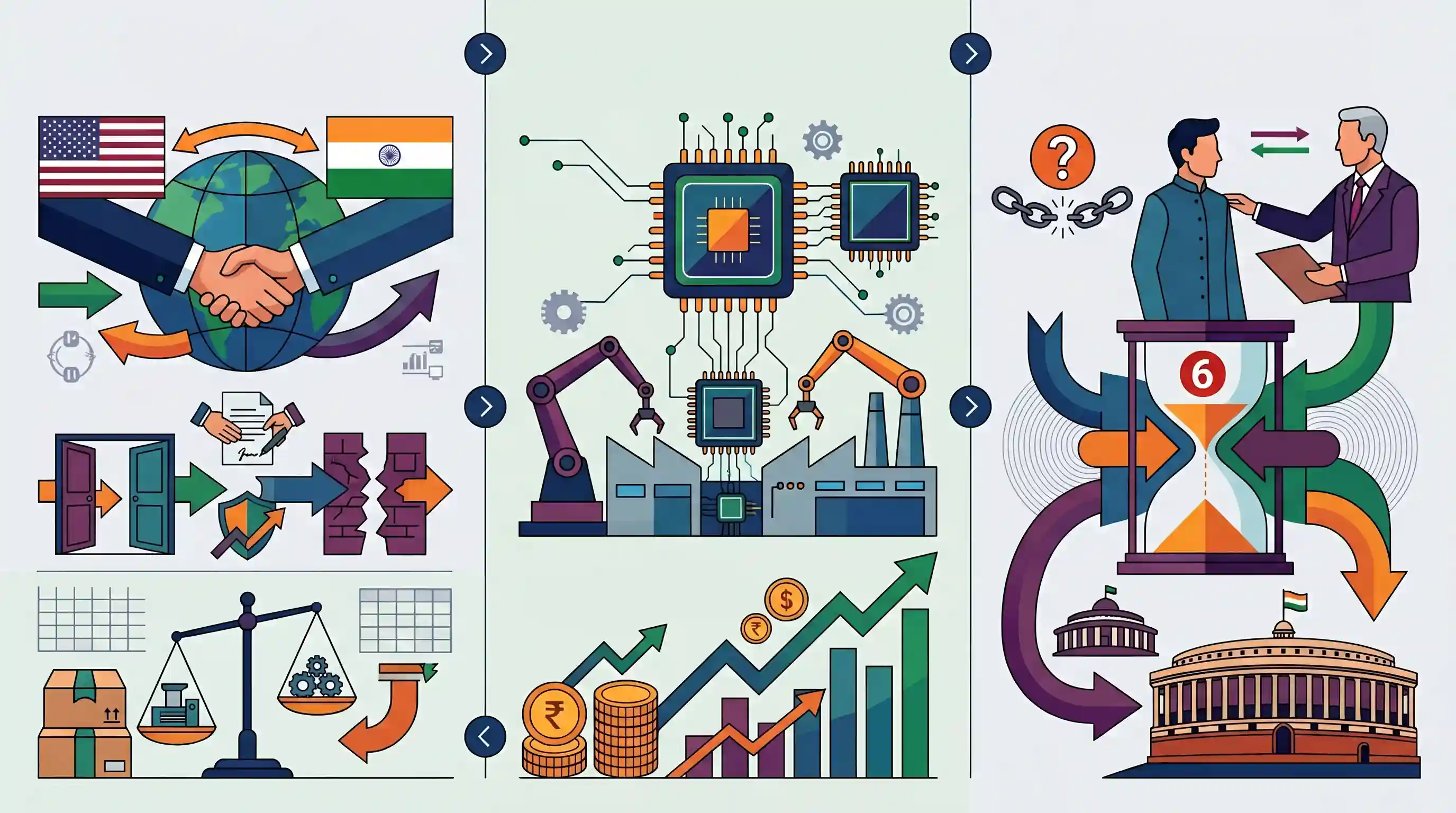
The article outlines three critical areas for UPSC preparation: the strategic push for an India-US interim trade agreement, the expected launch of India Semiconductor Mission (ISM) 2.0 to strengthen domestic electronics manufacturing, and the constitutional provisions regarding the appointment of non-legislators as Ministers. The trade deal focuses on GSP restoration and market access, while ISM 2.0 builds on PLI successes. Additionally, the piece highlights the constitutional six-month mandate under Articles 75(5) and 164(4) for unelected Ministers to secure parliamentary or state legislature seats.
Key Points
- India-US Interim Trade Deal: Bilateral negotiations aim to reduce trade barriers, with India seeking the restoration of GSP status and the US demanding enhanced market access for agricultural and medical products.
- India Semiconductor Mission (ISM) 2.0: The anticipated second phase of the mission will expand on PLI schemes, supporting commercial fabs, ATMP/OSAT facilities, and domestic electronics manufacturing.
- Minister without a House seat: Under Articles 75(5) and 164(4) of the Constitution, an individual can be appointed as a Minister without being a legislator, provided they secure a seat within six consecutive months.
Important Terms
Generalized System of Preferences (GSP)

A trade program where developed nations grant preferential (low or zero) tariffs to imports from developing countries to support their economic growth. India was a major beneficiary before its status was revoked in 2019.
UPSC context
GS Paper 2 (International Relations) and GS Paper 3 (Economy); covers trade policies and their impact on India's interests.
India Semiconductor Mission (ISM)
A flagship initiative aimed at building a robust domestic semiconductor and display ecosystem. Version 2.0 expands focus from fabrication to indigenous chip design, equipment manufacturing, and R&D.
UPSC context
GS Paper 3 (Economy/S&T); essential for industrial policy, self-reliance (Atmanirbhar Bharat), and critical technology supply chains.
Production Linked Incentive (PLI) Scheme
A scheme providing financial incentives to companies based on incremental sales of goods manufactured in domestic units. It targets 14 key sectors to boost global manufacturing competitiveness.
UPSC context
GS Paper 3 (Economy); central to India's manufacturing strategy, job creation, and export growth.
Article 75(5)
Constitutional provision stating that a Union Minister who is not a member of either House of Parliament for six consecutive months must cease to be a Minister.
UPSC context
GS Paper 2 (Polity); tests understanding of the executive structure and legislative accountability.
Article 164(4)
The equivalent of Article 75(5) at the state level, requiring a state Minister to secure a seat in the state legislature within six months of appointment.
UPSC context
GS Paper 2 (Polity); focuses on state executive functions and constitutional mandates for legislators.
US Trade Representative (USTR)
The lead US government agency responsible for developing and conducting trade negotiations. It serves as the primary advisor to the US President on international trade policy.
UPSC context
GS Paper 2 (IR); vital for bilateral trade mechanisms and understanding foreign institutional frameworks.
Prelims Trap
"The Constitution explicitly bars the consecutive reappointment of an unelected minister after their six-month term expires."
The Constitution itself only sets the six-month limit. The strict ban on consecutive reappointment stems from the Supreme Court's judicial interpretation in the S.R. Chaudhuri v. State of Punjab (2001) case.
Static Concepts Connected
What are the constitutional rules for appointing an unelected Minister?
- Six-month limit: Articles 75(5) and 164(4) allow a non-legislator to hold a ministerial post for a maximum of six consecutive months before they must secure a seat.
- Supreme Court ruling: The S.R. Chaudhuri case (2001) established that this six-month window is a one-time privilege; reappointment without winning an election violates democratic principles.
- Executive scope: This provision applies equally to the Prime Minister and Chief Ministers, who can assume office before being formally elected to their respective Houses.
What is the Generalized System of Preferences (GSP) in international trade?
- Preferential tariffs: An umbrella trade system where developed nations unilaterally grant zero or low-tariff access to specific imports from developing countries to promote economic growth.
- WTO exception: GSP functions as a formal exception to the WTO's Most-Favored-Nation (MFN) principle, legally permitted under the 1979 Enabling Clause.
- Bilateral leverage: Because it is granted unilaterally by developed nations like the US, it is frequently used as geopolitical leverage to demand reciprocal market access.
Cross-Topic Patterns
PLI schemes + Quad tech alliances
ISM 2.0's push for ATMP/OSAT fabs mirrors the Quad's semiconductor supply chain initiative, linking domestic subsidies directly to 'China-plus-one' geostrategic goals.
GSP negotiations + WTO agriculture disputes
US demands for agricultural market access in exchange for GSP restoration highlight the friction between bilateral trade deals and India's protective stance on domestic food security at the WTO.

Expect a Prelims 2026 multi-statement question merging Article 75(5) with the S.R. Chaudhuri ruling on unelected minister appointments.
Linked PYQs · 4
Linked PYQs · 4
- 2025MainsGS3
India aims to become a semiconductor manufacturing hub. What are the challenges faced by the semiconductor industry in India? Mention the salient features of the India Semiconductor Mission.
- 2025MainsGS3
Discuss the rationale of the Production Linked Incentive (PLI) scheme. What are its achievements? In what way can the functioning and outcomes of the scheme be improved?
- 2020PrelimsGS1
Consider the following statements: 1. According to the Constitution of India, a person who is eligible to vote can be made a minister in a State for six months even if he/she is not a member of the Legislature of that State. 2. According to the Representation of People Act, 1951, a person convicted of a criminal offence and sentenced to imprisonment for five years is permanently disqualified from contesting an election even after his release from prison. Which of the statements given above is/are correct?
- 2012PrelimsGS1
The Prime Minister of India, at the time of his/her appointment
