Indigenous Naval Shipbuilding and Bilateral Strategic Agreements
Source:Indian Express ↗
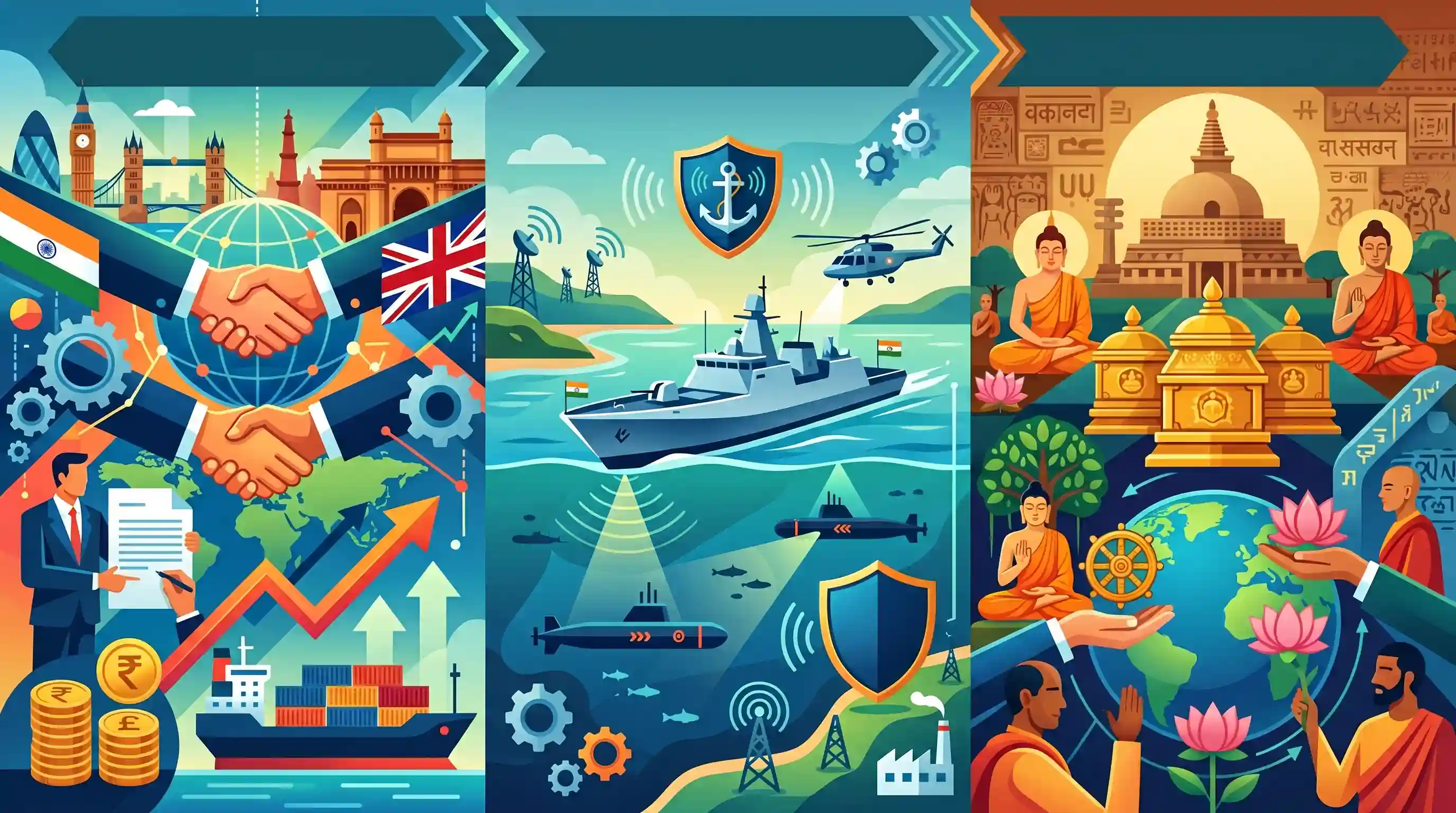
Why It Matters
This compilation provides crucial updates across multiple UPSC syllabus areas: evaluating the trajectory of India-UK ties (GS2), understanding the modernization of the Indian Navy through indigenous shipbuilding (GS3), and appreciating the historical and diplomatic weight of India's Buddhist heritage (GS1).
Summary
The article highlights three distinct UPSC current affairs topics: the ongoing evolution of India-UK bilateral relations (including FTA negotiations), the launch of the Indian Navy's first Anti-Submarine Warfare Shallow Water Craft (ASW SWC) named 'Arnala' for enhanced coastal defence, and the cultural and diplomatic significance of the Kapilavastu Buddhist relics. These topics span international relations, defence technology indigenisation, and ancient Indian art and culture.
Key Points
- India and the UK are actively engaged in negotiations for a Free Trade Agreement (FTA) to bolster bilateral trade, investment, and strategic partnerships.
- The Indian Navy launched 'Arnala', the first Anti-Submarine Warfare Shallow Water Craft (ASW SWC), marking a significant step in coastal defence and defence indigenisation.
- Built by GRSE, the Arnala-class ships will replace the Abhay-class corvettes, specializing in anti-submarine operations in coastal waters and Low Intensity Maritime Operations (LIMO).
- The Kapilavastu relics, containing bone fragments of the Buddha, underscore India's profound Buddhist heritage and are utilized in cultural diplomacy to strengthen ties with Southeast Asian nations.
- The veneration of relics and the construction of Stupas are central to Buddhist art, architecture, and religious traditions, originating in ancient India.
Important Terms
India-UK Free Trade Agreement (FTA)

A comprehensive trade pact signed in 2025 aiming to eliminate tariffs on over 90% of goods, targeting a bilateral trade volume of $120 billion by 2030.
UPSC context
GS Paper 2: International Relations; tests India's trade strategy, post-Brexit economic diplomacy, and bilateral cooperation with major economies.
Anti-Submarine Warfare Shallow Water Craft (ASW SWC)
A class of indigenously built naval vessels designed for underwater surveillance, mine-laying, and detecting submarines in coastal and shallow waters (less than 30 meters deep).
UPSC context
GS Paper 3: Security & Defence; examines maritime security, indigenisation of technology, and the "Atmanirbhar Bharat" initiative in the Navy.
Kapilavastu Relics
Sacred bone fragments of Lord Buddha and his disciples excavated from Piprahwa (UP), categorized as rare 'AA' antiquities and used as tools for cultural diplomacy.
UPSC context
GS Paper 1: Art & Culture; relates to ancient history, Buddhist architecture, and India's soft power outreach in Asia.
Garden Reach Shipbuilders and Engineers (GRSE)
A leading Miniratna defence Public Sector Undertaking (PSU) based in Kolkata, specialized in the design and construction of warships for the Indian Navy and Coast Guard.
UPSC context
GS Paper 3: Science & Technology; tests the role of public sector enterprises in domestic manufacturing and defence self-reliance.
Buddhist Diplomacy
The strategic use of India's shared Buddhist heritage and spiritual leadership to foster cooperation and strengthen diplomatic ties with Buddhist-majority nations in Asia.
UPSC context
GS Paper 2: International Relations; examines the use of cultural assets and soft power as a tool of foreign policy.
Prelims Trap
"INS Arnala is a stealth vessel designed for deep-ocean blue-water anti-submarine operations."
Arnala is a Shallow Water Craft (SWC) specifically designed for coastal defense and low-intensity maritime operations, not deep-ocean blue-water deployments.
Static Concepts Connected
What are the 3 types of Buddhist Stupas based on their enshrined contents?
- Saririka (Bodily): Enshrines sacred bodily remains (relics) of the Buddha or his chief disciples, such as bones, teeth, or hair.
- Paribhogika (Objects): Contains objects historically used by the Buddha, such as his begging bowl, robes, or walking staff.
- Uddeshika (Memorial): Commemorative structures built at sacred places associated with significant events in the Buddha's life.
How does a standard Free Trade Agreement (FTA) differ from a CECA/CEPA?
- FTA focus: Primarily focuses on the mutual reduction or elimination of customs duties and tariffs on traded goods.
- CECA/CEPA scope: Broader in scope, covering trade in services, cross-border investment, intellectual property rights, and regulatory cooperation.
Cross-Topic Patterns
Buddhist heritage + Act East Policy
Displaying Kapilavastu relics in Southeast Asia leverages soft power, directly linking Ancient Indian History with modern diplomatic initiatives like the Act East Policy and Neighborhood First.
Coastal Defense vs Blue Water Navy
While Project 75/75I focuses on deep-sea submarines, ASW-SWCs like Arnala fill the critical gap in coastal subsurface surveillance and anti-submarine operations for tier-2 maritime security.

Expect a paired Prelims question matching Buddhist relic sites (like Piprahwa or Bhattiprolu) with their excavated contents or present states.
Linked PYQs · 4
Linked PYQs · 4
- 2023MainsGS2
Compare and contrast the British and Indian approaches to Parliamentary sovereignty.
- 2020MainsGS2
The judicial systems in India and UK seem to be converging as well as diverging in recent times. Highlight the key points of convergence and divergence between the two nations in terms of their judicial practices.
- 2023PrelimsGS1
With reference to ancient India, consider the following statements: 1. The concept of Stupa is Buddhist in origin. 2. Stupa was generally a repository of relics. 3. Stupa was a votive and commemorative structure in Buddhist tradition. How many of the statements given above are correct?
- 2016MainsGS1
Early Buddhist Stupa-art, while depicting folk motifs and narratives successfully expounds Buddhist ideals. Elucidate.
