Key Economic and Social Policy Issues for Civil Services Exam
Source:Indian Express ↗
Why It Matters
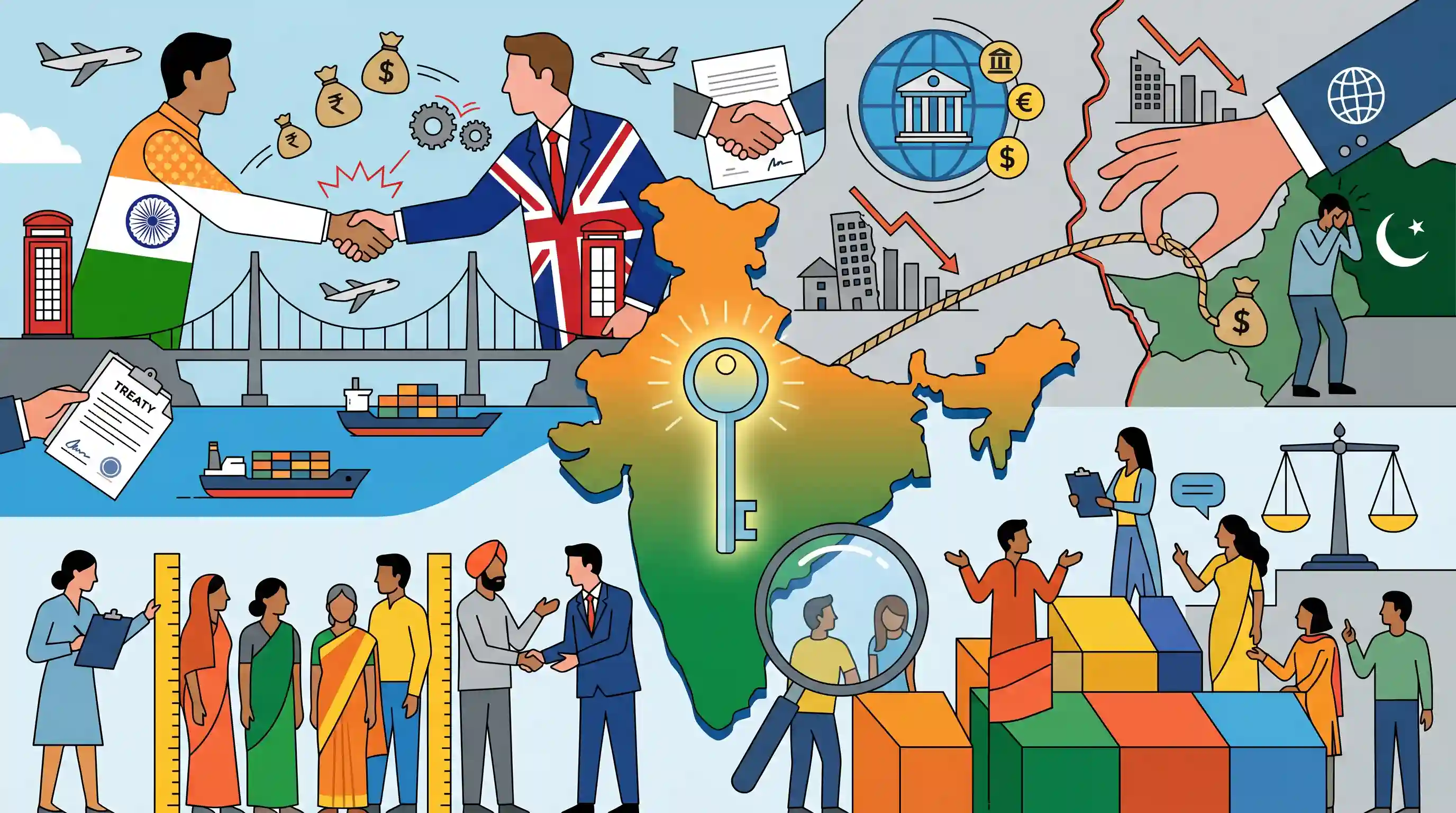
These topics are highly relevant for the Civil Services Examination across multiple papers. The India-UK FTA and Pakistan's crisis touch upon International Relations and Neighborhood First policies (GS2) as well as the Economy (GS3). The Caste Census is a fundamental issue regarding Governance, Constitutional affirmative action (GS2), and Indian Society (GS1).
Summary
This UPSC Key briefing highlights three significant current affairs topics: the progress and challenges of the India-UK Free Trade Agreement (FTA), the implications of the IMF's bailout loan to a financially struggling Pakistan, and the socio-political debates surrounding the demand for a nationwide Caste Census in India. Together, these issues encompass crucial dimensions of India's international relations, neighborhood geopolitics, and internal social justice frameworks.
Key Points
- India-UK FTA: The ongoing negotiations for a Free Trade Agreement aim to boost bilateral trade and investments, with critical sticking points involving tariff reductions, mobility for professionals, and intellectual property rights.
- IMF Loan to Pakistan: The International Monetary Fund's bailout package highlights Pakistan's profound macroeconomic instability and balance-of-payments crisis, presenting indirect security and geopolitical implications for India.
- Caste Census: The political and social push for a nationwide caste census seeks to update demographic data for targeted affirmative action and welfare schemes, while raising concerns about reinforcing caste identities.
Important Terms
India-UK Free Trade Agreement (FTA)

A bilateral pact signed in July 2025 to eliminate tariffs on most goods, enhance services trade, and facilitate labor mobility between India and the United Kingdom.
UPSC context
GS Paper II: Bilateral Agreements. Tests understanding of post-Brexit trade dynamics and India's 'Comprehensive Strategic Partnership' with Britain.
International Monetary Fund (IMF)
An international organization of 191 countries working to foster global monetary cooperation, secure financial stability, and provide emergency loans to nations facing balance-of-payments crises.
UPSC context
GS Paper II: Important International Institutions. Tests knowledge of the global financial architecture and the Bretton Woods legacy.
Extended Fund Facility (EFF)
An IMF lending program for countries facing serious medium-term balance-of-payments problems due to structural economic weaknesses, requiring long-term reforms in exchange for tranches.
UPSC context
GS Paper III: Economy. Tests technical knowledge of international lending mechanisms and their impact on India's neighborhood (e.g., Pakistan).
Caste Census
The systematic enumeration of all castes in a nationwide population survey to collect data for assessing social backwardness and refining reservation policies.
UPSC context
GS Paper I: Indian Society. Tests understanding of the socio-political debate over data-driven social justice and identity-based welfare.
Socio-Economic and Caste Census (SECC)
A 2011 enumeration exercise designed to identify beneficiaries of state support by capturing economic status and caste information, distinct from the regular demographic census.
UPSC context
GS Paper II: Governance. Tests ability to distinguish between administrative data for welfare targeting and general demographic enumeration.
Affirmative Action
Policy initiatives, such as India's reservation system, aimed at providing opportunities to historically marginalized groups to ensure social equity and representation.
UPSC context
GS Paper II: Social Justice. Tests knowledge of constitutional provisions for the upliftment of Scheduled Castes, Tribes, and Other Backward Classes.
Prelims Trap
"The decennial Census of independent India does not enumerate caste data at all."
This is false. While OBC and general caste data are excluded, the official decennial Census explicitly enumerates Scheduled Castes (SCs) and Scheduled Tribes (STs) as per constitutional mandates.
Static Concepts Connected
How has caste enumeration evolved in India's Census history?
- 1931 Census: The last comprehensive, published nationwide enumeration of all castes, conducted under the British colonial government.
- Post-1951 Policy: Independent India restricted official decennial census enumeration exclusively to Scheduled Castes (SCs) and Scheduled Tribes (STs).
- SECC 2011: Attempted a socio-economic and caste census, but the raw caste data was plagued by errors and never officially released for formulating quotas.
What mechanisms does the IMF use to fund BoP crises?
- Stand-By Arrangement: Provides short-term financial assistance to countries facing temporary Balance of Payments (BoP) problems, subject to strict policy conditions.
- Extended Fund Facility: Designed for medium- to long-term structural BoP issues requiring deeper economic reforms and extended repayment periods.
- Rapid Financing Instrument: Offers quick, low-conditionality financial assistance for urgent BoP needs arising from unexpected shocks like natural disasters.
Cross-Topic Patterns
Caste Census + OBC Sub-categorization
Empirical caste data is the missing link required to implement the Justice Rohini Commission's recommendations for equitable sub-quota distribution among marginalized OBCs.
UK FTA + IPR 'Evergreening' debates
Negotiations with developed nations like the UK often pressure India to dilute Section 3(d) of the Patents Act, pitting trade goals against affordable healthcare.

Expect a Prelims question blending the 1931 Census, SECC 2011 limits, and Constitutional mandates (Art 340) for backwardness.
Linked PYQs · 4
Linked PYQs · 4
- 2018MainsGS1
Caste system is assuming new identities and associational forms. Hence, caste system cannot be eradicated in India." Comment.
- 2024MainsGS1
Despite comprehensive policies for equity and social justice, underprivileged sections are not yet getting the full benefits of affirmative action envisaged by the Constitution. Comment.
- 2016MainsGS2
Increasing cross-border terrorist attacks in India and growing interference in the internal affairs of several member-states by Pakistan are not conducive for the future of SAARC (South Asian Association for Regional Cooperation)." Explain with suitable examples.
- 2020MainsGS2
The judicial systems in India and UK seem to be converging as well as diverging in recent times. Highlight the key points of convergence and divergence between the two nations in terms of their judicial practices.
