UPSC Core Themes on FTAs, Chola Empire, and GM Crops
Source:Indian Express ↗
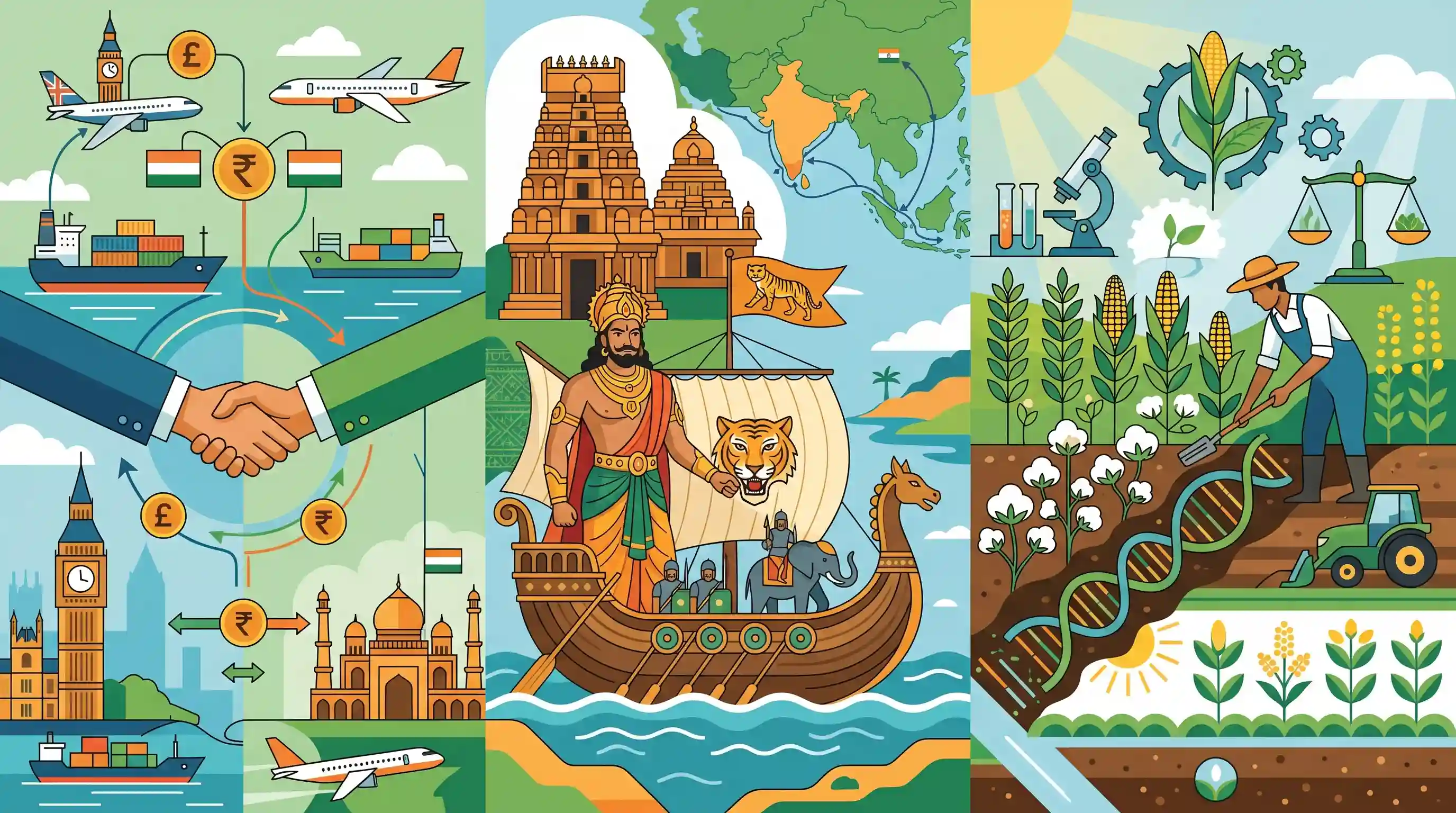
Why It Matters
These topics are highly recurrent in UPSC exams. India's FTAs are crucial for GS-II (International Relations) and GS-III (Economy). The Chola dynasty, specifically Rajendra I's naval achievements, is a staple of GS-I (History). Biotechnology and GM crops are central to the GS-III (Science & Technology and Agriculture) syllabus.
Summary
This UPSC Key roundup highlights three major current affairs themes: the ongoing negotiations and geopolitical significance of the India-UK Free Trade Agreement (FTA), the historical legacy of Chola Emperor Rajendra I (noted for his naval expeditions and architectural contributions), and the regulatory and ecological debates surrounding Genetically Modified (GM) crops in India's agricultural sector.
Key Points
- The India-UK Free Trade Agreement (FTA) aims to boost bilateral trade but faces negotiations over tariffs, intellectual property rights, and mobility of professionals.
- Rajendra I (Chola dynasty) is historically significant for his extensive naval campaigns in Southeast Asia (Srivijaya) and monumental temple architecture.
- The adoption and regulation of Genetically Modified (GM) crops, such as GM mustard, involve debates over their impact on agricultural yield, environmental safety, and farmers' livelihoods.
Important Terms
India-UK Free Trade Agreement (FTA)

A comprehensive pact to reduce or eliminate tariffs and trade barriers between India and the UK. It targets sectors like textiles and services while enhancing professional mobility and investment.
UPSC context
GS Paper-II (Bilateral Agreements); tests understanding of economic diplomacy, post-Brexit trade dynamics, and strategic international partnerships.
Genetic Engineering Appraisal Committee (GEAC)
The apex statutory body under the Ministry of Environment, Forest and Climate Change. It regulates the environmental release of genetically engineered organisms and evaluates field trial proposals for GM crops.
UPSC context
GS Paper-III (Environment/Science); essential for understanding India's biotechnology regulatory framework and biosafety assessment protocols.
Rajendra I (Chola Empire)
The 11th-century Chola emperor who expanded the empire to North India and Southeast Asia. He is renowned for his powerful navy and founding the capital Gangaikonda Cholapuram.
UPSC context
GS Paper-I (History/Culture); highlights India's medieval maritime legacy, administrative excellence (local self-governance), and temple architecture.
Genetically Modified (GM) Crops
Crops whose DNA is modified through biotechnology to introduce traits like pest resistance. In India, Bt Cotton is commercially cultivated, while others like GM Mustard face regulatory hurdles.
UPSC context
GS Paper-III (Agriculture/Biotechnology); focuses on food security, scientific innovation debates, and ecological impact of transgenic technology.
World Trade Organization (WTO)
An international organization that regulates global trade. It ensures trade flows smoothly and predictably through agreements on tariffs, subsidies, and intellectual property rights.
UPSC context
GS Paper-III (Economy); significant for understanding multilateral trade rules, dispute settlement, and India’s stance on global trade barriers.
Prelims Trap
"GEAC functions under the Ministry of Agriculture and Farmers Welfare to approve GM crops."
GEAC is a statutory body constituted under the Environment (Protection) Act, 1986, and operates under the Ministry of Environment, Forest and Climate Change (MoEFCC).
Static Concepts Connected
What are the defining achievements of Chola Emperor Rajendra I?
- Srivijaya Campaign: Launched unprecedented naval expeditions to Southeast Asia to secure the Strait of Malacca and dominate Indian Ocean trade routes.
- New Capital: Built Gangaikondacholapuram and its monumental Shiva temple to commemorate his victorious military march to the river Ganga.
- Cholagangam Reservoir: Constructed a massive artificial irrigation reservoir, showcasing advanced medieval water management and hydrology.
What is the statutory framework governing GM crops in India?
- EPA 1986: GEAC is legally constituted under the Rules of 1989 of the Environment (Protection) Act, 1986, not under agricultural legislation.
- MoEFCC Oversight: Operates as the apex body under the Environment Ministry for approving the large-scale use of hazardous microorganisms and recombinants.
- Commercial Release: Evaluates environmental safety and grants final statutory approval for experimental field trials and commercial cultivation of GM crops.
Cross-Topic Patterns
FTAs & TRIPS-plus IPRs
UK/EU FTA negotiations often push for strict IPRs and data exclusivity, conflicting with India's Patents Act (Section 3(d)) and its generic pharma industry.
Chola Maritime & Indo-Pacific
Ancient Chola control over the Srivijaya kingdom (Malacca Strait) reflects historical antecedents of India's modern naval strategy and Act East policy.

A multi-statement question on GM crops will likely contrast GEAC's EPA 1986 mandate with the Agriculture Ministry's advisory roles.
Linked PYQs · 3
Linked PYQs · 3
- 2025PrelimsGS1
Who among the following led a successful military campaign against the kingdom of Srivijaya, the powerful maritime State, which ruled the Malay Peninsula, Sumatra, Java and the neighbouring islands?
- 2019MainsGS3
How can biotechnology help to improve the living standards of farmers?
- 2016MainsGS2
The broader aims and objectives of WTO are to manage and promote international trade in the era of globalization. But the Doha round of negotiations seem doomed due to differences between the developed and the developing countries." Discuss in the Indian perspective.
