India UK Bilateral Trade and Jal Jeevan Mission Implementation
Source:Indian Express ↗
Why It Matters
These topics cover crucial areas across GS2 and GS3, including international relations (India-UK ties), governance and rural infrastructure (Jal Jeevan Mission), and internal security/technology (cybersecurity vulnerabilities in state institutions like ICAR).
Summary
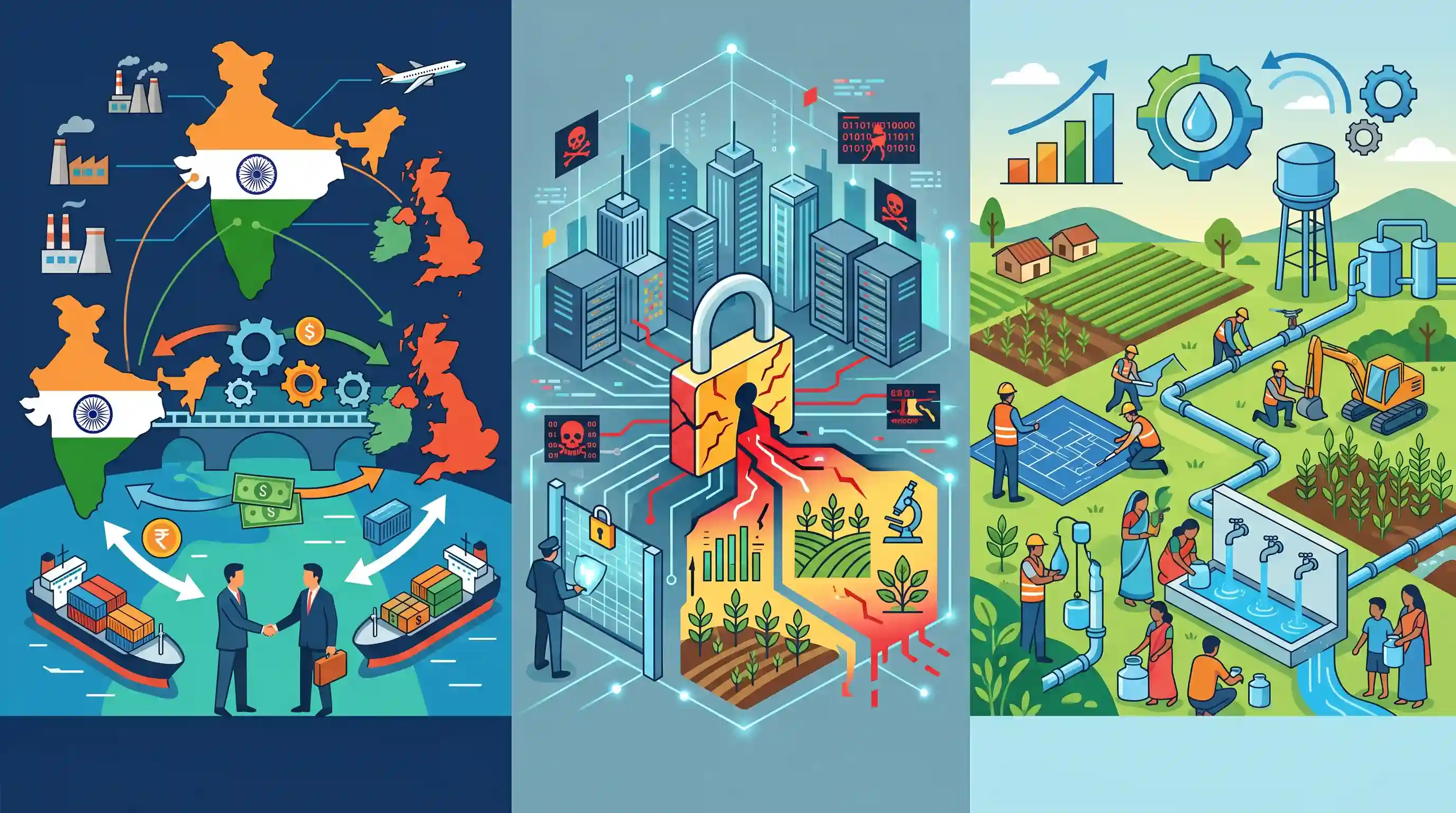
The article highlights three significant developments relevant to UPSC preparation: the strategic and economic dimensions of India-UK bilateral agreements, the implications of a major data breach at the Indian Council of Agricultural Research (ICAR) on national cybersecurity, and the governance and implementation outcomes of the Jal Jeevan Mission in delivering rural water security.
Key Points
- The ongoing developments in India-UK bilateral relations emphasize strengthening trade, technology exchange, and strategic cooperation, including potential FTA progress.
- A data breach at the Indian Council of Agricultural Research (ICAR) highlights critical vulnerabilities in India's digital infrastructure and the pressing need for enhanced cybersecurity measures in government institutions.
- The Jal Jeevan Mission remains a critical focus area for governance and rural development, aiming to provide safe and sustainable tap water connections to all rural households despite implementation challenges.
Important Terms
Jal Jeevan Mission (JJM)

A Centrally Sponsored Scheme launched in 2019 under the Ministry of Jal Shakti to provide 55 liters of safe drinking water per capita daily to all rural households through Functional Household Tap Connections (FHTC).
UPSC context
GS Paper 2: Governance and Government Schemes; GS Paper 3: Environment and Water Security. Tests understanding of rural infrastructure and sustainable development.
India-UK Comprehensive Economic and Trade Agreement (CETA)
Signed on July 24, 2025, this pact aims to eliminate/reduce tariffs on 90% of goods. It targets doubling bilateral trade to $112 billion by 2030, covering sectors like textiles, automobiles, and services.
UPSC context
GS Paper 2: Bilateral Agreements; GS Paper 3: Economic Relations. Tests knowledge of international trade dynamics and strategic economic partnerships.
Indian Council of Agricultural Research (ICAR)
The apex autonomous organization under the Ministry of Agriculture and Farmers Welfare, responsible for coordinating agricultural research and education. It manages one of the world's largest national agricultural research systems.
UPSC context
GS Paper 3: Agriculture and Food Security; Science & Technology. Relevant for research institutions' role in the Green Revolution and modern agricultural innovation.
India-UK Vision 2035
A strategic roadmap endorsed in July 2025 to elevate India-UK relations across defense, technology security, climate action, and education, building upon the 2030 Roadmap and the Comprehensive Strategic Partnership.
UPSC context
GS Paper 2: International Relations. Tests understanding of long-term strategic frameworks and shifting geopolitical alignments between India and major European powers.
Double Contribution Convention (DCC)
An agreement signed alongside the India-UK FTA allowing temporary workers to avoid double social security payments. It particularly benefits Indian IT professionals and British workers on short-term assignments.
UPSC context
GS Paper 2: Indian Diaspora; GS Paper 3: Economy. Tests knowledge of specific bilateral trade facilitation measures and their impact on the service sector.
Technology Security Initiative (TSI)
An initiative launched in 2024 to foster collaboration in critical and emerging technologies like AI, telecoms, and semiconductors between India and the UK, aimed at securing supply chains and R&D.
UPSC context
GS Paper 3: Cybersecurity and Science & Technology. Essential for topics related to high-tech diplomacy and safeguarding digital infrastructure.
Prelims Trap
"Jal Jeevan Mission aims to provide 55 liters per capita per day of piped water to both rural and urban households."
The core Jal Jeevan Mission (launched in 2019) is strictly for rural households. AMRUT 2.0 handles urban supply. UPSC frequently swaps rural/urban beneficiaries in schemes.
Static Concepts Connected
What is the role of 'Paani Samitis' under the Jal Jeevan Mission?
- Village Level Committee: A statutory sub-committee of the Gram Panchayat responsible for planning, implementing, and managing in-village water supply infrastructure.
- Composition: Must comprise 10-15 members, with a mandatory minimum of 50% women and proportional representation from weaker sections like SCs and STs.
- Financial Autonomy: Empowered to levy and collect user charges to ensure the long-term financial sustainability of the local water supply systems.
What is the institutional framework for cybersecurity in India?
- CERT-In: The national nodal agency under MeitY for responding to computer security incidents, issuing alerts, and directing emergency measures.
- NCIIPC: Operating under NTRO, it is the designated agency to protect India's Critical Information Infrastructure (CII) across critical sectors.
- Cyber Swachhta Kendra: A specialized center aimed at providing a secure cyberspace by detecting botnet infections and analyzing malware.
Cross-Topic Patterns
Agriculture Tech + Cyber Security
The ICAR breach shifts cybersecurity from a finance focus to food security. UPSC often links digital agriculture missions like AgriStack with critical information infrastructure vulnerabilities.
FTAs vs. Aatmanirbhar Bharat
Balancing tariff eliminations for UK automobiles and spirits with domestic manufacturing policies. This highlights the tension between strategic FTA integration and the Aatmanirbhar Bharat mandate.

Expect a 2026 multi-statement prelims question linking JJM's 'Paani Samitis' with the 73rd Amendment and local user-charge collection.
Linked PYQs · 4
Linked PYQs · 4
- 2017MainsGS3
Discuss the potential threats of Cyber attack and the security framework to prevent it.
- 2020MainsGS3
Discuss different types of cyber crimes and measures required to be taken to fight the menace.
- 2021MainsGS3
Keeping in view India's internal security, analyse the impact of cross-border cyber attacks. Also discuss defensive measures against these sophisticated attacks.
- 2024MainsGS2
Analyse the role of local bodies in providing good governance at local level and bring out the pros and cons merging the rural local bodies with the urban local bodies.
