India Spain Defense Ties and Media Sensationalism
Source:Indian Express ↗
Why It Matters
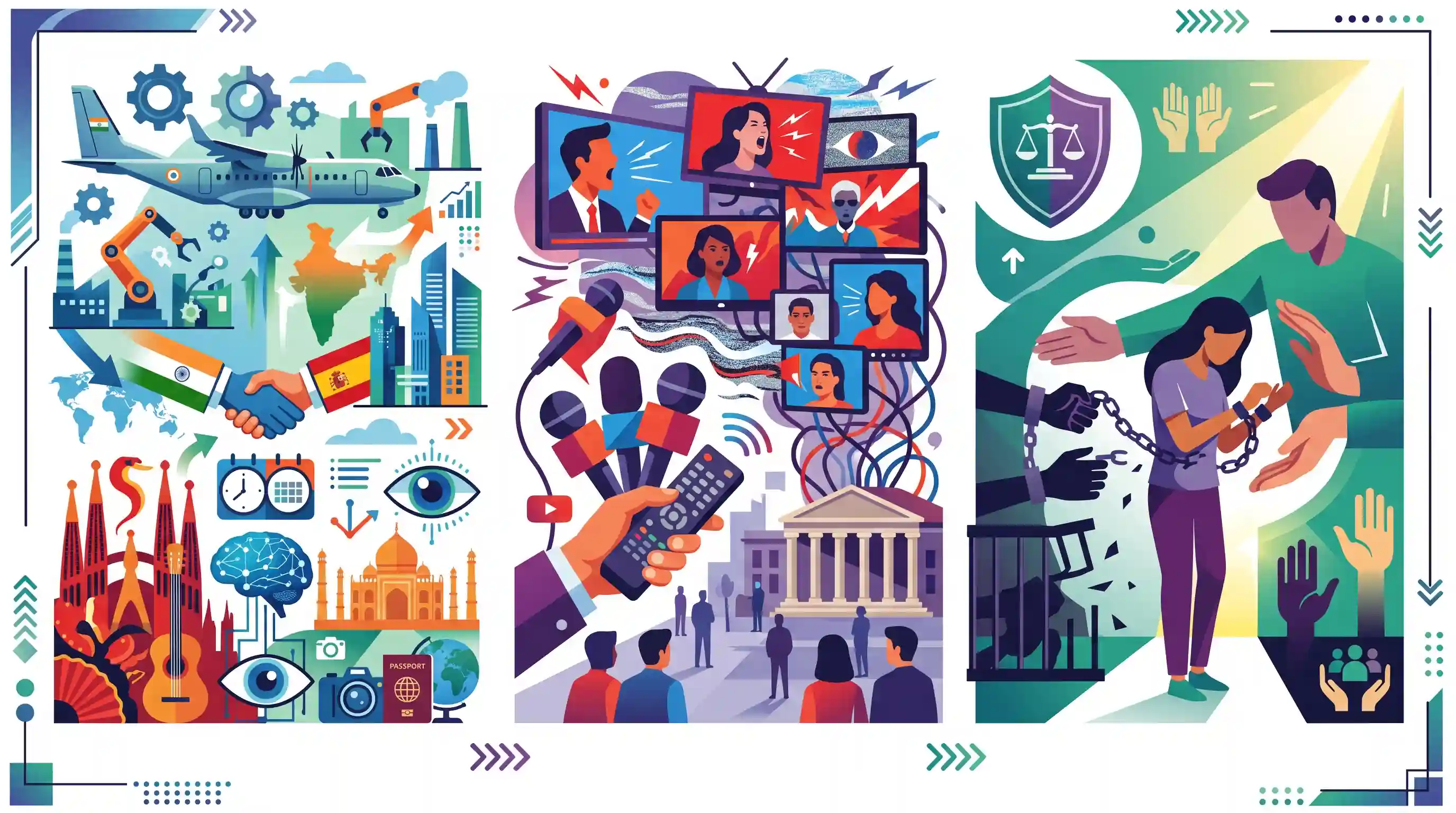
It provides a multidimensional perspective on current affairs, connecting India's strategic defense partnerships in Europe (Spain) with broader domestic social justice issues (PITA) and the ethical implications of modern media consumption trends ('cable newsification') on democratic discourse.
Summary
The article highlights three diverse developments relevant to UPSC aspirants: the strengthening of India-Spain bilateral relations through defense manufacturing (C-295 aircraft) and the declaration of a Dual Year of Culture, Tourism, and AI; the ethical and democratic challenges posed by the 'cable newsification' of public discourse; and the ongoing relevance of the Prevention of Immoral Traffic Act (PITA) in addressing human trafficking. These topics span international relations, media ethics, and social justice.
Key Points
- India and Spain have agreed to designate 2026 as the India-Spain Year of Culture, Tourism, and Artificial Intelligence, indicating a diversification of their bilateral ties beyond traditional sectors.
- The partnership is heavily bolstered by defense cooperation, notably the Tata-Airbus joint venture in Vadodara to manufacture C-295 transport aircraft, marking a milestone in India's 'Make in India' defense push.
- The term 'Cable newsification' highlights a growing concern in modern media and political discourse, where complex governance and geopolitical issues are reduced to sensationalized, high-conflict soundbites, posing ethical challenges for democracy.
- The Prevention of Immoral Traffic Act (PITA) remains central to India's legal framework against human trafficking and the exploitation of vulnerable groups, continuing to be a focal point for social justice reforms.
Important Terms
Prevention of Immoral Traffic Act (PITA)

India's primary legislation (1956, amended 1986) aimed at preventing human trafficking and commercial sexual exploitation, primarily targeting the infrastructure of the flesh trade like brothels and pimps.
UPSC context
GS Paper II (Social Justice/Vulnerable Sections) and GS Paper I (Social Issues). Tests knowledge of legal protections against exploitation.
India-Spain Year of Culture, Tourism, and AI (2026)
A 2026 bilateral initiative marking 70 years of diplomatic relations, intended to boost cooperation in cultural exchange, tourism promotion, and joint Artificial Intelligence research.
UPSC context
GS Paper II (International Relations). Tests understanding of bilateral groupings and strategic partnerships with European nations.
Cable newsification
The transformation of public discourse into a spectacle driven by conflict, outrage, and sensationalism, often prioritizing viral emotional engagement over substantive policy information.
UPSC context
GS Paper II (Media's Role in Democracy) and GS Paper IV (Ethics). Tests critical thinking on media's impact on public morality.
Tata Advanced Systems
The defense and aerospace arm of the Tata Group, partnered with Airbus to operate India's first private-sector military aircraft Final Assembly Line in Vadodara.
UPSC context
GS Paper III (Indigenization of Technology/Defense Manufacturing). Tests knowledge of the private sector's role in 'Atmanirbhar Bharat'.
C-295 Aircraft
A multi-role tactical transport aircraft being manufactured in India under a landmark partnership between Airbus and Tata to replace the Indian Air Force's aging Avro-748 fleet.
UPSC context
GS Paper III (Security/Defense Procurement). Relevant to indigenization efforts and modernization of the Indian Air Force.
Prelims Trap
PITA makes the act of prostitution by an adult individual entirely illegal in India.
PITA criminalizes the organization, facilitation, and profiting from commercial sexual exploitation (e.g., brothel-keeping, pimping, soliciting), not the individual act of prostitution by consenting adults.
Static Concepts Connected
What are the primary constitutional and legal safeguards against human trafficking in India?
- Article 23: A Fundamental Right that explicitly prohibits "traffic in human beings" and forced labour (begar), making it a punishable offence.
- Article 39 (e) & (f): Directive Principles instructing the State to ensure citizens are protected against exploitation and moral or material abandonment.
- ITPA 1956 (PITA): The primary legislation enacted to fulfill India's obligations under the 1950 UN Convention against the exploitation of prostitution.
How does India promote private sector participation in Defence Manufacturing?
- DAP 2020: The Defence Acquisition Procedure (DAP) highly prioritizes the 'Buy (Indian-IDDM)' category, focusing on indigenous design, development, and manufacturing.
- FDI Limits: FDI in the defence sector is allowed up to 74% under the automatic route, encouraging global OEMs to form Indian JVs.
- Breaking monopolies: Projects like the Vadodara Tata-Airbus plant mark a deliberate policy shift away from the traditional monopoly of Defence PSUs like HAL.
Cross-Topic Patterns
Defence Indigenization + Global Supply Chains
The Tata-Airbus C-295 facility signifies a major GS3 shift from PSU monopolies to private-sector defense manufacturing, integrating Indian private firms into global military supply chains.
Media Ethics + Democratic Discourse
'Cable newsification' is a high-value concept for GS4 (Ethics in Media) and Essay papers, demonstrating how sensationalism directly degrades informed citizenry and democratic governance.
International Treaties + Domestic Laws
PITA (1956) exemplifies a recurring UPSC GS2 theme: domestic legislation enacted to fulfill India's international commitments, in this case, the 1950 UN Convention on trafficking.

Expect Prelims statements testing the 'first private military assembly' aspect of C-295 and the exact legal boundary of PITA vs Article 23.
Linked PYQs · 2
Linked PYQs · 2
- 2023MainsGS2
‘The expansion and strengthening of NATO and a stronger US-Europe strategic partnership works well for India.’ What is your opinion about this statement ? Give reasons and examples to support your answer.
- 2025MainsGS4
In the present digital age, social media has revolutionised our way of communication and interaction. However, it has raised several ethical issues and challenges. Describe the key ethical dilemmas in this regard.
