Strategic Maritime Partnership and Behavioral Public Policy
Source:Indian Express ↗
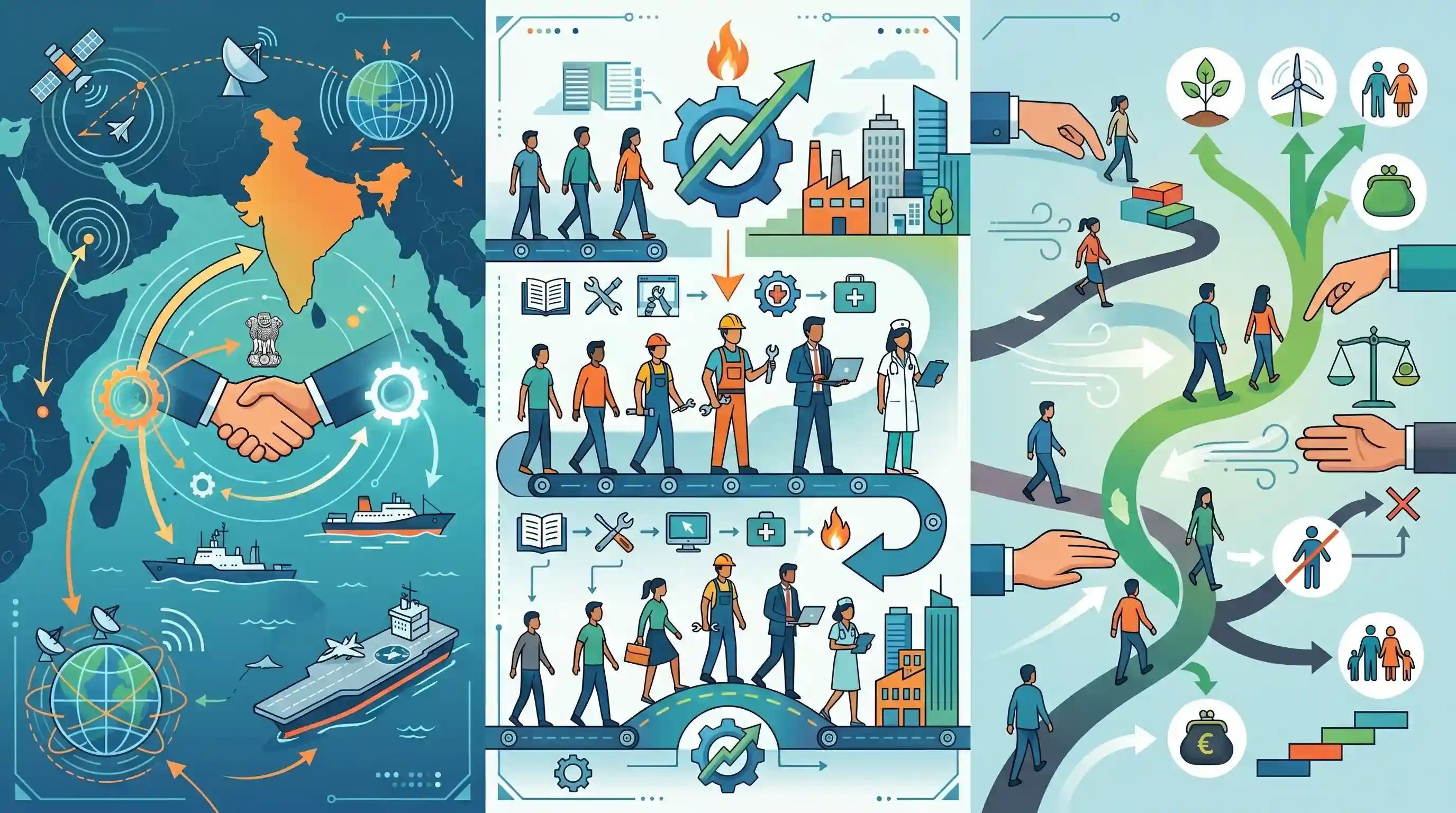
Why It Matters
The diverse topics cover crucial areas across GS Papers 2, 3, and 4. Analyzing maritime security partnerships in the IOR, addressing the structural skill deficit for economic growth, and leveraging behavioral insights for governance are recurring themes in the UPSC Mains examination.
Summary
The article discusses three distinct topics relevant for UPSC preparation: the geopolitical and maritime significance of India-Seychelles relations in the Indian Ocean Region, the objectives of the Pradhan Mantri Kaushal Vikas Yojana (PMKVY) in bridging the skill gap for employment, and the application of 'Nudge' theory in governance. Nudging applies behavioral economics to gently steer citizen behavior towards positive public policy outcomes.
Key Points
- India's strategic partnership with Seychelles plays a vital role in ensuring maritime security in the Indian Ocean Region (IOR) and advances the SAGAR (Security and Growth for All in the Region) vision.
- The Pradhan Mantri Kaushal Vikas Yojana (PMKVY) is a flagship scheme aimed at boosting the employability of the youth through industry-relevant skill training, thereby harnessing India's demographic dividend.
- The 'Nudge' campaign showcases the integration of behavioral economics into public policy, utilizing positive reinforcement and indirect suggestions to encourage socially desirable behaviors without coercion.
Important Terms
SAGAR (Security and Growth for All in the Region)

India's strategic doctrine for the Indian Ocean, emphasizing cooperative maritime security, capacity building, and sustainable development to ensure the region remains safe and prosperous for all littoral nations.
UPSC context
GS Paper II: International Relations. Crucial for understanding India’s maritime strategy and its role as a 'net security provider' in the IOR.
Pradhan Mantri Kaushal Vikas Yojana (PMKVY)
The flagship skill development scheme of the Ministry of Skill Development and Entrepreneurship, aiming to provide industry-relevant vocational training and certification to Indian youth to enhance employability.
UPSC context
GS Paper II & III: Government Schemes and Employment. Tests knowledge of human resource development and bridging the skill-gap.
Nudge Theory
A behavioral economics concept using subtle policy shifts or 'choice architecture' to steer citizen behavior toward positive outcomes without restricting freedom of choice or using mandates.
UPSC context
GS Paper III & IV: Economics and Ethics. Relevant for innovative governance and public policy implementation (e.g., Swachh Bharat Mission).
Island Diplomacy
A nation's strategic engagement with small island states through defense cooperation, infrastructure development, and climate support to secure maritime interests and counter regional rivals.
UPSC context
GS Paper II: International Relations. Highlights India's specific outreach to nations like Seychelles and Mauritius to maintain regional influence.
Blue Economy
The sustainable use of ocean resources for economic growth, improved livelihoods, and jobs while preserving the health of the marine ecosystem.
UPSC context
GS Paper III: Economy and Environment. A key pillar of bilateral cooperation with island nations regarding fisheries and seabed minerals.
Ministry of Skill Development and Entrepreneurship (MSDE)
The nodal ministry established in 2014 to coordinate all skill development efforts across the country, aiming to create a 'Skilled India' through various vocational training initiatives.
UPSC context
GS Paper II: Statutory/Regulatory/Quasi-judicial bodies. Important for institutional frameworks governing human capital.
Prelims Trap
Nudge theory relies on economic penalties, strict legal mandates, and bans to ensure citizen behavioral compliance.
Nudging explicitly avoids coercion, bans, or heavy economic penalties. It alters the 'choice architecture' using positive reinforcement to guide decisions voluntarily.
Static Concepts Connected
What is India's SAGAR doctrine and its role in Indian Ocean maritime security?
- SAGAR Doctrine: Launched in 2015, it stands for Security and Growth for All in the Region, promoting cooperative security and economic growth among Indian Ocean littorals.
- Capacity Building: India acts as a 'net security provider' by supplying patrol vessels (e.g., PS Zoroaster to Seychelles) and setting up Coastal Surveillance Radar Systems.
- Vision MAHASAGAR: A strategic initiative bringing together maritime heads of IOR littorals to foster active security cooperation and regional trust.
What is 'Nudge Theory' in the context of behavioral economics and public governance?
- Libertarian Paternalism: Guiding citizens' behavior toward socially desirable outcomes while preserving their fundamental freedom to choose otherwise.
- Choice Architecture: Designing the context or environment in which people make decisions, such as making organ donation an 'opt-out' default rather than 'opt-in'.
- Non-Coercive Mechanism: It actively avoids bans, legal mandates, or heavy economic penalties, relying instead on indirect suggestions and positive reinforcement.
Cross-Topic Patterns
Skilling converges with Green Transition
Linking PMKVY 4.0 to the National Green Hydrogen Mission and PM Surya Ghar aligns India's demographic dividend with its Net Zero climate commitments, generating 'green jobs'.
Western IOR Maritime Shield
Assisting Seychelles and Mauritius with coastal radars forms India's primary maritime defense screen, tracking extra-regional (Chinese) naval movements across critical chokepoints in the Western Indian Ocean.
Ethics, Governance and Nudging
Behavioral economics bridges GS2 (governance) and GS4 (ethics). Past campaigns like 'GiveItUp' (LPG) demonstrate how shaping cognitive biases achieves policy success without coercion.

A 2026 MCQ will likely test PMKVY 4.0’s shift from target-driven to demand-driven Industry 4.0 skilling and green tech convergence.
Linked PYQs · 4
Linked PYQs · 4
- 2024MainsGS2
Discuss the geopolitical and geostrategic importance of Maldives for India with a focus on global trade and energy flows. Further also discuss how this relationship affects India's maritime security and regional stability amidst international competition ?
- 2014MainsGS3
While we flaunt India's demographic dividend, we ignore the dropping rates of employability. What are we missing while doing so? Where will the jobs that India desperately needs come from? Explain.
- 2023MainsGS3
Most of the unemployment in India is structural in nature. Examine the methodology adopted to compute unemployment in the country and suggest improvements.
- 2025MainsGS4
"For any kind of social re-engineering by successfully implementing welfare schemes, a civil servant must use reason and critical thinking in an ethical framework." Justify this statement with suitable examples.
