India Seychelles Maritime Relations PMKVY and Nudge Theory
Source:Indian Express ↗
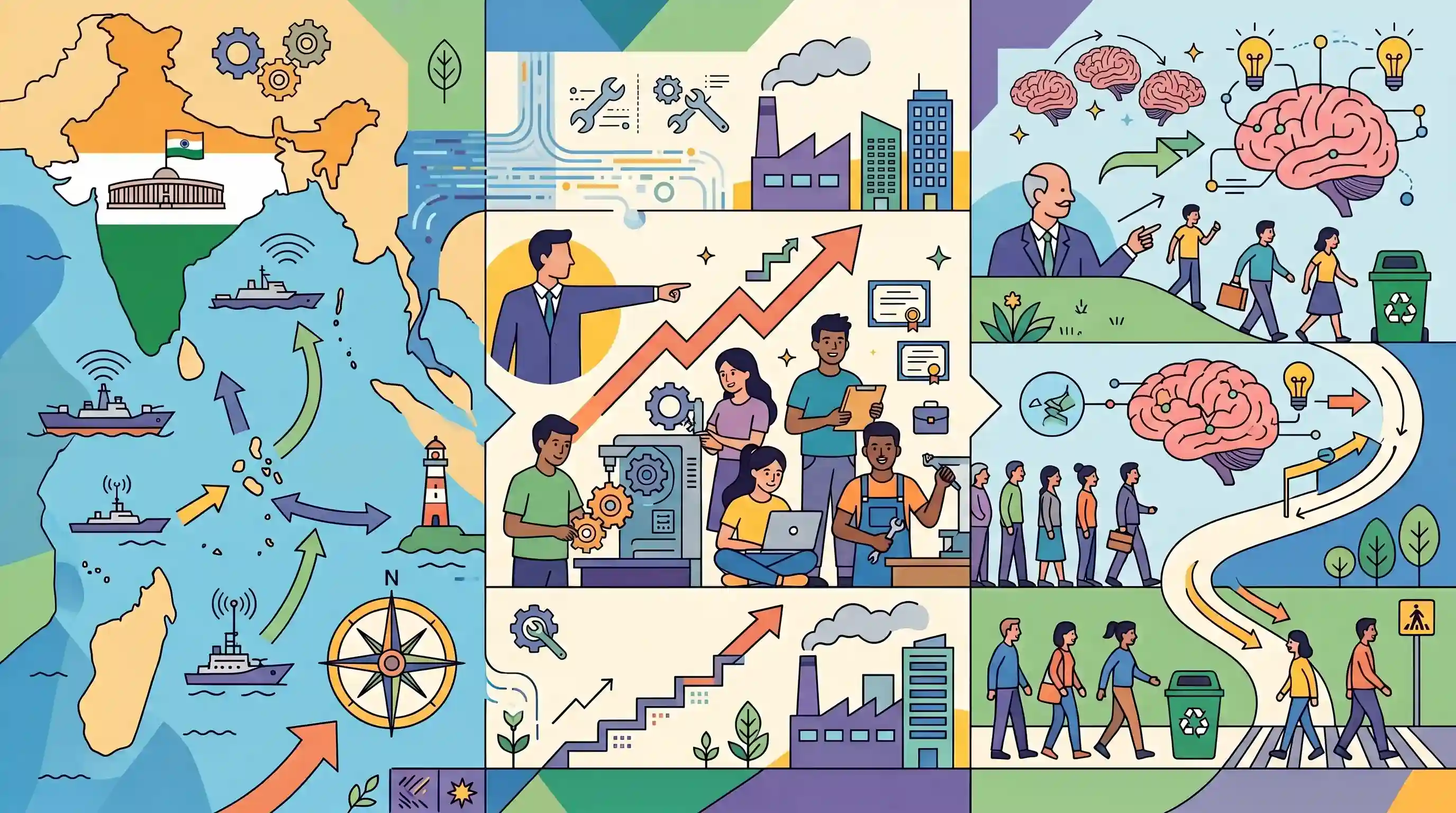
Why It Matters
Strategic partnerships in the Indian Ocean Region (IOR) are essential for maritime security (GS2), while skill development via PMKVY (GS2/GS3) and innovative governance like Nudge theory (GS4/GS2) are crucial to harnessing the demographic dividend and enhancing public policy efficacy.
Summary
The article details key UPSC current affairs topics, focusing on the strategic significance of India-Seychelles bilateral relations for maritime security in the Indian Ocean Region. It also highlights the role of the Pradhan Mantri Kaushal Vikas Yojana (PMKVY) in skill development and youth employability, and explains the application of 'Nudge Theory' in public policy to encourage positive behavioral changes in society without coercive mandates.
Key Points
- India-Seychelles relations are crucial for India's SAGAR vision and securing vital sea lanes of communication in the western Indian Ocean against piracy and increasing geopolitical competition.
- The Pradhan Mantri Kaushal Vikas Yojana (PMKVY) is a flagship scheme aimed at empowering youth through short-term skill training and Recognition of Prior Learning (RPL), aligning competencies with the National Skills Qualifications Framework (NSQF).
- Nudge theory, rooted in behavioral economics, is increasingly utilized in Indian public policy to steer citizen choices towards socially desirable outcomes without relying on strict bans or financial coercion.
Important Terms
SAGAR (Security and Growth for All in the Region)

India’s strategic vision for the Indian Ocean, emphasizing maritime security, economic cooperation, and collective growth among littoral states to ensure a stable, peaceful, and prosperous regional maritime order.
UPSC context
GS Paper II (IR). Tests understanding of India’s maritime diplomacy, Indian Ocean security, and regional leadership.
Nudge Theory
A behavioral economics concept using subtle interventions to influence decision-making without coercion. In India, it has been applied to policies like Swachh Bharat to drive positive social change through behavioral insights.
UPSC context
GS Paper IV (Ethics) & GS II (Governance). Evaluates the use of behavioral insights for social persuasion and effective policy implementation.
Pradhan Mantri Kaushal Vikas Yojana (PMKVY)
A flagship skill certification scheme providing industry-relevant vocational training to Indian youth. It aims to boost employability, certify prior learning, and align the workforce with the requirements of "Skill India."
UPSC context
GS Paper II (Social Justice/Schemes) & GS III (Economy). Focuses on human resource development, employment, and poverty alleviation strategies.
National Skill Development Corporation (NSDC)
A not-for-profit Public-Private Partnership (PPP) that catalyzes vocational training infrastructure. It manages the implementation of major skilling schemes and facilitates private sector participation in the Indian skill ecosystem.
UPSC context
GS Paper III (Economy). Tests knowledge of Public-Private Partnership models in social infrastructure and vocational education delivery.
Ministry of Skill Development and Entrepreneurship (MSDE)
The central ministry responsible for coordinating skill development efforts nationwide. It formulates policies for vocational training, apprenticeships, and entrepreneurship to maximize India’s demographic dividend.
UPSC context
GS Paper II (Governance). Analyzes institutional mechanisms for coordinating government interventions in skill development and economic productivity.
Prelims Trap
"PMKVY is implemented by the Ministry of Labour and Employment to boost formal sector jobs."
PMKVY is the flagship scheme of the Ministry of Skill Development and Entrepreneurship (MSDE), implemented by the NSDC, not the Labour Ministry.
Static Concepts Connected
What is the strategic significance of Seychelles for India?
- Choke Points: Proximity to critical Sea Lanes of Communication (SLOCs) and the Mozambique Channel, vital for energy transit.
- SAGAR Vision: A central node in India's 'Security and Growth for All in the Region' doctrine to ensure a net security provider status.
- Joint Exercises: Hosts 'Exercise Lamitiye' (biennial), enhancing interoperability and anti-piracy capabilities in the Western Indian Ocean.
How is 'Nudge Theory' applied in Indian governance?
- Behavioral Economics: Uses choice architecture to gently push citizens toward socially desirable choices without forbidding options or using heavy financial coercion.
- Indian Examples: Prominent in Swachh Bharat (community praise/shaming), the GiveItUp campaign for LPG subsidies, and Beti Bachao Beti Padhao.
- Choice Architecture: Aims to modify behavior predictably by altering the environment, famously pioneered by Richard Thaler.
Cross-Topic Patterns
SAGAR & IOR Geopolitics
Seychelles acts as a counterweight to China's presence. UPSC frequently links Indian Ocean Region (IOR) island nations to broader maritime security, SLOCs, and deep-ocean mineral mapping.
RPL and the Demographic Dividend
PMKVY's 'Recognition of Prior Learning' (RPL) formalizes India's vast informal workforce, linking directly to GS-3 labor economics, the gig economy, and the demographic dividend.

Expect a multi-statement Prelims question pairing PMKVY's 'Recognition of Prior Learning' with NSQF competency levels and MSDE's mandate.
Linked PYQs · 3
Linked PYQs · 3
- 2018PrelimsGS1
With reference to Pradhan Mantri Kaushal Vikas Yojana, consider the following statements: 1. It is the flagship scheme of the Ministry of Labour and Employment. 2. It, among other things, will also impart training in soft skills, entrepreneurship, financial and digital literacy. 3. It aims to align the competencies of the unregulated workforce of the country to the National Skill Qualification Framework. Which of the statements given above is/are correct?
- 2024MainsGS2
Discuss the geopolitical and geostrategic importance of Maldives for India with a focus on global trade and energy flows. Further also discuss how this relationship affects India's maritime security and regional stability amidst international competition ?
- 2025MainsGS4
"For any kind of social re-engineering by successfully implementing welfare schemes, a civil servant must use reason and critical thinking in an ethical framework." Justify this statement with suitable examples.
