India Russia relations and Sahyog Portal for civil services
Source:Indian Express ↗
Why It Matters
Understanding the geopolitical balancing of India-Russia relations is essential for GS-2 IR, while the Sahyog Portal and the Insurance Bill offer highly relevant examples for GS-2 Governance and GS-3 Indian Economy respectively.
Summary
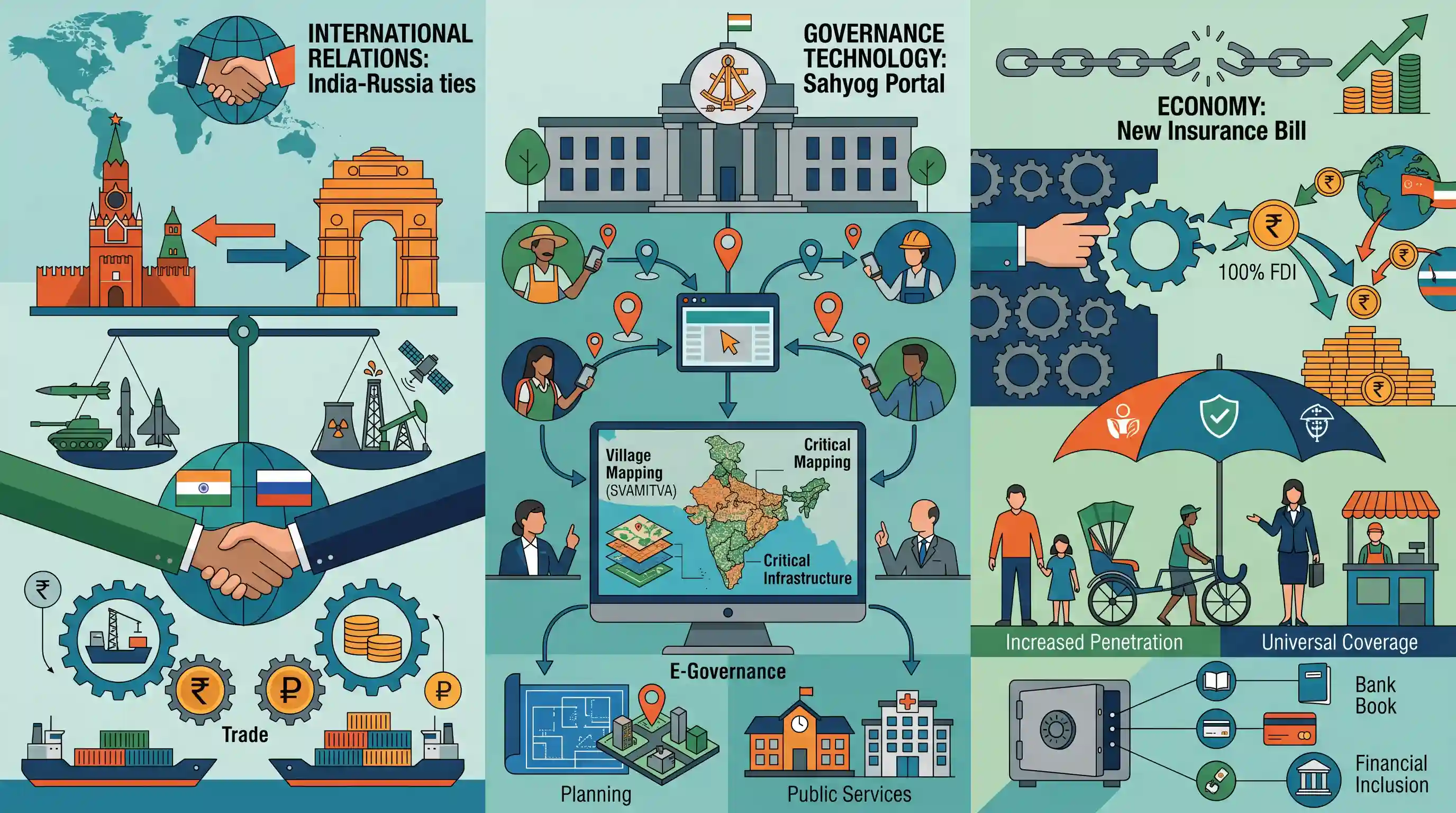
The article provides crucial UPSC insights across three diverse domains: international relations, focusing on the historical and contemporary dynamics of India-Russia ties; governance technology, detailing the Survey of India's 'Sahyog Portal' for crowdsourced geospatial data collection; and economy, discussing the New Insurance Bill's goal to overhaul regulations and increase insurance penetration.
Key Points
- India-Russia Ties: Explores the evolving strategic, defence, and energy partnership amidst global geopolitical shifts, highlighting the necessity of balancing India's multialignment strategy.
- Sahyog Portal: Evaluates the digital initiative by the Survey of India designed to crowdsource geospatial data, contributing to robust e-governance, digital mapping, and public service delivery.
- New Insurance Bill: Highlights proposed regulatory reforms in the insurance sector, including potential provisions for composite licenses, aimed at deepening insurance penetration and enhancing financial inclusion in India.
Important Terms
Insurance Laws (Amendment) Bill

Landmark legislation aiming for 'Insurance for All by 2047' by allowing 100% FDI, composite licenses for life and general insurance, and lowered capital requirements to encourage niche, regional, and specialized players.
UPSC context
GS-3 (Economy); Tests knowledge of financial sector reforms, foreign investment norms, and strategies for achieving universal financial inclusion.
Special and Privileged Strategic Partnership
The formal framework governing India-Russia bilateral relations since 2010, characterized by deep trust and cooperation in defense, nuclear energy, space, and a shared commitment to a multipolar world order.
UPSC context
GS-2 (International Relations); Crucial for analyzing India’s strategic autonomy, historical defense dependencies, and contemporary shifts in global alliances.
Sahyog Portal
A digital platform developed by the Survey of India for crowdsourcing geospatial data. It enables citizens and agencies to contribute or update mapping information, supporting schemes like SVAMITVA and national planning.
UPSC context
GS-2 (Governance); Tests understanding of e-governance, citizen-led data collection, and the implementation of the National Geospatial Policy.
IRDAI
An autonomous statutory body under the Ministry of Finance that regulates and promotes the insurance and re-insurance industries to protect policyholders and ensure the sector's orderly growth.
UPSC context
GS-3 (Economy); Relevant for understanding financial market regulators, institutional roles in consumer protection, and insurance sector stability.
Survey of India (SoI)
Founded in 1767, it is India’s oldest scientific department (under the Ministry of Science and Technology) acting as the National Mapping Agency responsible for topographical surveys and international boundary demarcation.
UPSC context
GS-1/GS-3 (Geography & Science); Tests knowledge of India's scientific heritage and its role in mapping for national security and development.
Prelims Trap
"The Sahyog geospatial portal is managed by the Ministry of Electronics and IT (MeitY)."
Aspirants often guess MeitY or Earth Sciences for tech/mapping portals. Survey of India actually falls under the Department of Science and Technology (DST).
Static Concepts Connected
What is Composite Licensing in the insurance sector?
- Current Law: Current laws (Insurance Act 1938) restrict insurers to offering either life, general, or health insurance under separate entities.
- Composite License: Allows a single corporate entity to underwrite and bundle multiple classes of insurance (life, health, general) under one regulatory registration.
- Significance: Expected to reduce compliance costs for insurers and allow consumers to buy comprehensive "all-in-one" policies, improving insurance penetration.
What is the mandate and administrative control of the Survey of India?
- Nodal Ministry: It functions under the Department of Science and Technology (Ministry of Science & Technology). Established in 1767, it is India's oldest scientific department.
- Core Mandate: It acts as the principal national mapping agency, responsible for the National Topographic Database and the official demarcation of India's external boundaries.
Cross-Topic Patterns
Geospatial mapping + SVAMITVA scheme
The Sahyog Portal's crowdsourced mapping data directly feeds into e-governance initiatives like SVAMITVA, linking the Department of Science and Technology's mapping capabilities with the Ministry of Panchayati Raj's rural property monetization goals.
Digital Public Infrastructure + Insurance reforms
IRDAI's 'Insurance for All by 2047' vision leverages Digital Public Infrastructure via 'Bima Sugam' (an e-marketplace), mirroring the UPI model to bridge the gap between regulatory reforms and tech-driven financial inclusion.

A 2026 prelims multi-statement question linking 'composite licensing', the 'Bima Trinity', and India's stagnating insurance penetration.
Linked PYQs · 4
Linked PYQs · 4
- 2024MainsGS2
e-governance is not just about the routine application of digital technology in service delivery process. It is as much about multifarious interactions for ensuring transparency and accountability. In this context evaluate the role of the 'Interactive Service Model' of e-governance.
- 2023MainsGS2
e-governance, as a critical tool of governance, has ushered in effectiveness, transparency and accountability in governments. What inadequacies hamper the enhancement of these features ?
- 2019PrelimsGS1
Recently, India signed a deal known as 'Action Plan for Prioritization and Implementation of Cooperation Areas in the Nuclear Field' with which of the following countries?
- 2022MainsGS3
Is inclusive growth possible under market economy ? State the significance of financial inclusion in achieving economic growth in India.
