India Russia Relations and Astronomical Infrastructure Developments
Source:Indian Express ↗
Why It Matters
The multifaceted ties between India, Russia, and the US form the core of India's strategic autonomy in foreign policy, which is a frequent theme in GS2. Additionally, awareness of new astronomical facilities is crucial for the Science & Technology segment in GS3 and Prelims.
Summary
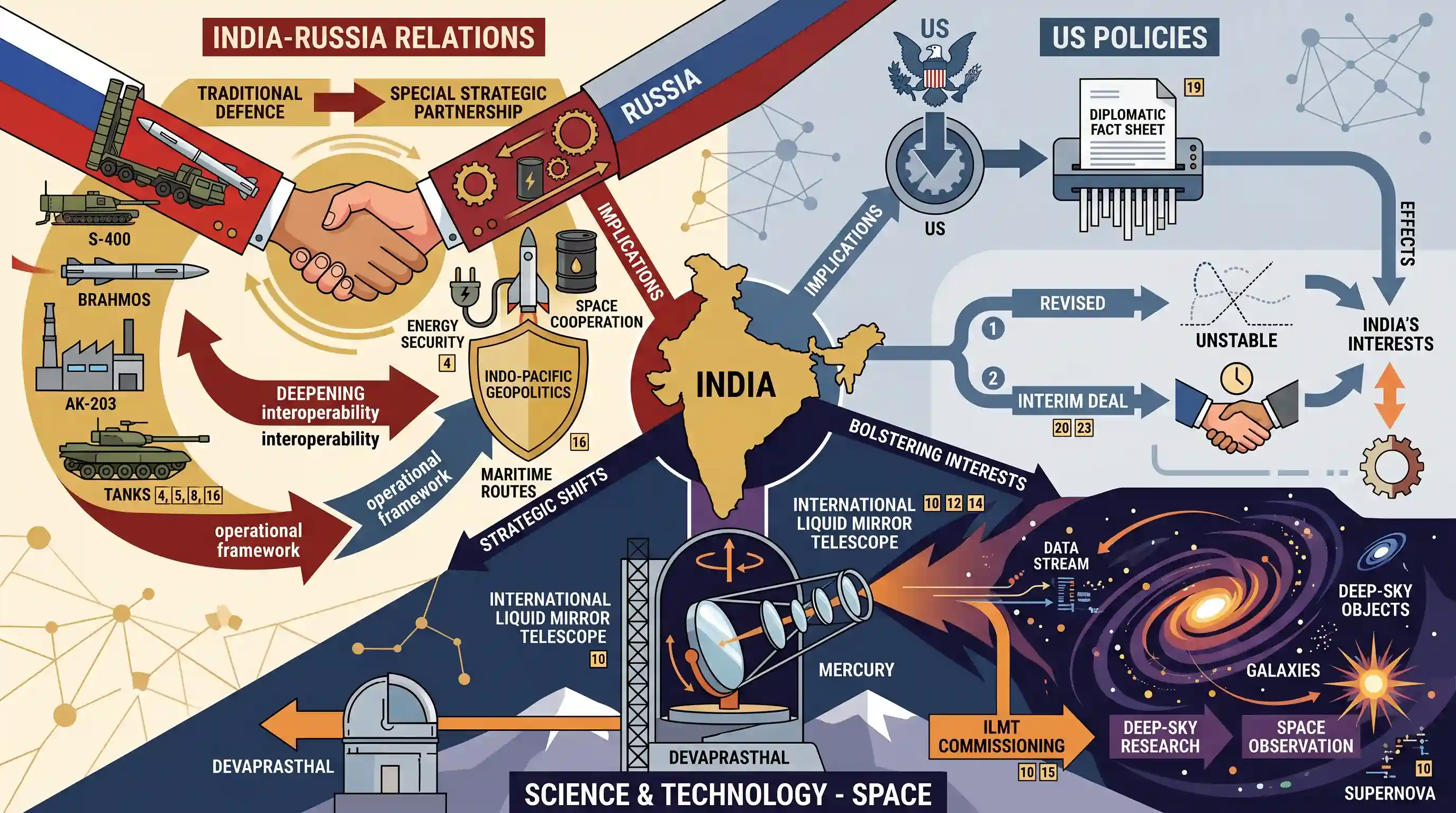
This UPSC Key analysis focuses on the evolving geopolitical dynamics of India-Russia relations, emphasizing defence and strategic shifts. It also examines the implications of the United States revising its official diplomatic fact sheets or pursuing interim deals. On the scientific front, it highlights India's advancements in space observation, notably the commissioning of new astronomical infrastructure like the International Liquid Mirror Telescope to bolster deep-sky research.
Key Points
- India-Russia bilateral relations are evolving amid global geopolitical shifts, notably involving energy ties, defence procurement, and multipolarity in the Indo-Pacific region.
- The US revising its diplomatic fact sheets (like on Taiwan) and exploring interim deals reflect adjustments in American strategic posture that hold implications for global stability and Indian foreign policy.
- India's new observational capabilities, such as the International Liquid Mirror Telescope (ILMT) in Devasthal, showcase significant advancements in the field of astronomy and space science.
Important Terms
Indo-Russian Defence Deals

Long-standing strategic partnership involving major procurements (S-400) and joint ventures (BrahMos, AK-203). It is currently evolving through logistics pacts like RELOS to maintain India's strategic autonomy.
UPSC context
GS Paper 2: Bilateral Relations. Tests understanding of historical dependencies, strategic autonomy, and the impact of global sanctions on military supply chains.
Indo-US Defence Deals
Strategic partnership focused on high-technology transfers (iCET), co-production, and foundational agreements (LEMOA, BECA). It aims to enhance interoperability and reduce India's reliance on traditional suppliers.
UPSC context
GS Paper 2: International Relations. Focuses on the "Major Defence Partner" status and critical technology cooperation in the Indo-Pacific.
International Liquid Mirror Telescope (ILMT)
Asia's largest 4-meter optical survey telescope located in Devasthal, Uttarakhand. It uses a rotating mirror of liquid mercury to detect transient celestial objects like supernovae and space debris.
UPSC context
GS Paper 3: Science and Technology. Relevant for astronomical advancements, indigenous infrastructure, and deep-sky research capabilities.
Indo-Pacific Geopolitics
Strategic focus on the maritime region spanning the Indian and Pacific Oceans. It emphasizes a "Free and Open" order and maritime security to balance regional power competition.
UPSC context
GS Paper 2: Regional Groupings. Central to the Quad, maritime domain awareness (UNCLOS), and India's leadership role in the region.
US State Department
The primary US federal executive department for foreign policy. Its official diplomatic documents, like "fact sheets," define the formal status and priority areas of bilateral relations.
UPSC context
GS Paper 2: Effect of policies of developed nations. Tests awareness of diplomatic shifts and official bilateral positioning.
Prelims Trap
"The ILMT can be steered in multiple directions to track specific moving celestial bodies across the night sky."
The ILMT is strictly stationary and looks only straight up (zenith). It cannot be tilted or steered, as the liquid mercury mirror would spill and lose its parabolic shape.
Static Concepts Connected
How does a Liquid Mirror Telescope differ from conventional optical telescopes?
- Reflective medium: Uses a rotating thin layer of liquid mercury instead of precisely polished solid glass.
- Parabolic shape: Gravity and centrifugal force from constant rotation naturally form the required concave parabolic surface to focus light.
- Stationary alignment: It cannot be steered; it strictly stares at the zenith, relying on Earth's rotation to continuously scan an overhead strip of the sky.
What is the distinction between the 'One China Principle' and 'One China Policy'?
- One China Principle: The strict stance held by Beijing that there is only one sovereign state under the name China, and Taiwan is an inalienable part of it.
- One China Policy: The diplomatic posture of countries like the US and India, which acknowledges Beijing's claim over Taiwan without explicitly endorsing it, allowing for unofficial ties.
Cross-Topic Patterns
Space observation + AI/ML integration
Massive continuous sky surveys generate terabytes of data daily. This necessitates linking space observational infrastructure directly with Big Data analytics and AI/ML algorithms to classify transients like supernovae and space debris.
Defence Indigenisation + Russian Supply Chains
India's strategic shift from Russian defence dependency to energy cooperation closely aligns with the domestic Atmanirbhar Bharat push, accelerated by recent global supply chain disruptions and geopolitical shifts.

Expect a Prelims question matching Indian telescopes (ILMT Devasthal vs MACE Hanle) with their unique working principles and locations.
Linked PYQs · 3
Linked PYQs · 3
- 2020MainsGS2
What is the significance of Indo-US defence deals over Indo-Russian defence deals? Discuss with reference to stability in the Indo-Pacific region.
- 2022MainsGS3
Launched on 25th December, 2021, James Webb Space Telescope has been much in the news since then. What are its unique features which make it superior to its predecessor Space Telescopes ? What are the key goals of this mission ? What potential benefits does it hold for the human race?
- 2023PrelimsGS1
Consider the following pairs: Objects in space Description 1. Cepheids: Giant clouds of dust and gas in space 2. Nebulae: Stars which brighten and dim periodically 3. Pulsars: Neutron stars that are formed when massive stars run out of fuel and collapse How many of the above pairs are correctly matched?
