India Nepal Relations, DAY NRLM and ENSO Dynamics for Governance
Source:Indian Express ↗
Why It Matters
The article consolidates highly probable themes across multiple GS papers: ENSO is a staple in GS1 Geography with ramifications for GS3 Agriculture; India-Nepal relations are central to GS2 Neighborhood First policy; and DAY-NRLM provides a vital case study for GS2 Social Justice and grassroots empowerment.
Summary
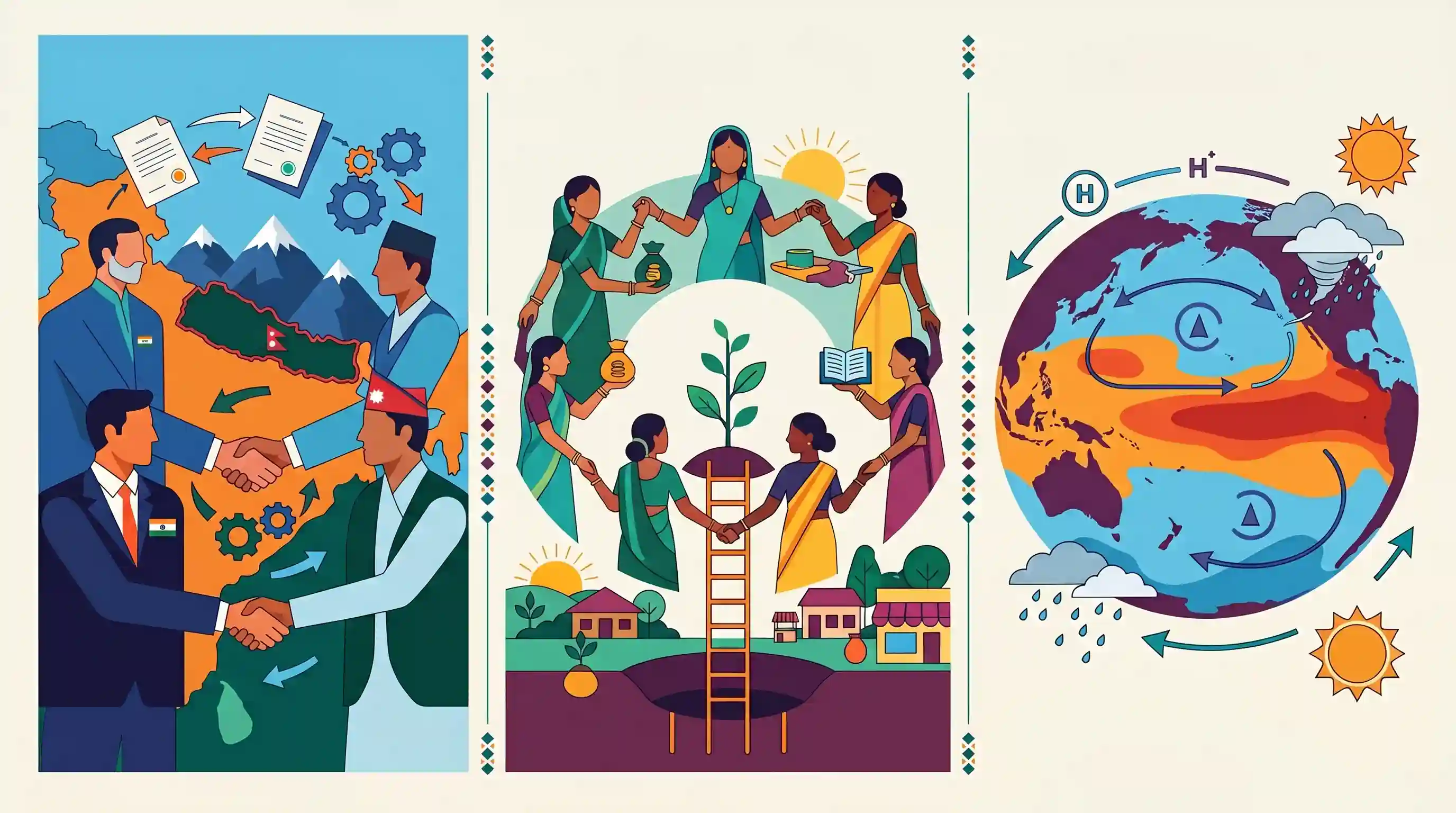
This edition of the UPSC Key aggregates significant current affairs spanning International Relations, Geography, and Governance. It explores the enduring complexities of India-Nepal relations, focusing on bilateral treaties and border dynamics. In the realm of Social Justice, it highlights the Deendayal Antyodaya Yojana-National Rural Livelihoods Mission (DAY-NRLM), underscoring its impact on rural poverty alleviation and women’s empowerment via Self-Help Groups (SHGs). Furthermore, the article delves into the El Nino-Southern Oscillation (ENSO), detailing its climatological mechanics and critical implications for the Indian monsoon. It also tracks ongoing developments like Project Glasswing as part of essential exam preparation.
Key Points
- India-Nepal relations are underpinned by historical ties, an open border, and the 1950 Treaty of Peace and Friendship, requiring diplomatic balance amid border disputes and regional geopolitical shifts.
- DAY-NRLM remains a cornerstone of India's rural poverty alleviation strategy, functioning by mobilizing rural women into Self Help Groups (SHGs) to facilitate financial inclusion and sustainable livelihoods.
- The El Nino-Southern Oscillation (ENSO) involves periodic sea surface temperature changes in the equatorial Pacific, which heavily influence global weather anomalies and directly impact the intensity and distribution of the Indian monsoon.
- Project Glasswing is highlighted as a notable current affairs development with relevance for broader socio-environmental or administrative topics in the exam.
Important Terms
DAY-NRLM (Deendayal Antyodaya Yojana - National Rural Livelihoods Mission)

A flagship poverty alleviation scheme (restructured from Aajeevika) that organizes the rural poor—primarily women—into Self-Help Group networks to facilitate financial inclusion and sustainable livelihood opportunities.
UPSC context
GS Paper II (Governance) and GS Paper III (Poverty); tests knowledge of welfare schemes and rural development.
India-Nepal Treaty of Peace and Friendship (1950)
The bedrock agreement of India-Nepal relations, granting reciprocal rights for movement, residence, and property ownership to each other’s citizens, while formalizing a "special strategic relationship."
UPSC context
GS Paper II (International Relations); tests understanding of India-Nepal bilateral dynamics and neighborhood security.
Project Glasswing
A cybersecurity initiative by AI company Anthropic that grants vetted government agencies (including India's CERT-In and NCIIPC) access to advanced AI to autonomously detect and patch vulnerabilities in critical infrastructure.
UPSC context
GS Paper III (Cybersecurity/AI); tests awareness of proactive digital defense and critical infrastructure protection.
Self Help Groups (SHGs)
Informal, peer-controlled groups of 10-20 individuals (mostly women) who practice small savings and collective lending, serving as a primary vehicle for rural financial inclusion and empowerment.
UPSC context
GS Paper II (Governance) and GS Paper III (Economics); tests social capital and microfinance models for inclusive growth.
El Niño-Southern Oscillation (ENSO)
A large-scale ocean-atmosphere phenomenon in the tropical Pacific characterized by sea-surface temperature fluctuations (El Niño/La Niña), which significantly impacts global climate patterns and the Indian Monsoon.
UPSC context
GS Paper I (Geography); tests climatology, specifically the mechanics and impact of Pacific cycles on Indian rainfall.
Prelims Trap
"Project Glasswing is an environmental initiative to protect fragile ecosystems and endemic species."
The name sounds ecological (like the Glasswing butterfly), but it is actually a frontier AI-driven cybersecurity initiative used by NCIIPC and CERT-In to patch zero-day vulnerabilities.
Static Concepts Connected
How do the mandates of CERT-In and NCIIPC differ under the IT Act?
- CERT-In: The national nodal agency for responding to general computer security incidents as they occur, operating under Section 70B of the IT Act.
- NCIIPC: Created under Section 70A specifically to protect Critical Information Infrastructure (e.g., power grids, banking) from severe cyber threats.
How does the ENSO cycle mechanically influence the Indian Monsoon?
- El Nino: Anomalous warming in the central/eastern equatorial Pacific weakens the Walker Circulation, subsiding air over India and typically causing deficit monsoon rainfall.
- La Nina: Cooling of the eastern Pacific strengthens the Walker cell, intensifying the low-pressure system over the Indian Ocean and boosting monsoon rainfall.
Cross-Topic Patterns
AI integration in National Security
Project Glasswing bridges Generative AI and national security. UPSC often links new tech applications (like AI vulnerability patching) to statutory bodies (NCIIPC/CERT-In) securing critical infrastructure.
SHGs as Governance Multipliers
DAY-NRLM’s mobilization of 10 crore women connects directly to GS2 topics like microfinance, decentralized governance, and structural poverty alleviation models (like Kudumbashree).

Expect a 2026 Prelims question pairing Project Glasswing's AI cybersecurity role with the statutory mandates of CERT-In and NCIIPC.
Linked PYQs · 3
Linked PYQs · 3
- 2012MainsGS2
Discuss the contentious issues that have caused the prolonged constitutional logjam in Nepal.
- 2020MainsGS2
Micro-Finance as an anti-poverty vaccine, is aimed at asset creation and income security of the rural poor in India". Evaluate the role of the Self Help Groups in achieving the twin objectives along with empowering women in rural India.
- 2017PrelimsGS1
With reference to 'Indian Ocean Dipole (IOD)' sometimes mentioned in the news while forecasting Indian monsoon, which of the following statements is/are correct? 1. IOD phenomenon is characterised by a difference in sea surface temperature between tropical Western Indian Ocean and tropical Eastern Pacific Ocean. 2. An IOD phenomenon can influence an El Nino's impact on the monsoon. Select the correct answer using the code given below:
