India Maldives Relations and Renewable Energy Policy Dynamics
Source:Indian Express ↗
Why It Matters
Understanding these multidimensional topics is essential for both Prelims and Mains, as they intersect India's foreign policy priorities, international trade negotiations, and environmental sustainability commitments. CBAM, in particular, illustrates the growing overlap between climate policy and international trade.
Summary
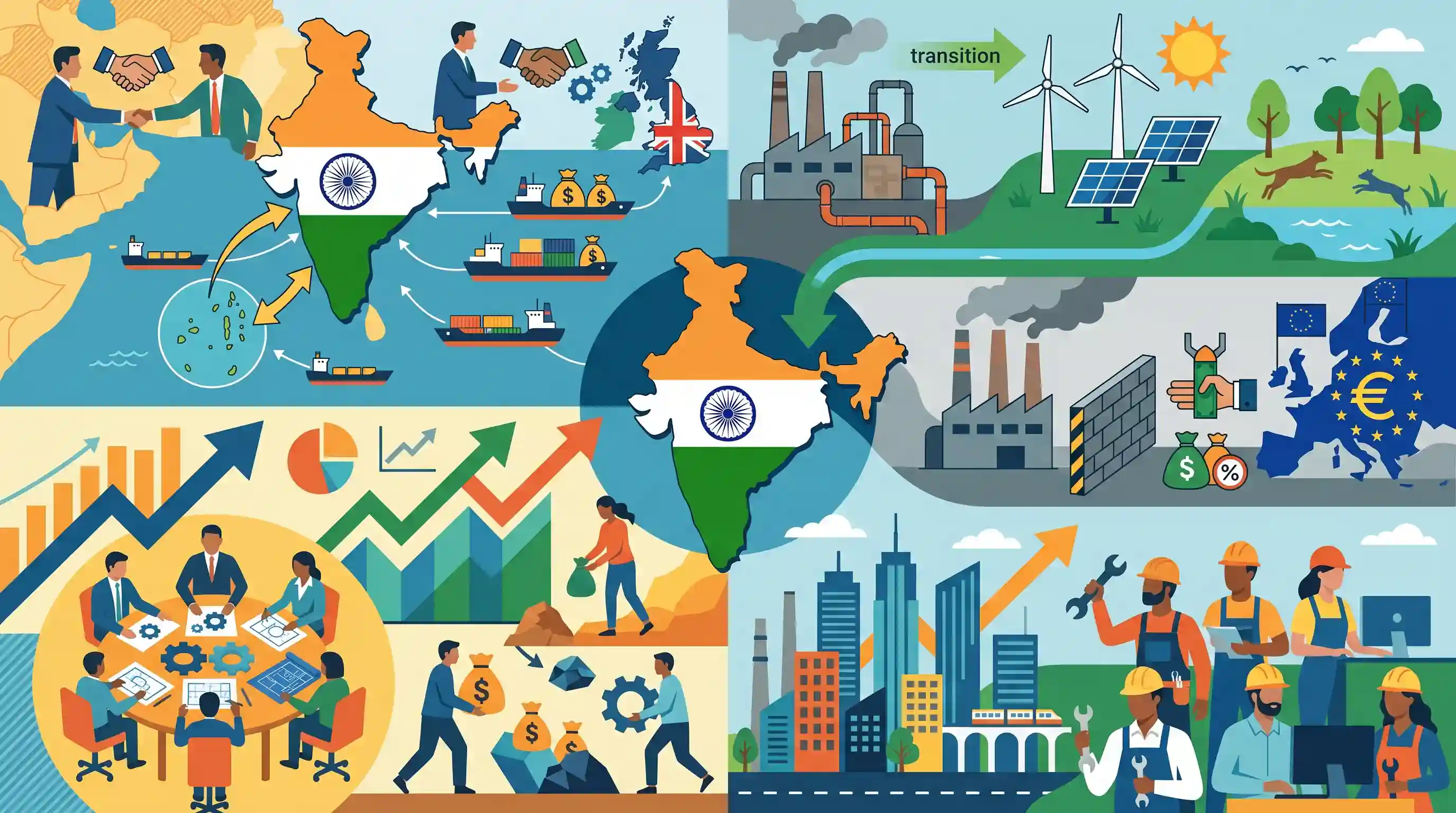
The article covers four critical current affairs themes for UPSC aspirants: India-Maldives bilateral relations, India's renewable energy transition, India-UK Free Trade Agreement negotiations, and the European Union's Carbon Border Adjustment Mechanism (CBAM). It highlights the strategic importance of the Maldives in the Indian Ocean, the economic potential of the India-UK partnership, the imperatives of shifting towards green energy, and the trade implications of global carbon taxation policies on developing economies like India.
Key Points
- India-Maldives relations are pivotal for maritime security and stability in the Indian Ocean Region, requiring careful diplomatic management amidst regional geopolitical competition.
- India's transition to renewable energy is critical for achieving its climate commitments, necessitating increased investments, technological advancements, and policy support.
- Negotiations for an India-UK Free Trade Agreement (FTA) aim to enhance economic ties, though challenges remain regarding tariffs, intellectual property, and mobility.
- The EU's Carbon Border Adjustment Mechanism (CBAM) acts as a carbon tax on imports, raising concerns for Indian exporters and sparking debates on climate justice and trade protectionism.
Important Terms
Carbon Border Adjustment Mechanism (CBAM)

An EU climate policy imposing carbon costs on imports (like steel/cement) to match the carbon price paid by domestic producers under the Emissions Trading System (ETS).
UPSC context
GS3 Environment/GS2 IR; tests understanding of trade-climate links, WTO compliance, and impact on India’s carbon-intensive exports.
Free Trade Agreement (FTA)
A formal pact between nations to reduce or eliminate tariffs and non-tariff barriers, facilitating preferential market access for goods, services, and investment.
UPSC context
GS2 IR/GS3 Economy; vital for analyzing bilateral trade relations (e.g., India-UK) and strategies for global market integration.
Neighborhood First Policy
The core pillar of India's foreign policy focusing on strengthening ties, connectivity, and development assistance with immediate neighbors to ensure regional stability and security.
UPSC context
GS2 International Relations; central to questions on India’s neighborhood management, maritime security (Maldives), and countering regional external influences.
World Trade Organization (WTO)
The only global international organization dealing with the rules of trade between nations, ensuring trade flows smoothly, predictably, and freely through consensus-based agreements.
UPSC context
GS3 Economy; fundamental for trade rules, dispute settlement, and debates on protectionism versus the Most Favored Nation (MFN) principle.
SAGAR Vision
India’s strategic vision for the Indian Ocean Region (IOR), emphasizing maritime security, cooperative development, and collective action among littoral states.
UPSC context
GS2 IR/GS3 Security; key for India’s role as a 'Net Security Provider' and maritime cooperation with Indian Ocean nations.
Carbon Leakage
The risk that businesses relocate production to countries with weaker climate policies or that carbon-intensive imports replace cleaner domestic products due to compliance costs.
UPSC context
GS3 Environment; technical term relevant to climate justice, emission mitigation strategies, and the justification for global carbon taxes.
Prelims Trap
CBAM is a global carbon pricing mechanism mandated by the UNFCCC under the Paris Agreement.
CBAM is a unilateral legislative tool by the European Union, not a UN mandate. Developing nations actively oppose it for violating UNFCCC's CBDR principles.
Static Concepts Connected
What is the principle of Common But Differentiated Responsibilities (CBDR)?
- Origin: Formalized at the 1992 Earth Summit (UNFCCC) in Rio de Janeiro.
- Core Principle: All states share responsibility for environmental protection, but have unequal capacities and historical contributions to greenhouse gas emissions.
- Current Relevance: India argues unilateral measures like CBAM violate CBDR by penalizing developing nations with fewer resources for green transitions.
What are the key maritime channels near the Maldives and Lakshadweep?
- Eight Degree Channel: Separates the Maldives from Minicoy Island (part of India's Lakshadweep archipelago).
- Nine Degree Channel: Separates Minicoy Island from the rest of the main Lakshadweep archipelago.
- Strategic Importance: These channels are crucial Sea Lines of Communication, handling massive volumes of India's external trade and energy imports.
Cross-Topic Patterns
Climate policies as trade barriers
The EU's CBAM bridges environment and economy, highlighting how unilateral climate actions can morph into non-tariff barriers that challenge WTO regulations and invite trade retaliation.
Maritime geography + Energy security
India's reliance on the Eight Degree Channel for 80% of energy imports links Maldives geopolitics directly to India's macroeconomic stability and energy security.

Expect a multi-statement 2026 question linking EU's CBAM to WTO non-tariff barriers and the UNFCCC CBDR principle.
Linked PYQs · 5
Linked PYQs · 5
- 2024MainsGS2
Discuss the geopolitical and geostrategic importance of Maldives for India with a focus on global trade and energy flows. Further also discuss how this relationship affects India's maritime security and regional stability amidst international competition ?
- 2022MainsGS3
Do you think India will meet 50 percent of its energy needs from renewable energy by 2030 ? Justify your answer. How will the shift of subsidies from fossil fuels to renewables help achieve the above objective ? Explain.
- 2020MainsGS3
Describe the benefits of deriving electric energy from sunlight in contrast to the conventional energy generation. What are the initiatives offered by our Government for this purpose?
- 2025MainsGS3
What is Carbon Capture, Utilization and Storage (CCUS)? What is the potential role of CCUS in tackling climate change?
- 2022MainsGS3
Discuss global warming and mention its effects on the global climate. Explain the control measures to bring down the level of greenhouse gases which cause global warming, in the light of the Kyoto Protocol, 1997.
