India Malaysia Relations PM Cares Fund and AI Impact Summit
Source:Indian Express ↗
Why It Matters
This comprehensive update touches upon India's foreign policy priorities in Southeast Asia, vital governance debates on public trusts and transparency, and the regulatory/ethical challenges posed by disruptive technologies like AI—all of which are high-yield areas for UPSC Prelims and Mains.
Summary
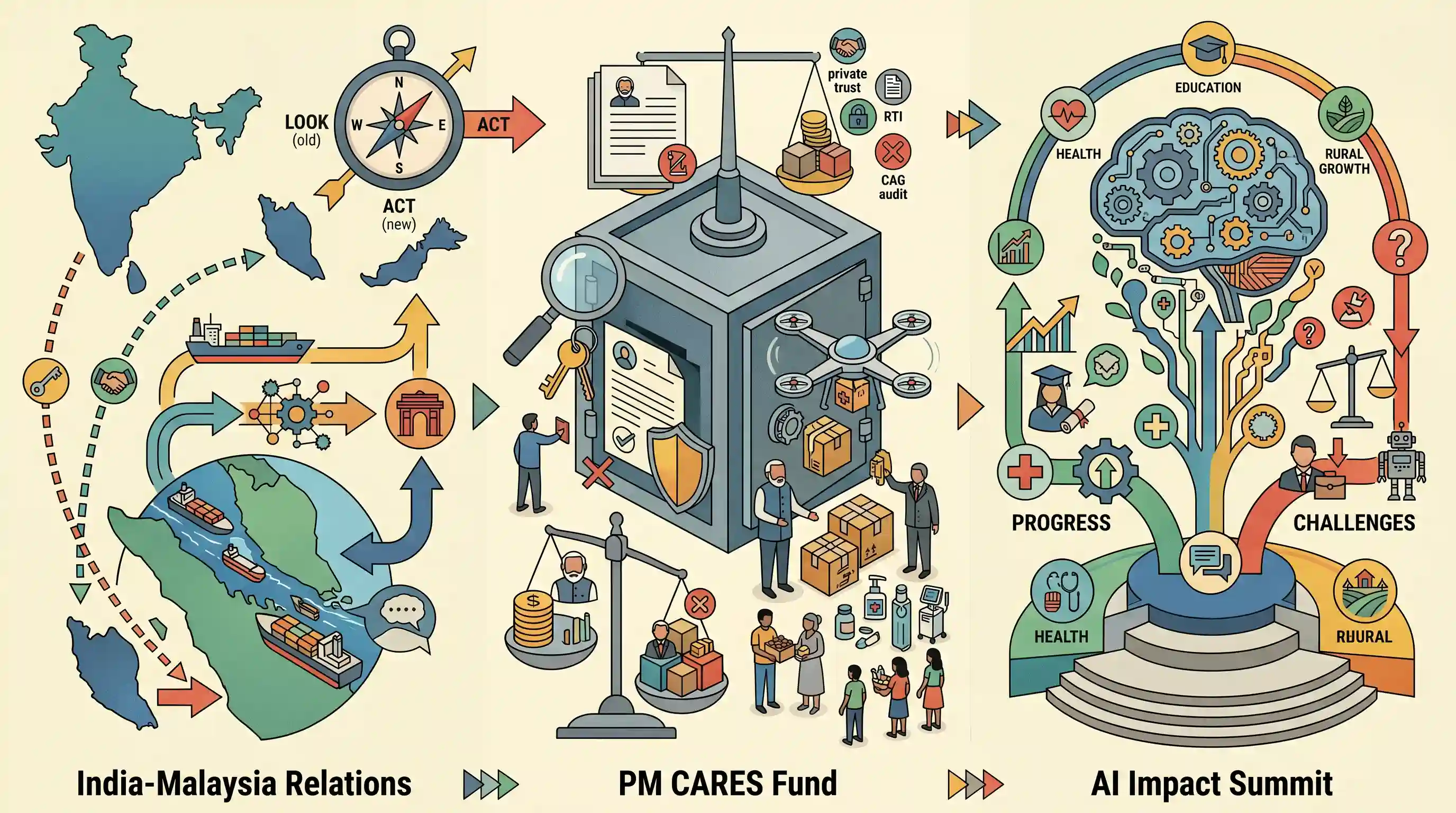
The article highlights three diverse and significant topics for civil services preparation: the strategic importance of India-Malaysia relations within the Act East Policy, the governance challenges and transparency debates surrounding the PM CARES Fund, and the societal and economic ramifications of emerging technologies as discussed in the AI Impact Summit.
Key Points
- India and Malaysia are strengthening their bilateral ties, marking an important step in India's broader Act East Policy and engagement with ASEAN.
- The PM CARES Fund remains a topic of governance debate, specifically regarding its transparency, accountability, and whether it qualifies as a public authority under the RTI Act.
- The AI Impact Summit highlighted the transformative role of Artificial Intelligence, discussing its applications, ethical considerations, and long-term socio-economic implications.
Important Terms
Act East Policy

A diplomatic initiative launched in 2014 to promote economic, strategic, and cultural ties with the Asia-Pacific. It upgraded the 1992 'Look East Policy' by adding a security dimension and focusing on connectivity.
UPSC context
GS Paper II (International Relations); tests understanding of regional diplomacy, ASEAN centrality, and the strategic importance of Northeast India.
PM CARES Fund
A public charitable trust established in 2020 to provide relief during emergencies like COVID-19. It is chaired by the Prime Minister and funded entirely by voluntary contributions, including CSR funds.
UPSC context
GS Paper II (Governance); tests debates on transparency, accountability, and the legal definition of 'Public Authority' under the RTI Act.
ASEAN
An intergovernmental organization of ten Southeast Asian nations. It is the cornerstone of India’s Act East Policy, with both entities currently maintaining a Comprehensive Strategic Partnership (CSP) to enhance maritime and digital cooperation.
UPSC context
GS Paper II (International Relations); critical for questions on regional groupings, trade agreements (AITIGA), and balancing Chinese influence in the Indo-Pacific.
Right to Information (RTI) Act
A legislative framework (2005) empowering citizens to request information from 'public authorities'. Recent debates center on whether trusts like PM CARES, managed by government officials, fall under its purview.
UPSC context
GS Paper II (Governance/Transparency); tests knowledge of citizen rights, exceptions under Section 8, and the role of the Central Information Commission.
India-AI Impact Summit 2026
A 2026 global forum in New Delhi focusing on 'AI for Development'. It emphasizes Global South perspectives, shifting focus from Western risk-regulation to 'Applied AI' for healthcare, agriculture, and sustainability.
UPSC context
GS Paper III (Science & Tech/Economy); tests emerging technology governance, Digital Public Infrastructure (DPI), and India’s role as a 'bridge power'.
Prelims Trap
PM CARES Fund is a 'Public Authority' under the RTI Act and is audited by the CAG.
The PM CARES Fund is NOT a 'Public Authority' under Section 2(h) of the RTI Act and is audited by an independent chartered accountant, not the CAG.
Static Concepts Connected
What constitutes a 'Public Authority' under Section 2(h) of the RTI Act?
- Constitutional/Statutory body: Established by or under the Constitution, or any law made by Parliament or a State Legislature.
- Government notification: Established or constituted by notification issued or order made by the appropriate Government.
- Substantial funding: Includes bodies owned, controlled, or substantially financed (directly or indirectly) by government funds, and NGOs substantially financed by the state.
What are the key geographical and strategic facts about the Strait of Malacca?
- Geography: A narrow, 800 km stretch of water between the Malay Peninsula and the Indonesian island of Sumatra.
- Trade Chokepoint: Connects the Indian Ocean to the South China Sea (Pacific Ocean), carrying a massive share of global maritime trade and energy shipments.
- Strategic imperative: Crucial for India's Act East policy and central to the "Malacca Dilemma" regarding China's vulnerability to naval blockades.
Cross-Topic Patterns
PM CARES + Corporate Governance (CSR)
Contributions to PM CARES qualify as CSR under the Companies Act, linking public governance and transparency debates with corporate statutory obligations and FCRA exemptions.
ASEAN Maritime Security + Emerging Tech
Integrating AI in maritime domain awareness (MDA) across chokepoints like the Strait of Malacca blends emerging tech capabilities with traditional Act East strategic geography.

Expect a Prelims question mixing PM CARES' exact legal status (RTI/CAG/FCRA) with CSR eligibility, or an AI ethics question in Mains GS4.
Linked PYQs · 5
Linked PYQs · 5
- 2016MainsGS2
Evaluate the economic and strategic dimensions of India's Look East Policy in the context of the post Cold War international scenario.
- 2024MainsGS2
Public charitable trusts have the potential to make India's development more inclusive as they relate to certain vital public issues. Comment.
- 2023MainsGS3
Introduce the concept of Artificial Intelligence (AI). How does Al help clinical diagnosis? Do you perceive any threat to privacy of the individual in the use of Al in healthcare?
- 2020PrelimsGS1
With the present state of development, Artificial Intelligence can effectively do which of the following? 1. Bring down electricity consumption in industrial units 2. Create meaningful short stories and songs 3. Disease diagnosis 4. Text-to-Speech Conversion 5. Wireless transmission of electrical energy Select the correct answer using the code given below:
- 2025PrelimsGS1
Consider the following statements: I. It is expected that Majorana 1 chip will enable quantum computing. II. Majorana 1 chip has been introduced by Amazon Web Services (AWS). III. Deep learning is a subset of machine learning. Which of the statements given above are correct?
