Deep sea exploration mission and Himalayan infrastructure challenges
Source:Indian Express ↗
Why It Matters
This blend of topics covers critical syllabus areas across multiple General Studies papers, testing the aspirant's understanding of global geopolitics (GS2), frontier marine technology (GS3), and the friction between developmental infrastructure and ecological vulnerability in the Himalayas (GS1/GS3).
Summary
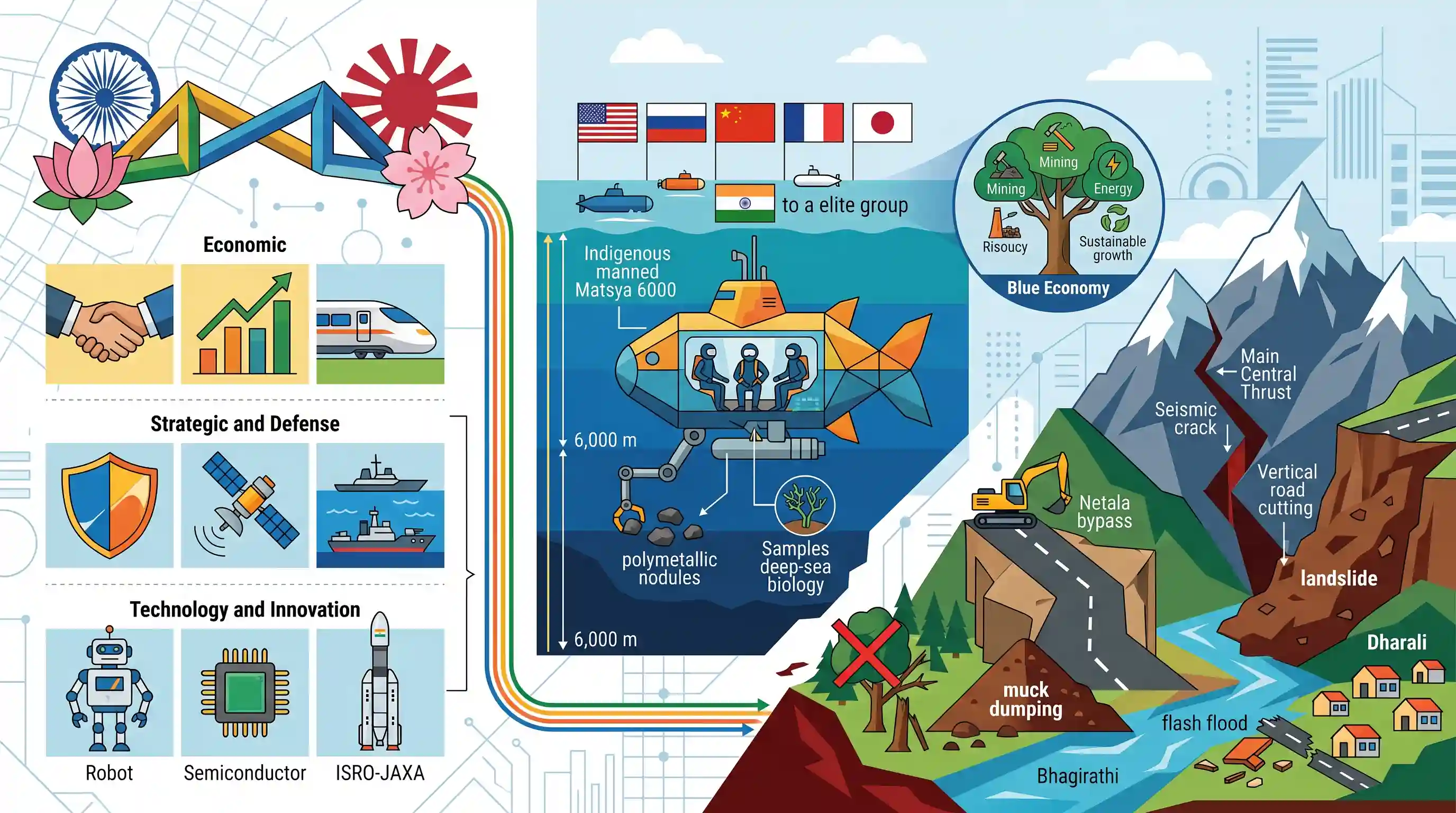
This UPSC Key analysis focuses on three crucial current affairs topics: the evolving strategic and economic dynamics of the India-Japan partnership, India's technological leap in deep-sea exploration through the Samudrayaan Mission, and the ecological challenges associated with Himalayan infrastructure projects, specifically the Netala bypass in Uttarakhand. It provides a multi-dimensional perspective covering international relations, science and technology, and disaster management.
Key Points
- The India-Japan strategic partnership is increasingly significant for geopolitical stability and economic development in the Indo-Pacific region.
- The Samudrayaan Mission is India's pioneering manned deep ocean exploration initiative designed to study marine biodiversity and harness deep-sea resources like polymetallic nodules.
- The Netala bypass project in Uttarakhand underscores the persistent conflict between infrastructure development and ecological preservation in the highly landslide-prone Himalayan region.
Important Terms
Samudrayaan Mission

India's first manned deep-ocean mission, part of the Deep Ocean Mission, aiming to send humans 6,000 meters deep in the indigenous 'Matsya 6000' submersible.
UPSC context
GS Paper 3: Science & Technology; tests awareness of indigenous technological advancements and deep-sea exploration capabilities.
Deep Ocean Mission (DOM)
A multi-ministerial flagship program launched in 2021 to explore deep-sea resources (like polymetallic nodules) and develop technologies for sustainable utilization of ocean resources.
UPSC context
GS Paper 3: Economic Development and Environment; critical for understanding India's 'Blue Economy' and resource security.
Ministry of Earth Sciences (MoES)
The nodal ministry responsible for earth system sciences, including weather forecasting, seismology, and the implementation of the Deep Ocean Mission.
UPSC context
GS Paper 2: Governance/Ministries; relevant for institutional frameworks overseeing climate, ocean, and disaster management.
Blue Economy
An economic model focused on the sustainable use of ocean resources for economic growth, improved livelihoods, and jobs while preserving the health of ocean ecosystems.
UPSC context
GS Paper 3: Economy; a frequent theme in discussions regarding maritime resources and India's GDP growth.
Bhagirathi Eco-sensitive Zone (ESZ)
A notified area in Uttarakhand covering the stretch from Gaumukh to Uttarkashi, protected under the Environment (Protection) Act, 1986, to maintain the health of the Bhagirathi river.
UPSC context
GS Paper 3: Environment; illustrates the conflict between strategic infrastructure development and Himalayan ecological conservation.
Special Strategic and Global Partnership
The diplomatic status conferred upon the India-Japan relationship in 2014, emphasizing deep cooperation in defense, infrastructure, and a 'Free and Open Indo-Pacific.'
UPSC context
GS Paper 2: Bilateral Relations; essential for questions on India's Act East policy and regional stability.
Prelims Trap
"India has exclusive rights to mine polymetallic nodules anywhere in the Indian Ocean."
Mining in international waters is strictly regulated by the International Seabed Authority (ISA). India is allocated a specific 75,000 sq km area in the Central Indian Ocean Basin, not blanket rights.
Static Concepts Connected
What are polymetallic nodules and how are they formed?
- Location & Structure: Potato-shaped, porous deposits found on the deep ocean floor (abyssal plains), typically between 4,000 to 6,000 meters deep.
- Mineral Composition: They primarily contain manganese and iron, along with highly valuable critical minerals like nickel, copper, and cobalt.
- Formation Process: They form over millions of years through the extremely slow precipitation of dissolved metals from seawater around a core (like a shark tooth or shell).
Why is the Himalayan region exceptionally vulnerable to landslides?
- Tectonic Activity: The Himalayas are young fold mountains formed by the ongoing collision of the Indian and Eurasian tectonic plates, making them seismically highly active.
- Fragile Geology: The mountains consist largely of uplifted sedimentary rocks that are highly fractured, weathered, and perched on very steep gradients.
- Anthropogenic Stress: Unscientific hill-cutting for roads (like the Char Dham project) alters the natural slope angle and removes binding vegetation, triggering mass movements.
Cross-Topic Patterns
Quad supply chains + Deep Sea Mining
Japan's push for supply chain resilience in the Indo-Pacific relies heavily on critical minerals—the very resources India aims to secure through deep-sea mining and the Samudrayaan mission.
Strategic Infrastructure vs. statutory ESZ protections
The Netala bypass highlights the clash between strategic border infrastructure (Char Dham) and statutory environmental protections like Eco-Sensitive Zones declared under the Environment Protection Act, 1986.

Expect a multi-statement question merging ISA deep-sea mining rules, Matsya-6000 specs, and the exact metals in polymetallic nodules.
Linked PYQs · 5
Linked PYQs · 5
- 2019MainsGS2
‘The time has come for India and Japan to build a strong contemporary relationship, one involving global and strategic partnership that will have a great significance for Asia and the world as a whole.’ Comment.
- 2014MainsGS1
Critically evaluate the various resources of the oceans which can be harnessed to meet the resource crisis in the world.
- 2016MainsGS1
The Himalayas are highly prone to landslides. Discuss the causes and suggest suitable measures of mitigation.
- 2021MainsGS1
Differentiate the causes of landslides in the Himalayan region and Western Ghats.
- 2016MainsGS3
Rehabilitation of human settlements is one of the important environmental impacts which always attracts controversy while planning major projects. Discuss the measures to be adopted to mitigate the impact of the recent incidents of cloudbursts in many places of Uttarakhand.
