India Israel strategic ties Prahaar missile and Canada relations
Source:Indian Express ↗
Why It Matters
These topics represent core pillars of the UPSC syllabus. India-Israel and India-Canada relations directly address the GS2 International Relations segment, illustrating both successful strategic partnerships and diplomatic challenges involving diaspora. The Prahaar missile touches upon GS3 (and Prelims) defence technology, highlighting India's evolving indigenisation of military capabilities.
Summary
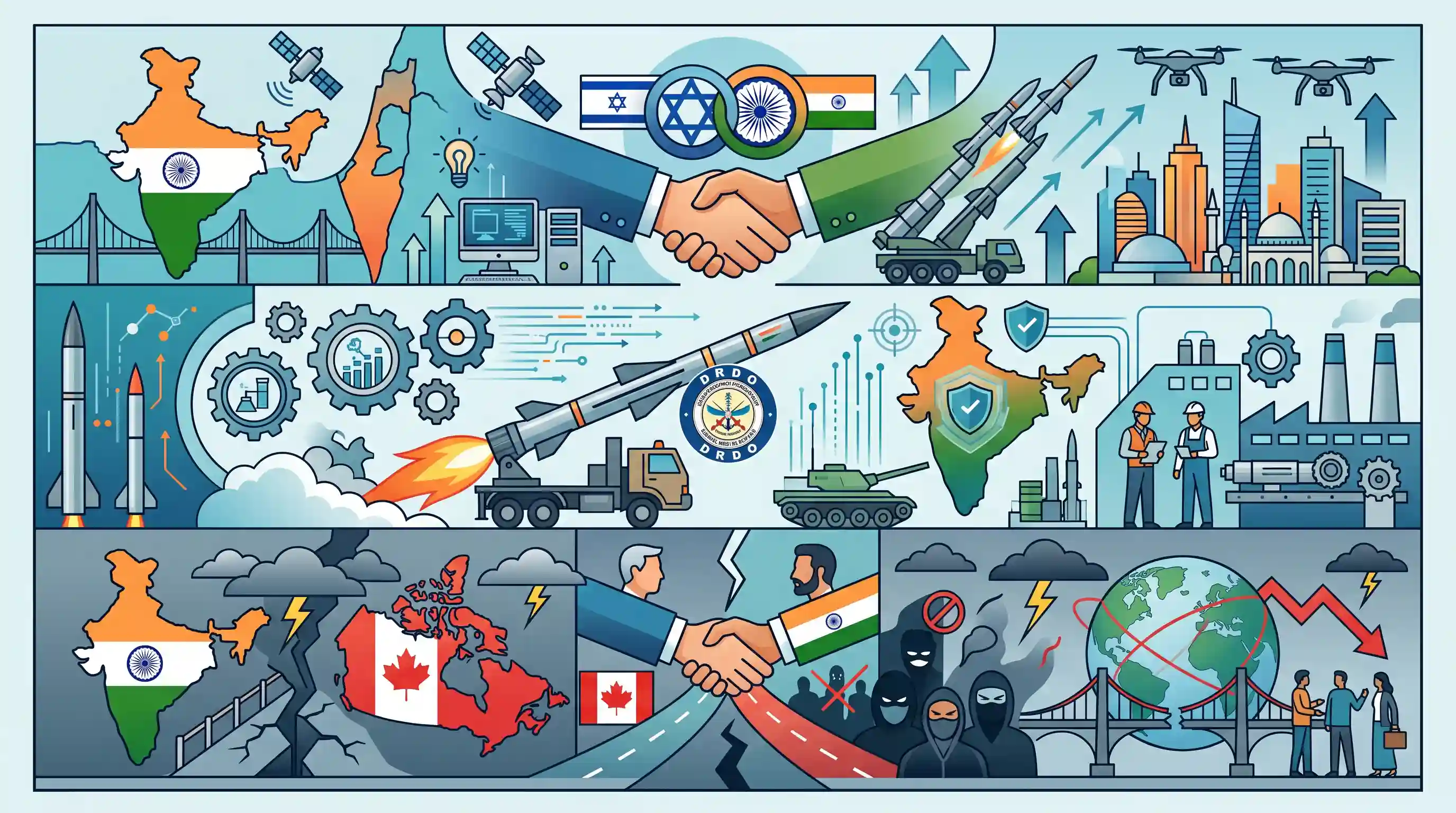
The Indian Express 'UPSC Key' discusses three major geopolitical and defence topics. First, it highlights the continuous elevation of India-Israel bilateral relations, characterized by deep strategic, defence, and technological cooperation. Second, it touches upon India's defence modernization with a focus on 'Prahaar', a short-range tactical ballistic missile developed by the DRDO. Lastly, it analyzes the deteriorating state of India-Canada diplomatic relations, driven by disputes over extremist elements and sovereignty concerns, underscoring the complexities of managing diaspora and domestic politics in international diplomacy.
Key Points
- India and Israel have progressively elevated their bilateral ties, transforming them into a comprehensive strategic partnership focusing on defence, agriculture, and water management.
- The Prahaar is a solid-fuelled, surface-to-surface, tactical short-range ballistic missile developed by DRDO to replace the Prithvi-I.
- India-Canada relations have experienced significant strain owing to issues related to diplomatic friction, allegations of foreign interference, and the harboring of anti-India extremist (Khalistan) elements.
- Maintaining strategic autonomy remains a core element of India's foreign policy when navigating complex partnerships involving the Middle East and the West.
Important Terms
DRDO (Defence Research and Development Organisation)

Established in 1958, it is the R&D wing of the Ministry of Defence, tasked with developing indigenous, state-of-the-art weapon systems and platforms for the Indian Armed Forces.
UPSC context
GS Paper 3: Science and Technology/Defence. Vital for topics on indigenization of technology and self-reliance (Aatmanirbhar Bharat) in the defense sector.
Prahaar
A short-range (150 km), single-stage, solid-fueled, surface-to-surface tactical ballistic missile. It is designed for quick-reaction battlefield support and bridges the gap between Pinaka rockets and Prithvi missiles.
UPSC context
GS Paper 3: Science and Technology/Defence. Tests knowledge of indigenous missile systems, tactical capabilities, and their roles in India's conventional deterrence posture.
Ministry of External Affairs (MEA)
The central government agency responsible for managing India's foreign relations, formulating foreign policy, and representing the nation in international forums and diplomatic missions globally.
UPSC context
GS Paper 2: International Relations. Core institution for understanding India’s diplomatic outreach, bilateral agreements, and management of overseas Indian interests.
De-hyphenation Policy
India's diplomatic strategy of treating relations with Israel and Palestine independently, allowing for deep strategic engagement with Israel without being constrained by the historical commitment to the Palestinian cause.
UPSC context
GS Paper 2: International Relations. A key concept in India's West Asia policy, testing a candidate's understanding of strategic autonomy and pragmatic diplomacy.
Strategic Partnership
A formal framework between two nations indicating high-level cooperation across critical sectors like defense, intelligence, energy, and technology, often involving regular summits and institutionalized dialogue mechanisms.
UPSC context
GS Paper 2: Bilateral Relations. Tests the ability to categorize the depth of India's engagement with major world powers and regional partners.
Indian Diaspora
Comprising Non-Resident Indians (NRIs) and Persons of Indian Origin (PIOs), this group serves as a bridge for cultural diplomacy but can also influence host-country domestic politics and bilateral ties.
UPSC context
GS Paper 2: International Relations. Specifically covers 'Effect of politics of developed/developing countries on India's interests' and the role of the diaspora.
Prelims Trap
Prahaar is a liquid-fuelled tactical missile designed to replace Prithvi-I.
Prahaar is solid-fuelled, which provides a quicker reaction time than the older liquid-fuelled Prithvi-I. UPSC frequently swaps solid/liquid fuel types to confuse aspirants.
Static Concepts Connected
What are the operational advantages of solid-fuelled missiles like Prahaar?
- High Readiness: They require minimal preparation time before launch, unlike liquid fuels which are often volatile and pumped in just before firing.
- Storage & Safety: Solid propellants are stable, allowing missiles to be stored fully loaded on road-mobile launchers for long periods without degrading.
What defines India's 'De-hyphenation' policy in West Asia?
- Independent Bilateralism: Treating relations with Israel and Palestine as mutually independent tracks, formally abandoning the previous zero-sum approach.
- Strategic Pragmatism: Pursuing strategic ties based on national interest (like defence, agriculture, and tech with Israel) without being constrained by historical ideological legacies.
Cross-Topic Patterns
Diaspora diplomacy vs. Internal Security
The Canada rift highlights how diaspora politics can bleed into GS3 internal security, testing India's extradition frameworks and the handling of transnational extremist networks.
Middle East Minilaterals (I2U2)
India-Israel ties have evolved beyond bilateral defence into multilateral geo-economics (I2U2), merging US diplomatic backing and UAE capital with Indo-Israeli tech and agricultural innovation.

Expect a multi-statement prelims question matching Indian missiles (Prahaar, Pralay, Agni) by fuel type, range, and trajectory.
Linked PYQs · 2
Linked PYQs · 2
- 2018MainsGS2
“India’s relations with Israel have, of late, acquired a depth and diversity, which cannot be rolled back.” Discuss.
- 2023PrelimsGS1
Consider the following statements: 1. Ballistic missiles are jet-propelled at subsonic speeds throughout their flights, while cruise missiles are rocket-powered only in the initial phase of flight. 2. Agni-V is a medium-range supersonic cruise missile, while BrahMos is a solid-fuelled intercontinental ballistic missile. Which of the statements given above is/are correct?
