India Israel strategic ties and indigenous missile development
Source:Indian Express ↗
Why It Matters
These topics cover core pillars of the UPSC syllabus: India's strategic partnerships (GS2), the role of the Indian diaspora in developed countries (GS2), and indigenous developments in defense technology like ballistic missiles (GS3).
Summary
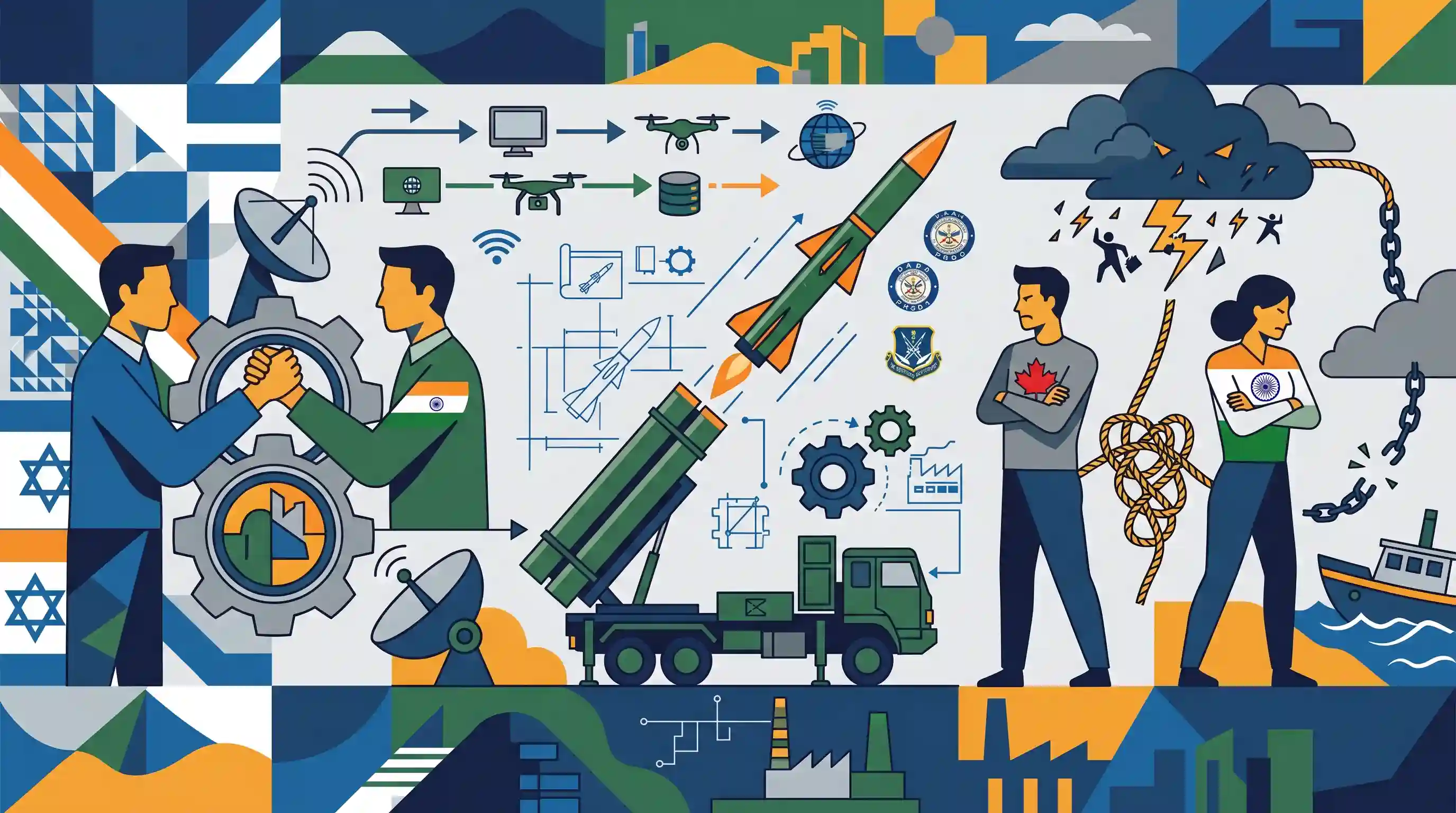
The article discusses three distinct developments in India's strategic sphere: the strengthening of India-Israel bilateral ties, the strategic significance of the indigenously developed Prahaar tactical ballistic missile, and the ongoing diplomatic frictions in India-Canada relations. It highlights the transition towards deeper defense and technological cooperation with Israel, the modernization of India's tactical missile arsenal by DRDO, and the complexities of managing foreign policy with Canada amidst diaspora-driven extremism.
Key Points
- India and Israel continue to deepen their strategic partnership with a focus on defense, technology, agriculture, and water management, acquiring a depth that reshapes regional diplomacy.
- The Prahaar missile, a short-range, solid-fueled tactical ballistic missile developed by DRDO, represents a significant upgrade in India's indigenous defense strike capabilities, replacing older systems like Prithvi-I.
- India-Canada bilateral relations are currently navigating severe diplomatic strains primarily due to the political influence of the diaspora and the tolerance of pro-Khalistan extremism in Canada.
- Balancing diaspora politics with core national security interests remains a critical challenge for India's foreign policy in Western nations.
Important Terms
I2U2

A strategic quadrilateral forum comprising India, Israel, the UAE, and the USA. It focuses on joint geoeconomic investments in water, energy, transportation, space, health, and food security.
UPSC context
GS Paper II (International Relations); relevant for West Asia policy, minilateralism, and India's multi-alignment strategy.
Abraham Accords
A series of 2020 agreements brokered by the US to normalize diplomatic relations between Israel and several Arab nations, including the UAE, Bahrain, Sudan, and Morocco.
UPSC context
GS Paper II (International Relations); crucial for understanding shifting Middle East dynamics and India's 'Link West' policy.
DRDO
India's premier military research agency under the Ministry of Defence. It leads the indigenous design and development of advanced weapon systems, including the Prahaar tactical missile.
UPSC context
GS Paper III (S&T and Indigenization of Technology); key to topics on defense self-reliance and national security.
Prahaar
An indigenously developed, solid-fuel, short-range (150 km) tactical ballistic missile designed by DRDO for quick-reaction battlefield support and precision strikes.
UPSC context
GS Paper III (Defence Technology); relevant for modernizing India's theater-level strike capabilities and tactical deterrence.
Tactical Ballistic Missile
Short-range missiles (typically <300 km) used for immediate battlefield operations to strike military targets like command centers, rather than for long-range strategic deterrence.
UPSC context
GS Paper III (Internal Security/Defence); tests knowledge of functional differences between tactical and strategic weaponry.
Diaspora Politics
The political engagement of overseas ethnic communities in the affairs of their home or host countries, often influencing bilateral diplomatic and security relations.
UPSC context
GS Paper II (International Relations); essential for analyzing India-Canada frictions and the influence of the Indian diaspora.
Prelims Trap
Prahaar is a liquid-fueled strategic ballistic missile.
Prahaar is a solid-fueled, short-range tactical missile. It specifically replaces the older liquid-fueled Prithvi-I to drastically reduce launch preparation time.
Static Concepts Connected
Why are solid-fueled missiles preferred for tactical battlefield operations?
- Quick Reaction: Solid fuels do not require pre-launch fueling, allowing canisterised missiles like Prahaar to be fired in just 2-3 minutes.
- Storage & Transport: Solid propellants are highly stable, enabling safe transport on road-mobile launchers across rugged terrains without fuel degradation or leakage risks.
- Lower Maintenance: The lack of complex pumps and valves makes solid-propellant engines simpler, cheaper, and more reliable for rapid battlefield deployment.
How do Indo-Israeli Agricultural Centres of Excellence (CoEs) function?
- Tech Transfer: They introduce advanced Israeli technologies like micro-irrigation, precise fertigation, and protected cultivation directly to Indian farmers.
- Resource Efficiency: The primary focus is maximizing crop yield per drop of water, which is crucial for India's increasingly water-stressed agricultural regions.
- Bilateral Extension: Operating under the Indo-Israel Agricultural Project (IIAP), they serve as a prime example of utilizing agricultural expertise as diplomatic soft power.
Cross-Topic Patterns
Diaspora politics and Internal Security
The Canada row shows how domestic vote-bank politics in host nations can shelter radical elements, directly threatening India's internal security (GS3) and complicating bilateral diplomacy (GS2).
Geopolitics of Free Trade Agreements
The freezing of the India-Canada FTA demonstrates how non-trade bilateral friction (political extremism) can derail crucial economic integrations and broader global supply chain realignments.

Expect a Prelims 2026 question contrasting Prahaar (solid/tactical) with older Prithvi (liquid) or Agni (strategic) missile variants.
Linked PYQs · 4
Linked PYQs · 4
- 2018MainsGS2
“India’s relations with Israel have, of late, acquired a depth and diversity, which cannot be rolled back.” Discuss.
- 2023MainsGS2
Indian diaspora has scaled new heights in the West. Describe its economic and political benefits for India.
- 2020MainsGS2
Indian diaspora has a decisive role to play in the politics and economy of America and European Countries'. Comment with examples.
- 2007PrelimsGS1
Consider the following statements: 1. In November, 2006, DRDO successfully conducted the interception test using Prithvi-II missile. 2. Prithvi-II is a surface-to-surface missile and can be deployed to guard the metros against air attacks. Which of the statements given above is/are correct?
