Bilateral trade negotiations and macroeconomic capital flows overview
Source:Indian Express ↗
Why It Matters
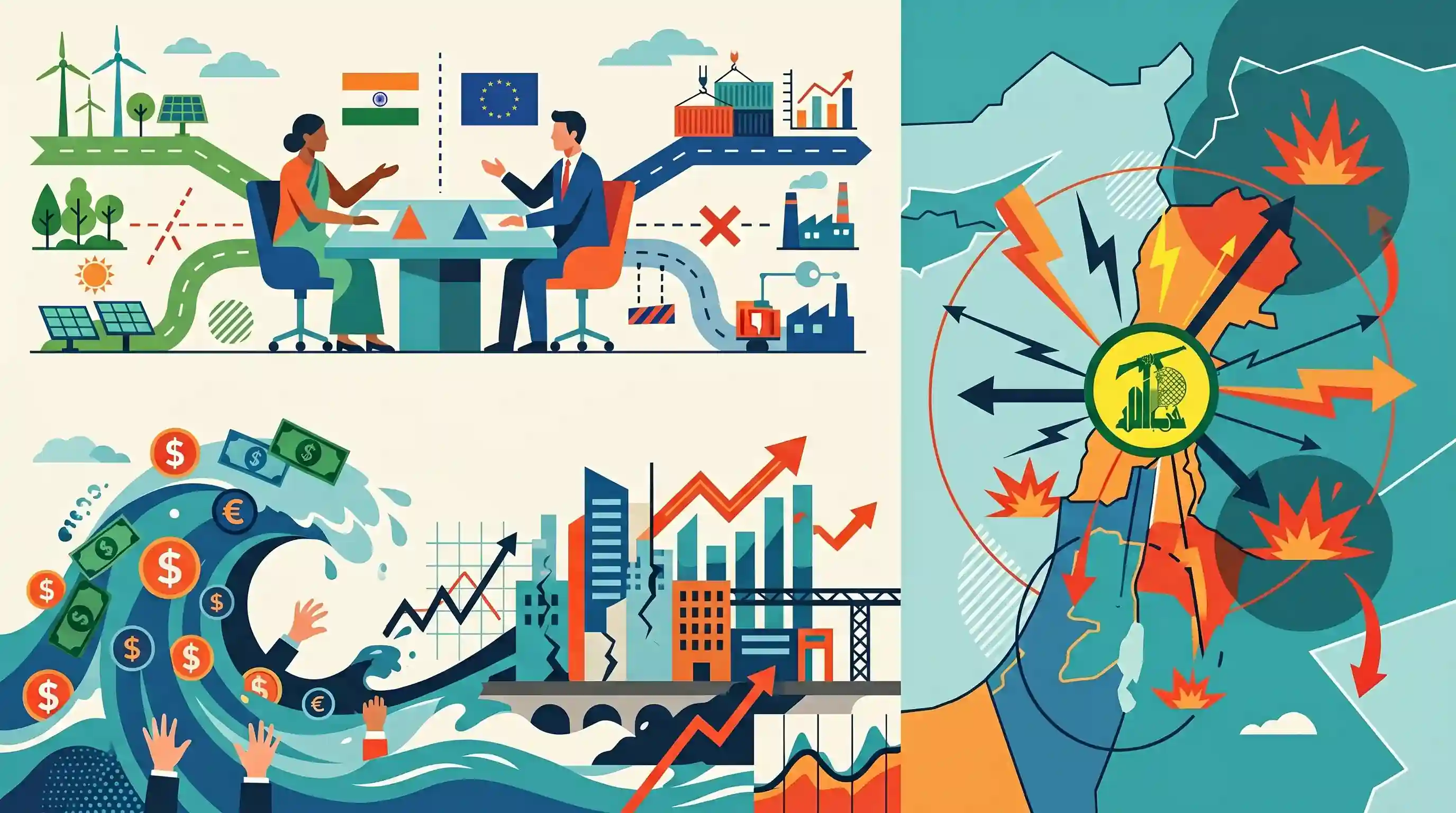
The India-EU FTA is pivotal for India's integration into global value chains and export growth. Managing foreign capital is a core macroeconomic challenge for the RBI to ensure economic stability. The Hezbollah conflict affects West Asian stability, which directly impacts global energy markets, supply chains, and India's diaspora.
Summary
The article analyzes three distinct issues across international relations and macroeconomics. It covers the strategic importance and ongoing hurdles in the India-EU Free Trade Agreement (FTA) talks, emphasizing differing priorities on sustainability and market access. In economics, it examines the 'foreign capital paradox'—the challenge developing nations face in absorbing foreign capital efficiently without triggering exchange rate volatility or monetary instability. Additionally, it highlights the geopolitical significance of Hezbollah in Lebanon and its central role in the escalating conflicts involving Israel and the broader Middle East.
Key Points
- India-EU Free Trade Agreement (FTA) negotiations aim to enhance market access, reduce tariffs, and boost investments, though challenges remain regarding non-tariff barriers, sustainability standards, and agricultural duties.
- The 'foreign capital paradox' highlights the dilemma where emerging economies like India must balance the need for foreign direct investment (FDI) for growth against the macroeconomic complications of managing large, volatile capital inflows.
- Hezbollah, a powerful Iran-backed militant group and political party in Lebanon, remains a key actor in the ongoing Israel-Lebanon border tensions and broader West Asian geopolitical instability.
Important Terms
India-EU Free Trade Agreement (FTA)

A proposed (now concluded) comprehensive agreement to eliminate tariffs on over 90% of goods, ease professional mobility, and align sustainability standards between India and its largest trading partner.
UPSC context
GS Paper II: Bilateral groupings and agreements involving India and affecting its interests; key for trade diversification and "China-plus-one" strategy.
Foreign Capital Paradox
The disconnect where India remains the world's fastest-growing major economy yet faces declining foreign capital inflows (FDI and FPI) to levels not seen since the 2008 financial crisis.
UPSC context
GS Paper III: Indian Economy and issues relating to planning, mobilization of resources, and growth; tests external sector resilience.
Hezbollah
A Lebanon-based Shiite militant group and political party that acts as a primary Iranian proxy, frequently engaging in conflict with Israel and influencing Middle Eastern stability.
UPSC context
GS Paper II: Effect of policies and politics of countries on India's interests; critical for West Asia stability and energy security.
Reserve Bank of India (RBI)
India's central bank responsible for maintaining monetary stability, managing foreign exchange reserves, and intervening in the forex market to curb excessive rupee volatility caused by capital shifts.
UPSC context
GS Paper III: Indian Economy and issues relating to mobilization of resources; tests knowledge of monetary policy and external sector management.
Carbon Border Adjustment Mechanism (CBAM)
The EU's proposed tax on carbon-intensive imports (like steel and cement), designed to prevent "carbon leakage," which serves as a significant non-tariff barrier in India-EU trade talks.
UPSC context
GS Paper III: Economy and Environment; tests understanding of trade-related environmental regulations and their impact on Indian exports.
Balance of Payments (BoP)
A systematic record of all economic transactions between residents of a country and the rest of the world, comprising the current account and the capital account.
UPSC context
GS Paper III: Indian Economy; fundamental for assessing external sector health, trade deficits, and foreign exchange reserve adequacy.
Prelims Trap
"The Lucas Paradox implies capital naturally flows from rich to poor countries because of higher returns."
The paradox highlights the exact opposite. Despite higher potential returns in capital-scarce developing economies, capital often fails to flow there due to institutional risks.
Static Concepts Connected
How does the RBI sterilize excess foreign capital inflows?
- Open Market Operations: The central bank sells government securities in the open market to absorb the excess rupee liquidity created after it purchases foreign currency.
- Market Stabilization Scheme: Uses special bonds issued specifically to mop up massive, enduring excess liquidity caused by large capital inflows, without adding to the fiscal deficit.
What is the geopolitical significance of the Litani River?
- Geographical location: It flows entirely within southern Lebanon, serving as a critical water resource and a natural geographic boundary in the region.
- UNSC Resolution 1701: It acts as the northern boundary for a UN-mandated buffer zone meant to be free of unauthorized armed personnel, specifically targeting Hezbollah's presence near Israel.
Cross-Topic Patterns
EU's CBAM as a Non-Tariff Barrier
Environmental regulations like the EU's Carbon Border Adjustment Mechanism blur the line between climate action and protectionism, serving as a major non-tariff barrier complicating India's FTA negotiations.
The Macroeconomic Trilemma (Impossible Trinity)
The foreign capital dilemma connects to the Mundell-Fleming 'Impossible Trinity', highlighting India's struggle to simultaneously balance exchange rate stability, free capital movement, and an independent monetary policy.

Expect a 2026 Prelims question testing the 'Lucas Paradox' alongside RBI's sterilization methods for managing volatile capital inflows.
Linked PYQs · 4
Linked PYQs · 4
- 2011MainsGS2
Compared to the South Asian Free Trade Area (SAFTA), the Bay of Bengal Initiative for Multisectoral Technical and Economic Cooperation Free Trade Area (BIMSTEC FTA) seems to be more promising." Critically evaluate.
- 2016MainsGS3
Justify the need for FDI for the development of the Indian economy. Why there is gap between MOUs signed and actual FDIs? Suggest remedial steps to be taken for increasing actual FDIs in India.
- 2023PrelimsGS1
Consider the following pairs: Area of conflict mentioned in news Country where it is located 1. Donbas : Syria 2. Kachin : Ethiopia 3. Tigray : North Yemen How many of the above pairs are correctly matched?
- 2023PrelimsGS1
Consider the following pairs: Regions often mentioned in news Reason for being in news 1. North Kivu and Ituri : War between Armenia and Azerbaijan 2. Nagorno-Karabakh : Insurgency in Mozambique 3. Kherson and Zaporizhzhia : Dispute between Israel and Lebanon How many of the above pairs are correctly matched?
