India Energy Stack and ELI Scheme for Green Growth and Jobs
Source:Indian Express ↗
Why It Matters
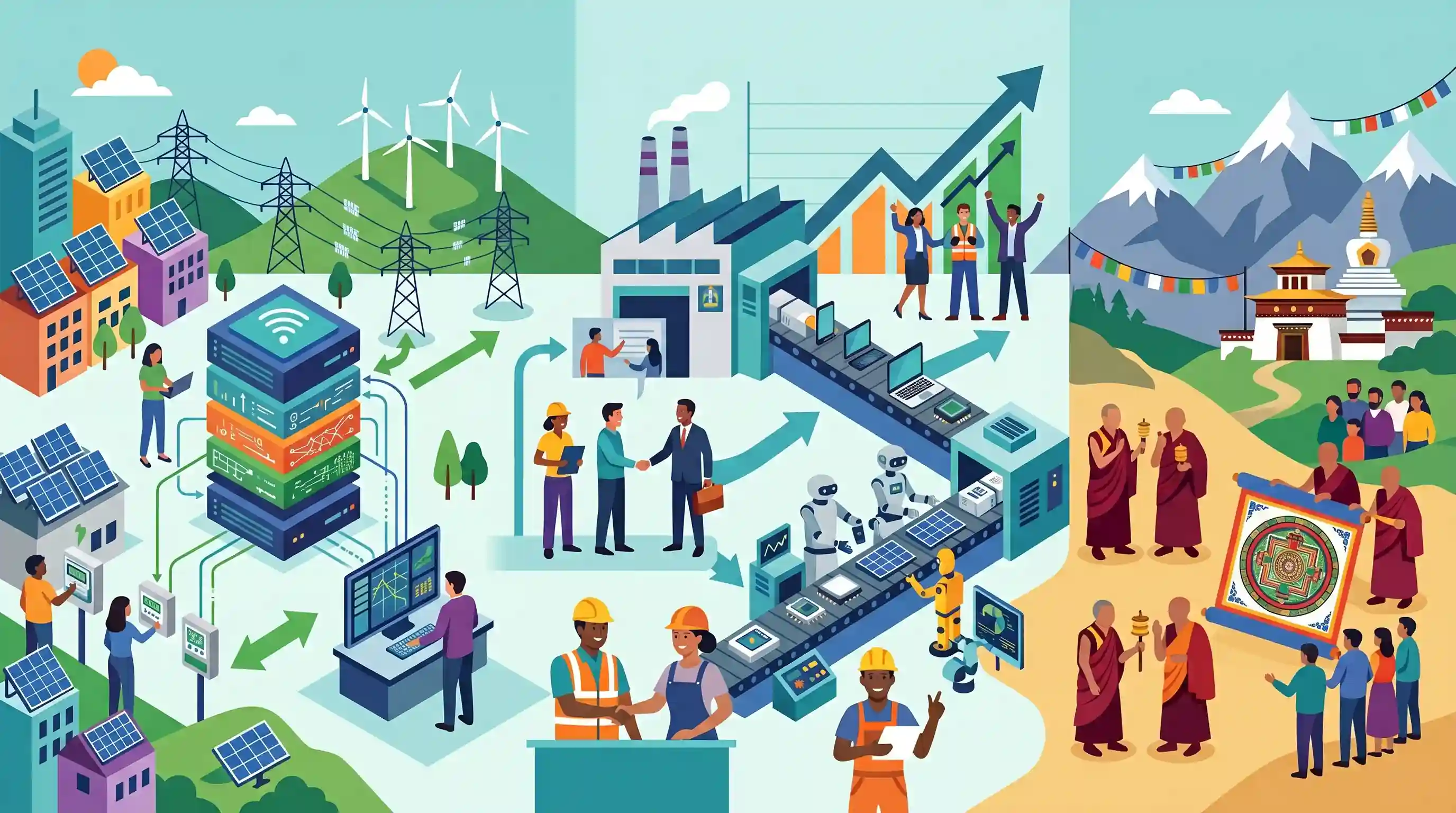
India's dual challenges of transitioning to a green economy and creating sufficient formal employment require innovative policy tools like the Energy Stack and ELI scheme. Additionally, understanding the cultural dynamics of Tibetan Buddhism is important for art & culture as well as geopolitical strategies in the Himalayas.
Summary
The article covers three key UPSC themes: the India Energy Stack as a digital public infrastructure for managing the renewable energy transition; the Employment Linked Incentive (ELI) Scheme to explicitly target job creation as a complement to the production-focused PLI scheme; and the cultural and strategic significance of Tibetan Buddhist schools in the Himalayan region.
Key Points
- The India Energy Stack aims to apply the Digital Public Infrastructure (DPI) model to the energy sector, enabling better grid management, renewable energy integration, and seamless data exchange for the green transition.
- The Employment Linked Incentive (ELI) Scheme is proposed to incentivize companies to create formal jobs, addressing concerns of 'jobless growth' that capital-intensive manufacturing under the PLI scheme may inadvertently foster.
- Tibetan Buddhist schools represent a critical component of India's cultural heritage and strategic soft power in the Himalayan region, emphasizing the preservation of Tibetan religious traditions.
Important Terms
India Energy Stack (IES)

A Digital Public Infrastructure (DPI) for the power sector designed to create a unified, secure, and interoperable digital backbone for managing electricity generation, distribution, and consumption data.
UPSC context
Relevant for GS Paper III (Economy and Infrastructure); tests knowledge of digital transformation in energy and sustainable development goals.
Employment Linked Incentive (ELI) Scheme
A fiscal initiative providing financial rewards to employers for creating new formal jobs. It targets first-time employees and manufacturing growth, aiming to align industrial expansion with direct job creation.
UPSC context
Crucial for GS Paper III (Employment and Growth); highlights policy shifts from production-centric to job-centric economic models.
Production Linked Incentive (PLI) Scheme
A government scheme offering financial incentives to companies based on incremental sales of products manufactured in domestic units. It aims to boost manufacturing, reduce import dependence, and increase exports.
UPSC context
Essential for GS Paper III (Industrial Policy); tests understanding of "Atmanirbhar Bharat" and India's global manufacturing competitiveness.
Digital Public Infrastructure (DPI)
Shared digital systems—such as identity, payments, and data exchange—that provide foundational services for a country’s digital economy. Examples include Aadhaar, UPI, and the India Energy Stack.
UPSC context
Relevant for GS Paper II (Governance) and III (Technology); tests awareness of India’s leadership in global digital architecture.
Tibetan Buddhist Traditions
Four major lineages—Nyingma, Kagyu, Sakya, and Gelug—practiced in the Indian Himalayan region. They represent a unique cultural synthesis of ancient Indian philosophy and Tibetan monastic practices.
UPSC context
Important for GS Paper I (Art and Culture); tests knowledge of India's cultural heritage and strategic significance in border regions.
Prelims Trap
"The ELI scheme provides wage subsidies to all newly hired workers to combat jobless growth."
ELI does not cover all new hires; it strictly targets first-time EPFO-registered workers earning under ₹1 lakh/month, explicitly aiming to formalize the workforce.
Static Concepts Connected
What are the primary traditions of Tibetan Buddhism?
- Nyingma: The oldest school, founded in the 8th century, tracing its lineage directly to the Indian master Padmasambhava.
- Kagyu: Emerged in the 11th century; strongly emphasizes the oral transmission of teachings from master to disciple.
- Gelug: The newest "Yellow Hat" school founded in the 14th century by Je Tsongkhapa. The Dalai Lama belongs to this tradition.
What distinguishes 'jobless growth' from inclusive economic expansion?
- Jobless Growth: GDP expands rapidly due to increased capital intensity and productivity, but employment elasticity approaches zero (few new jobs created).
- Inclusive Growth: Economic expansion proportionally absorbs surplus labor into the formal, wage-paying economy, reducing poverty and inequality.
- Policy Correction: Shifting from output-based incentives (PLI) to direct employment-linked incentives (ELI) is a state intervention to correct this market failure.
Cross-Topic Patterns
DPI + Renewable Energy Transition
Extending India's DPI success (UPI, Aadhaar) to the power sector creates a unified 'India Energy Stack', linking decentralized renewable energy sources to smart grids to help achieve the 2030 Panchamrit targets.
Cultural Soft Power + Border Geopolitics
Himalayan Tibetan Buddhist institutions (e.g., Tawang monastery) serve as vital strategic soft-power assets, subtly countering China's 'sinicization' policies and territorial narratives along the LAC.
Demographic Dividend + Formalization
While high GDP growth driven by capital intensity leads to 'jobless growth', the ELI scheme connects formalization (EPFO registration) directly to state subsidies (DBT) to harness India's demographic dividend.

Expect a Prelims question on ELI eligibility (EPFO, wage caps) or a Mains question on DPI's emerging role in the green energy transition.
Linked PYQs · 4
Linked PYQs · 4
- 2025MainsGS3
Discuss the rationale of the Production Linked Incentive (PLI) scheme. What are its achievements? In what way can the functioning and outcomes of the scheme be improved?
- 2022MainsGS3
Economic growth in the recent past has been led by increase in labour productivity." Explain this statement. Suggest the growth pattern that will lead to creation of more jobs without compromising labour productivity.
- 2022MainsGS3
Do you think India will meet 50 percent of its energy needs from renewable energy by 2030 ? Justify your answer. How will the shift of subsidies from fossil fuels to renewables help achieve the above objective ? Explain.
- 2020PrelimsGS1
With reference to the cultural history of India, which one of the following is the correct description of the term 'paramitas'?
