Delhi Declaration on Artificial Intelligence and Trade Protectionism
Source:Indian Express ↗
Why It Matters
The convergence of these three topics covers critical areas of the UPSC syllabus, touching upon India's foreign policy maneuvers in South America, its leadership role in emerging technology regulations (AI), and the economic challenges arising from de-globalization and protectionist trade measures by developed nations.
Summary
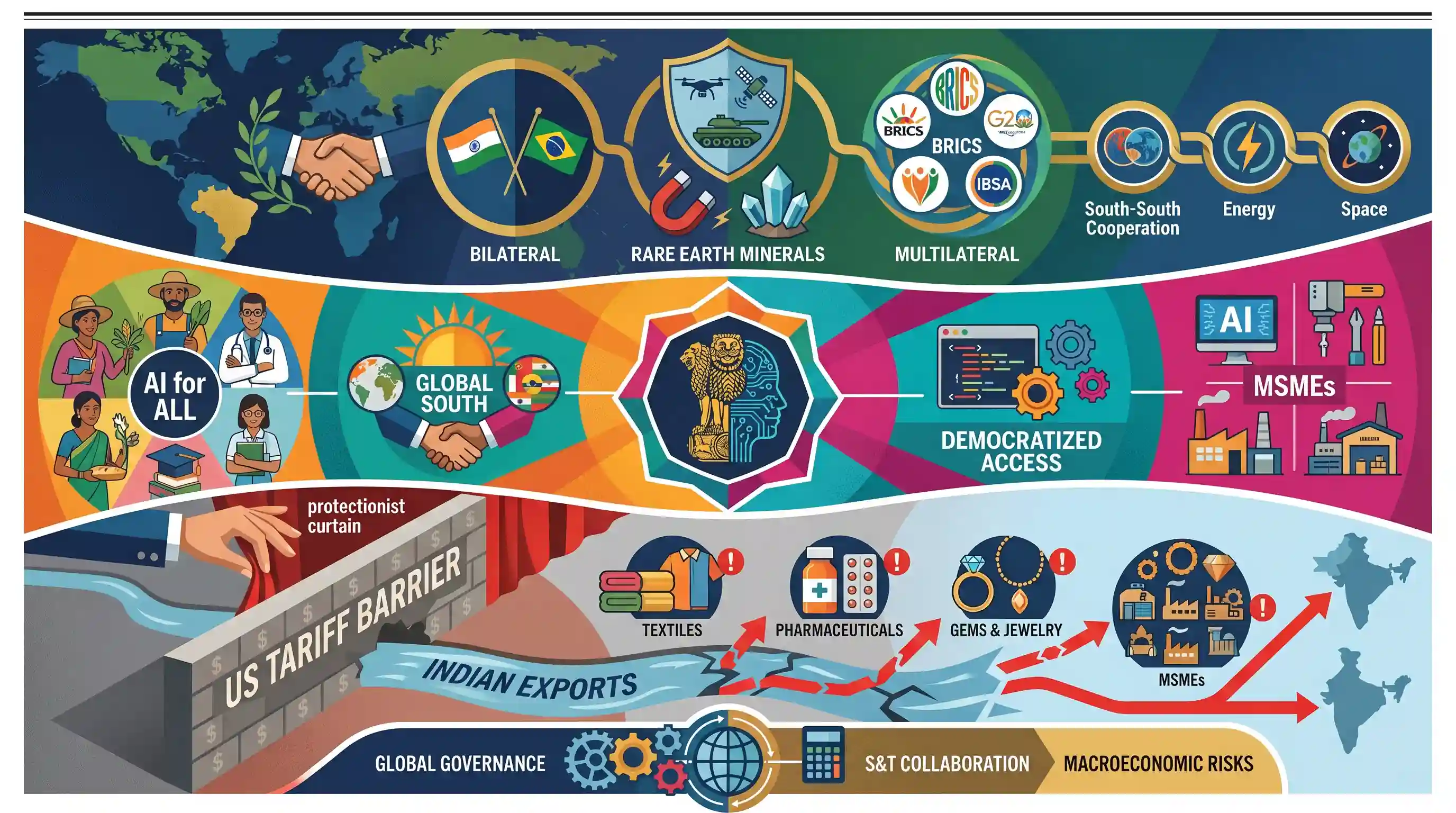
The article addresses three major current affairs topics relevant to UPSC: the strategic bilateral and multilateral dynamics of India-Brazil relations, the framework for global AI governance as highlighted by the Delhi Declaration, and the macroeconomic risks posed to Indian exports by the US administration's impending protectionist tariffs.
Key Points
- India-Brazil relations are strengthening through multilateral forums like IBSA, BRICS, and the G20, emphasizing South-South cooperation and shared global challenges.
- The Delhi Declaration on Artificial Intelligence outlines a framework for responsible, inclusive, and human-centric AI development, aligning with India's role in the Global Partnership on AI.
- Proposed trade tariffs by the Trump administration indicate a renewed shift towards protectionism, threatening global supply chains and potentially impacting Indian exports and macroeconomic stability.
- These developments highlight the dual challenges for India in navigating bilateral/multilateral diplomacy while safeguarding its economic and technological interests.
Important Terms
New Delhi Declaration on AI

A ministerial commitment adopted during the 2023 GPAI Summit in India, focusing on human-centric AI, risk mitigation (like deepfakes), and leveraging AI for agriculture and healthcare.
UPSC context
GS Paper 3: Science & Tech; GS Paper 2: Global Governance. Tests understanding of ethical AI frameworks and India's leadership in tech diplomacy.
Global Partnership on Artificial Intelligence (GPAI)
A multi-stakeholder international initiative (launched in 2020) that bridges the gap between AI theory and practice by supporting research and applied activities on AI priorities.
UPSC context
GS Paper 2: International Organizations. Relevant for questions on global technology standards and India's role as the 2024 Lead Chair.
IBSA Dialogue Forum
A trilateral forum of India, Brazil, and South Africa established in 2003 (Brasilia Declaration) to promote South-South cooperation, democratic values, and global governance reforms like UNSC expansion.
UPSC context
GS Paper 2: Bilateral and Regional Groupings. Important for topics on the Global South, maritime security (IBSAMAR), and democratic alternatives to BRICS.
G20 Troika
A leadership structure consisting of the current, previous, and incoming G20 presidencies; currently involving India (2023), Brazil (2024), and South Africa (2025) to ensure policy continuity.
UPSC context
GS Paper 2: International Relations. Tests knowledge of multilateral diplomacy and India’s influence in shaping the Global South agenda.
Reciprocal Tariffs
A trade policy where a country imposes import duties on another nation's goods at the same rate that the other nation charges on its own exports.
UPSC context
GS Paper 3: Indian Economy (Trade). Crucial for analyzing US-India trade tensions, protectionism, and the impact on Indian export competitiveness.
World Trade Organization (WTO)
An intergovernmental organization that regulates international trade; currently facing challenges from unilateral protectionist measures that bypass its rules-based dispute settlement mechanism.
UPSC context
GS Paper 3: Economy; GS Paper 2: Global Institutions. Tests understanding of rules-based trade systems and challenges to multilateralism.
Prelims Trap
The IBSA Dialogue Forum manages its poverty alleviation fund through its permanent secretariat.
IBSA is strictly an informal grouping of large democracies. It deliberately operates without any permanent headquarters or secretariat, unlike other structured geopolitical organizations.
Static Concepts Connected
How does the IBSA Dialogue Forum structurally differ from the BRICS grouping?
- Democratic membership: IBSA strictly consists of large multi-cultural democracies (India, Brazil, South Africa), unlike BRICS which includes various non-democracies.
- Institutional setup: IBSA deliberately operates informally without a permanent headquarters or secretariat, whereas BRICS established formal institutions like the New Development Bank (NDB).
- Core focus: The IBSA Fund strictly focuses on South-South cooperation for poverty and hunger alleviation in developing nations, avoiding broader anti-Western geopolitical posturing.
What is the core mandate of the Global Partnership on Artificial Intelligence (GPAI)?
- Values-based AI: A 29-member multi-stakeholder initiative hosted by the OECD, guiding responsible AI development rooted in human rights and democratic values.
- New Delhi Declaration: Under India's 2024 chairship, it successfully integrated agriculture, healthcare, and personal data protection into the priority AI development agenda.
Cross-Topic Patterns
Global South & UNSC Expansion
India and Brazil's strategic coordination in IBSA and BRICS strongly mirrors their G4 alliance, jointly advocating for permanent UNSC seats to represent the Global South.
DPI merging with AI Governance
India's inclusion of agriculture in the GPAI framework extends its G20 Digital Public Infrastructure (DPI) agenda, leveraging global AI governance for socio-economic inclusion and food security.
Tariffs vs. Rupee Internationalization
Rising US protectionism may accelerate BRICS' de-dollarization efforts, indirectly boosting India's push for Rupee trade settlements to bypass Western tariff shocks and safeguard its exports.

A multi-statement question contrasting IBSA's democratic, informal structure with BRICS' expansion and NDB is highly probable in 2026.
Linked PYQs · 5
Linked PYQs · 5
- 2012MainsGS2
Compare the significance of IBSA and BRICS in the context of India's multilateral diplomacy.
- 2018MainsGS3
How would the recent phenomena of protectionism and currency manipulations in world trade affect macroeconomic stability of India?
- 2025MainsGS3
What are the challenges before the Indian economy when the world is moving away from free trade and multilateralism to protectionism and bilateralism? How can these challenges be met?
- 2023MainsGS3
Introduce the concept of Artificial Intelligence (AI). How does Al help clinical diagnosis? Do you perceive any threat to privacy of the individual in the use of Al in healthcare?
- 2025PrelimsGS1
Consider the following statements regarding AI Action Summit held in Grand Palais, Paris in February 2025 : I. Co-chaired with India, the event builds on the advances made at the Bletchley Park Summit held in 2023 and the Seoul Summit held in 2024. II. Along with other countries, US and UK also signed the declaration on inclusive and sustainable AI. Which of the statements given above is/are correct?
