Income Inequality Ganga Water Treaty And Exam Reforms
Source:Indian Express ↗
આ શા માટે મહત્વનું છે
This article touches upon pivotal areas across the UPSC syllabus—addressing structural economic flaws (inequality), crucial bilateral resource diplomacy with Bangladesh (river water sharing), and key governance overhauls to secure the career paths of millions of students (exam reforms). understanding these issues is essential for generating multidimensional Mains answers.
સારાંશ
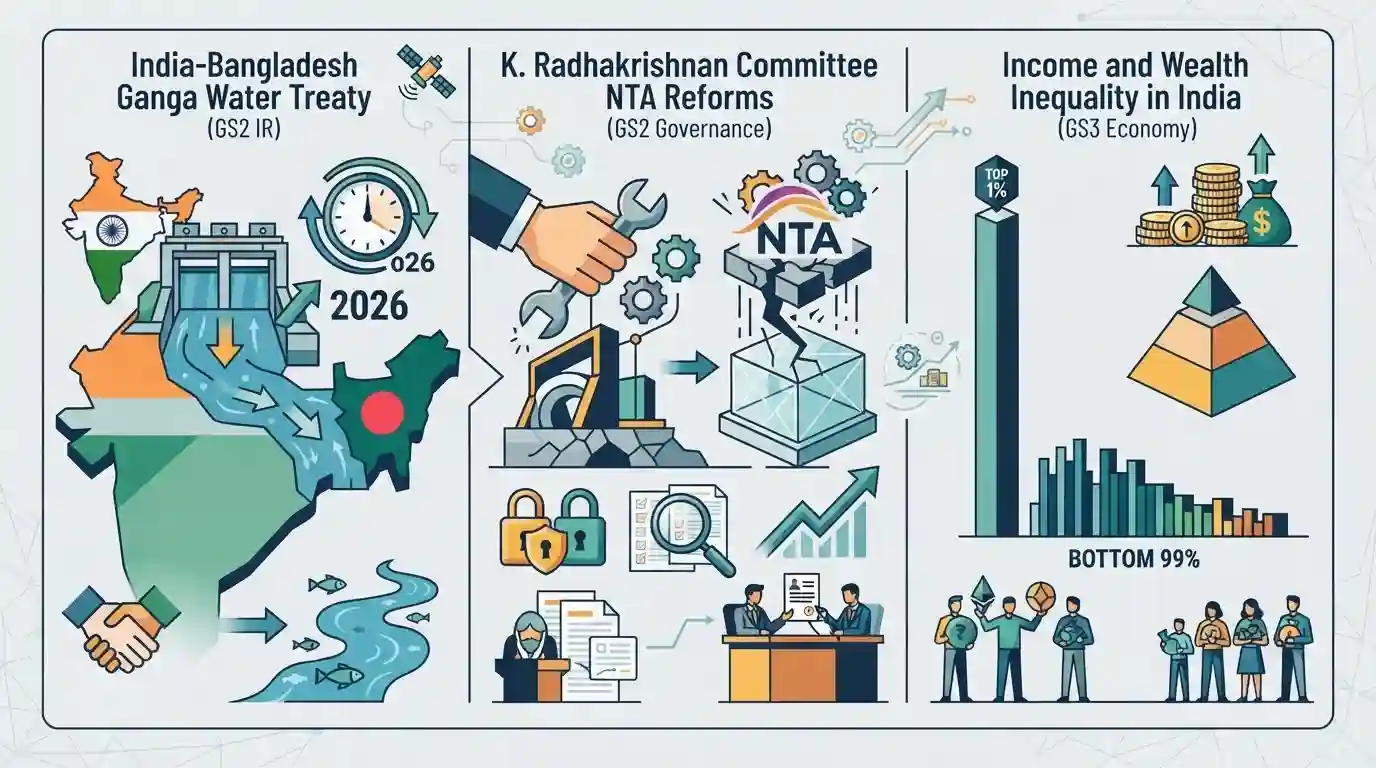
This article provides a comprehensive overview of three major current affairs topics of high relevance to the UPSC exam: the alarming levels of income and wealth inequality in India (GS3 Economy), the impending 2026 expiration and renewal process of the 1996 Ganga Water Treaty between India and Bangladesh (GS2 IR), and the critical institutional reforms proposed by the K. Radhakrishnan Committee to overhaul the National Testing Agency (NTA) and restore integrity to India's high-stakes examination system (GS2 Governance).
મુખ્ય મુદ્દા
- Income Inequality: Recent studies like the World Inequality Lab highlight that income and wealth inequality in India is at historically high levels, with the top 1% of the population holding a disproportionate share of national resources, necessitating structural shifts towards progressive taxation and human capital investments.
- Ganga Water Treaty (1996): Set to expire in December 2026, the 30-year treaty governs dry-season water sharing at the Farakka Barrage between India and Bangladesh. Joint Technical Committees are exploring its renewal amid concerns over depleting dry-season flows and regional river basin management.
- K. Radhakrishnan Committee: Appointed to reform the National Testing Agency (NTA) following structural lapses in competitive exams. Recommendations include transitioning to hybrid/digital exams, multi-stage testing for high-stakes papers, robust cybersecurity, and decreasing reliance on private exam centers in favor of government-owned infrastructure.
મહત્વપૂર્ણ શબ્દો
Ganga Water Treaty 1996

A 30-year bilateral agreement between India and Bangladesh signed in 1996 regulating the dry-season (January–May) sharing of the Ganges River's waters at the Farakka Barrage, expiring in December 2026.
UPSC context
GS Paper II (International Relations). Tests knowledge of transboundary water diplomacy, bilateral ties, and regional resource management.
Indus Water Treaty
A 1960 bilateral river water-sharing treaty between India and Pakistan brokered by the World Bank, allocating the three Eastern rivers to India and three Western rivers primarily to Pakistan.
UPSC context
GS Paper II (International Relations). Crucial for studying transboundary river disputes and neighborhood relations.
National Testing Agency (NTA)
An autonomous, self-sustained premier testing organization established by the Indian Government to conduct high-profile, transparent, and standardized entrance examinations for admissions and recruitment in higher education.
UPSC context
GS Paper II (Governance). Evaluates understanding of statutory/autonomous bodies and educational sector reforms.
Ministry of Education
The apex government ministry in India responsible for formulating and implementing national policies on education, expanding school and higher education, and overseeing key regulatory and testing bodies.
UPSC context
GS Paper II (Social Sector/Education). Tests policies for human resource development and public governance.
World Inequality Lab
A Paris-based global research center that compiles, analyzes, and publishes comprehensive data on global income and wealth inequality, notable for producing the World Inequality Report.
UPSC context
GS Paper III (Economy). Relevant for understanding inclusive growth, distribution of wealth, and socio-economic divides.
પ્રિલિમ્સ ટ્રેપ
The Ganga Water Treaty of 1996 mandates an equal 50:50 sharing of river water between India and Bangladesh on a year-round basis.
The treaty does not apply equally year-round. It governs water flow strictly during the dry season (January 1 to May 31) using a complex, variable allocation formula rather than a flat 50:50 split.
સંલગ્ન સ્થિર ખ્યાલો
How does the Indian Constitution distribute legislative power regarding water and international treaties?
- Entry 17 (State List): Grants states authority over water supply, irrigation, canals, drainage, water storage, and water power.
- Entry 56 (Union List): Empowers the Union to regulate and develop inter-state rivers and river valleys as declared by Parliament.
- Article 253: Allows Parliament to legislate on state subjects (like water) to implement international treaties, overriding State List limitations.
What are the primary economic metrics used to measure income and wealth inequality?
- Gini Coefficient: Measures income distribution inequality, ranging from 0 (perfect equality) to 1 (perfect inequality).
- Lorenz Curve: A graphical representation of cumulative income distribution, showing the actual share of income held by cumulative percentiles of population.
- Palma Ratio: Measures the ratio of the national income share of the richest 10% to that of the poorest 40%.
આંતર-વિષય પેટર્ન
Hydro-diplomacy and Indian Federalism
The upcoming renewal of the Ganga Water Treaty showcases the intersection of Article 253 (Union treaty power) with State-level water interests under Entry 17 of the State List.
Inequality and State Capacity
Extreme wealth concentration limits public resource mobilization, directly restricting state capacity to fund large-scale educational and digital infrastructure overhauls recommended for bodies like the NTA.

The 2026 Ganga Treaty renewal is highly likely to feature in GS2 as a multi-statement question testing Article 253 and transboundary river rules.
સંલગ્ન PYQ · 3
સંલગ્ન PYQ · 3
- 2020MainsGS3
Explain intra-generational and inter-generational issues of equity from the perspective of inclusive growth and sustainable development.
- 2019MainsGS3
It is argued that the strategy of inclusive growth is intended to meet the objectives of inclusiveness and sustainability together. Comment on this statement.
- 2012MainsGS2
The situation today is far different to that prevalent fifty years back when the Indus Water Treaty was signed." Highlight the complexity of the current challenges on both sides of the border in this regard. Do you think that a review of the Treaty is in India's best interests?
